
If you're graduating soon and job hunting feels harder than it should, you're not imagining it. The AI job market for international graduates looks different than it did even two years ago, and the timing matters more for you than it does for a lot of your classmates. Your visa clock is running while the hiring market shifts under your feet. Here's what's actually happening, backed by real data, not just headlines.

What's Actually Happening to Jobs
There's a lot of noise out there about AI wiping out entire career paths. That's not quite the full picture.
Stanford Digital Economy Lab has been tracking this closely using payroll data from millions of workers. Their finding: overall job numbers haven't collapsed. What's happening is more specific than that.
Young workers age 22 to 25 in AI-heavy fields like software development and customer service are falling behind their older peers in the same jobs. Stanford calls this an employment gap, and it's grown wider every few months since 2022. Meanwhile, workers in less AI-exposed fields, think healthcare aides or skilled trades, haven't seen the same dip.
So the story isn't "AI is taking all the jobs." It's "AI is taking a specific slice of entry-level work, and if your job search lands in that slice, you'll feel it."
Metric | Earlier | Now |
|---|---|---|
Employment gap for young workers in AI-exposed jobs | 15% (mid 2025) | 19% (mid 2026) |
Entry-level jobs requiring AI skills | Roughly a third of what it is now (fall 2025) | More than one in three (now) |
Wage premium for AI skills | 25% (2024) | 56% (2025) |
How AI Is Reshaping Hiring Everywhere
Here's what's shifting under the surface, in plain terms. And no, this isn't just a tech industry problem anymore.
Repetitive tasks go first. AI is best at the stuff that's easy to check and easy to codify. Junior-level grunt work fits that description.
New jobs are forming. AI oversight roles, prompt-heavy positions, and hybrid tech-plus-domain jobs are growing even as old ones shrink.
The career ladder is getting shorter. Entry-level postings increasingly ask for skills that used to belong to senior roles, like independent judgment and client communication.
It's spreading past tech. Marketing, finance, and HR postings now list AI fluency as a requirement, not a bonus. If you're studying literally anything outside computer science, this applies to you too.
Pay gaps are widening. People who can work with AI tools are earning noticeably more than people who can't, and that gap keeps growing.
The Main Cause of the Entry-Level Squeeze
Employers used to hire junior staff and train them up over a year or two. That math is changing.
More than a third of entry-level jobs now require AI skills, nearly triple the share that did back in fall 2025. Companies increasingly want new hires who already know how to work alongside AI tools, not people they'll train from scratch.
If a student spends their final semester learning a coding language but skips learning how to actually use AI tools inside that workflow, for example, they'll walk into interviews a step behind someone who did both. It's not about being the best coder anymore. It's about being useful on day one.
3 Reasons It Hits International Students Harder
You're not dealing with the same clock as a domestic grad, and that changes everything about how this squeeze feels.
Your OPT window is fixed. You get 12 months on standard OPT, extendable to 36 months total if you qualify for the STEM OPT extension. A slower hiring market eats into that time in a way it doesn't for someone with no visa deadline.
The H-1B lottery adds a second filter. Even if you land a job offer, you're still competing for a capped number of visas, and the current selection process weights higher salaries more heavily.
You're often concentrated in the exact fields getting squeezed. Computer science and business analytics, both popular with international students, sit right in the AI-exposed zone.
If a student on OPT spends four months applying before landing an interview, for example, that's four months off a clock that was already short. It's worth applying earlier and wider than you think you need to.
The OPT clock, by the numbers
Average time to land a first job right now: about six months, according to Iowa State University economist Peter Orazem
Unemployment allowance on standard OPT: 90 days total
Extra unemployment allowance under the STEM OPT extension: 60 more days, for 150 days total across your full OPT period
The math is blunt. If your search runs at the current average, you'll burn through your unemployment allowance well before you land something. That's exactly why starting early and networking hard matter more for you than for most job seekers.
One more thing worth saying plainly: cold applications get filtered hard right now. A lot of applicant tracking systems screen out candidates who need visa sponsorship before a human ever sees the resume. Referral-based networking skips that filter entirely, since a referral usually lands directly with a hiring manager instead of the automated screen. If you're on a tight OPT timeline, networking isn't a nice extra. It's the faster path.
Jobs That Are Holding Up Fine
Not everything is getting automated. Some work is holding steady or even growing.
Roles that need in-person trust, like healthcare and client-facing project work
Skilled trades that require physical presence and hands-on judgment
Jobs built around relationship management, where the human connection is the product
Positions that require handling messy, unclear situations rather than repeatable ones
The pattern is simple. If a task is easy to check and repeat, AI can probably do it. If it depends on judgment, trust, or a physical body in the room, it's safer ground for now. This is also where the STEM OPT extension earns its keep. It buys you extra time to land one of these lower-exposure or hybrid roles instead of rushing into whatever offer comes first.
How to AI-Proof Your Job Search
You can't control the market, but you can control how you show up in it. Skip the vague advice to "learn AI tools" and go straight to what employers in your field actually expect:
Software and engineering roles: get comfortable with GitHub Copilot. Employers increasingly assume you've already used it inside a real coding workflow, not just heard of it.
Business analytics and finance roles: learn a tool like Julius AI for data analysis and modeling. Being able to talk through how you'd use it on a dataset gives you a concrete story in interviews.
Marketing and communications roles: practice using Claude for campaign ideas, content drafts, and strategy work. Showing a sample of AI-assisted work you built and refined yourself carries real weight.
Build a few concrete examples of using these tools in your coursework or projects, not just a bullet point on your resume
Target roles and industries with lower AI exposure if your field is heavily squeezed
Start your job search earlier than you think you need to, given how tight the timeline already is
Beat the Paperwork Clock
When your OPT ticker is running, you can't afford administrative delays eating into it. Every week spent chasing down transcript translations or credential paperwork is a week not spent networking or interviewing.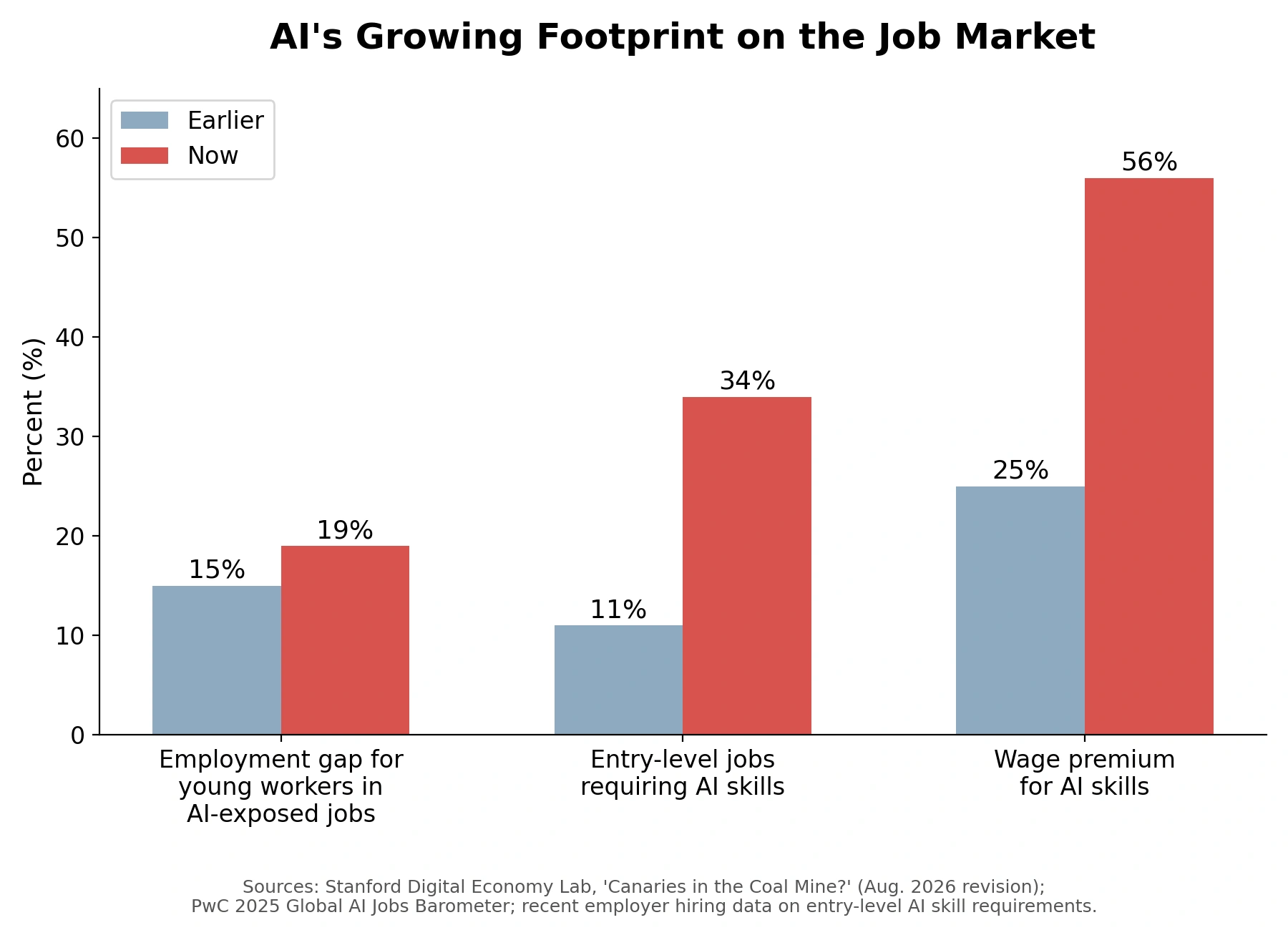
Sorting out your foreign degree evaluation and transcript translation early through Scholaro gets that paperwork out of the way before it becomes a bottleneck. That leaves your full bandwidth free for the parts of the job search that actually move the needle: building connections and showing up prepared for interviews.
The Upside Nobody Talks About
Here's the part that gets buried under all the bad headlines. Industries leaning hardest into AI are seeing revenue per employee grow roughly three times faster than less AI-exposed industries, and wages for AI-skilled workers are climbing about twice as fast too. That's according to PwC's analysis of nearly a billion job ads worldwide.
The market is splitting into two tracks, not collapsing into one. Landing on the growth track just takes showing up with the right skills already in hand.
Final Checklist for International Job Seekers
The AI job market for international graduates is tighter than before, but it's not closed. Learn the AI tools your field actually uses, network instead of cold applying, sort your credential paperwork out early, and start looking sooner than feels necessary. Do that, and your timeline stops working against you.
 How Universities Use Zero-Waste Swap Programs to Cut Student Costs
 How Industry Partnerships Shape Modern Curricula
 How Post-COVID Aid Programs Help Universities Rebuild Admissions
 Beyond the Acceptance Rate and How Colleges Decide Who Gets In
 How Leveraging Job Placement Strategies Can Reenroll Returning Students