
Most conversations about global education access focus on primary and secondary school. Higher education access barely gets mentioned, and that's a problem for two groups of countries in particular: Least Developed Countries (LDCs) and Small Island Developing States (SIDS). These UN designated categories cover dozens of nations that carry outsized development and climate pressure but hold a tiny share of the planet's university capacity.
Here's why that gap matters more than people think, and what it actually costs these countries when their brightest graduates leave and don't come back. Start with the numbers below. They show how many tertiary educated workers end up leaving for good.
Group | Share of tertiary educated workers living abroad |
|---|---|
Most low income countries | 10 to 50 percent |
Small Island Developing States, average | 50 percent |
Small Island Developing States, worst cases | 75 percent or higher |
That's not a rounding error. The numbers come from research tracked in IZA World of Labor, and the pattern holds across dozens of countries, not just a few outliers. Everything below traces back to that gap.
Scholarship Funding Without Local Investment
The Sustainable Development Goals include a specific commitment on higher education. Sustainable Development Goal 4 commits to funding scholarships so LDC and SIDS students can study abroad, but the target does not include funding to build up universities back home.
Researchers at Boston College's Center for International Higher Education tracked foreign aid to higher education since 2016. Their finding: funding kept going to primary and secondary schools while higher education got less attention. That leaves local universities without the resources to absorb all the students graduating high school.
If a student in a small nation finishes secondary school ready for university, for example, but the only local program in their field has three open seats a year, they're stuck. Either they leave the country or they give up on that career entirely.
A Case Study in Lost Investment
If a student from a small island nation wins a scholarship to study nursing abroad, for example, the arrangement usually looks good on paper. The country covers tuition, the student gets a globally recognized credential, and everyone assumes the graduate will come home and staff the local hospital.
Here's what tends to happen instead. The graduate finishes school, gets a job offer in the country where they studied, and the wage difference alone makes staying an easy call. Back home, the hospital that was counting on that hire still has the same staffing gap it had before the scholarship was ever awarded, minus the money already spent training someone who isn't coming back.
Run that same scenario across engineering, teaching, and public health, and you get a country that keeps paying to train its workforce for other countries to keep.
The Poverty Trap Built by Limited Access
A country's ability to grow its economy tracks closely with how many people hold a degree. Without accessible universities, LDCs and SIDS stay locked into low wage sectors like raw commodity exports and basic tourism.
Here's the pattern that plays out over and over:
Local industries need engineers, accountants, and health workers
The domestic university system can't train enough of them
Companies either import talent at a premium or don't expand at all
Wages stay flat because the skilled labor pool never grows
Expanding access to technical and professional degrees is one of the more direct ways lower income countries build a workforce that earns more, not just one that produces more raw goods.
Climate Adaptation Needs Local Experts, Not Just Local Data
SIDS face some of the worst climate risk on the planet relative to their size, and they need scientists, planners, and engineers who understand their specific coastlines, farming systems, and infrastructure.
A recent study out of Grenada, published through npj Climate Action, found that climate adaptation programs in SIDS keep running into the same wall: there's no education pipeline behind them. Curriculum development, vocational training, and the data systems needed to sustain climate planning are all underfunded. An OECD capacity report on SIDS reaches a similar conclusion: donor funded climate projects rarely include the education piece needed to make the work last.
A separate review of SIDS institutions found dozens of universities across these countries already teach chemistry, biology, or environmental science at some level. The infrastructure exists in pieces. It just isn't funded or connected well enough to produce the climate specialists these countries actually need.
This is the direct link between higher education access and climate resilience. You can't adapt to rising seas and shifting rainfall with imported consultants alone. You need people trained locally who plan to stay.
The Cost to Local Institutions
Courts, public health systems, and civil service offices all depend on a steady supply of trained professionals. When higher education access stays limited, that pipeline runs dry fast.
If a student earns a law degree abroad on a scholarship, for example, and the home country can't offer a competitive salary or enough of an established legal system to work within, there's little reason to go back. Multiply that by a few thousand graduates a year, and local offices end up running with a fraction of the staff they need.
Countries that build stronger local degree programs give students a reason to study and work in the same place. That's a much harder problem to solve if the only path to a professional degree runs through another country.
Fixes That Already Exist
None of this means the situation is hopeless. A few models are already working in different parts of the world, and they don't require waiting on a bigger global aid budget.
Regional university consortiums. The University of the South Pacific (USP) is jointly owned by twelve Pacific Island countries, sharing faculty, research capacity, and campuses across all of them. No single small nation has to fund a full university on its own, and students can study locally instead of leaving the region entirely.
Return of service agreements. Some scholarship programs require a set period of local work in exchange for funding overseas study, an approach researchers call return of service. A return of service study found this model gives countries a guaranteed multi year return on their investment, even though graduates are still free to leave once the service term ends.
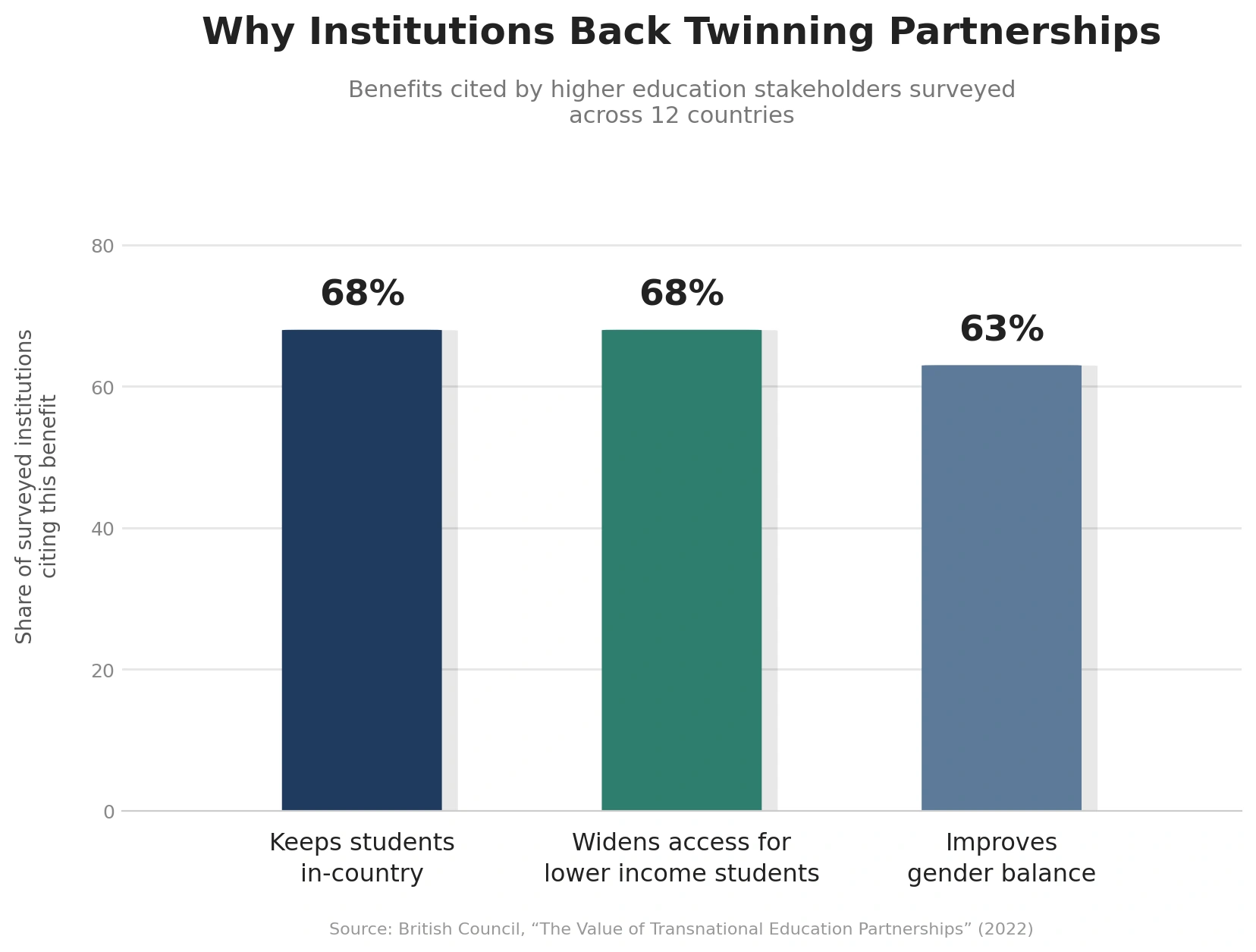
Hybrid domestic-foreign degree partnerships. Twinning programs let a student complete part of a degree at a local institution and part at a partner university abroad, graduating with an internationally recognized credential without needing to relocate for the entire program. That keeps more of the tuition and talent closer to home while still giving students access to programs their own country can't fully offer yet.
None of these solves the access gap by itself. Together, they give LDCs and SIDS a way to build capacity instead of just exporting their most promising students and hoping some of them return.
The Global Cost of a Shrinking Talent Pool
A shrinking pool of trained people in LDCs and SIDS doesn't stay contained. Pandemic response, food security research, and disaster planning all rely on expertise spread across many countries, not concentrated in a handful of wealthy ones.
When a country loses most of its trained scientists and engineers, everyone loses access to the research and innovation that country could have produced. Expanding higher education access in these countries isn't charity. It's how the global talent pool stays deep enough to handle problems that cross borders anyway.
What This Adds Up To
Poverty reduction, climate adaptation, functioning governments, and global innovation all trace back to the same starting point: whether a student in an LDC or SIDS can get a quality degree without leaving home for good. Fix that access gap, and a lot of these other problems get easier to solve too.
 How Universities Use Zero-Waste Swap Programs to Cut Student Costs
 How Industry Partnerships Shape Modern Curricula
 How Post-COVID Aid Programs Help Universities Rebuild Admissions
 Beyond the Acceptance Rate and How Colleges Decide Who Gets In
 How Leveraging Job Placement Strategies Can Reenroll Returning Students