
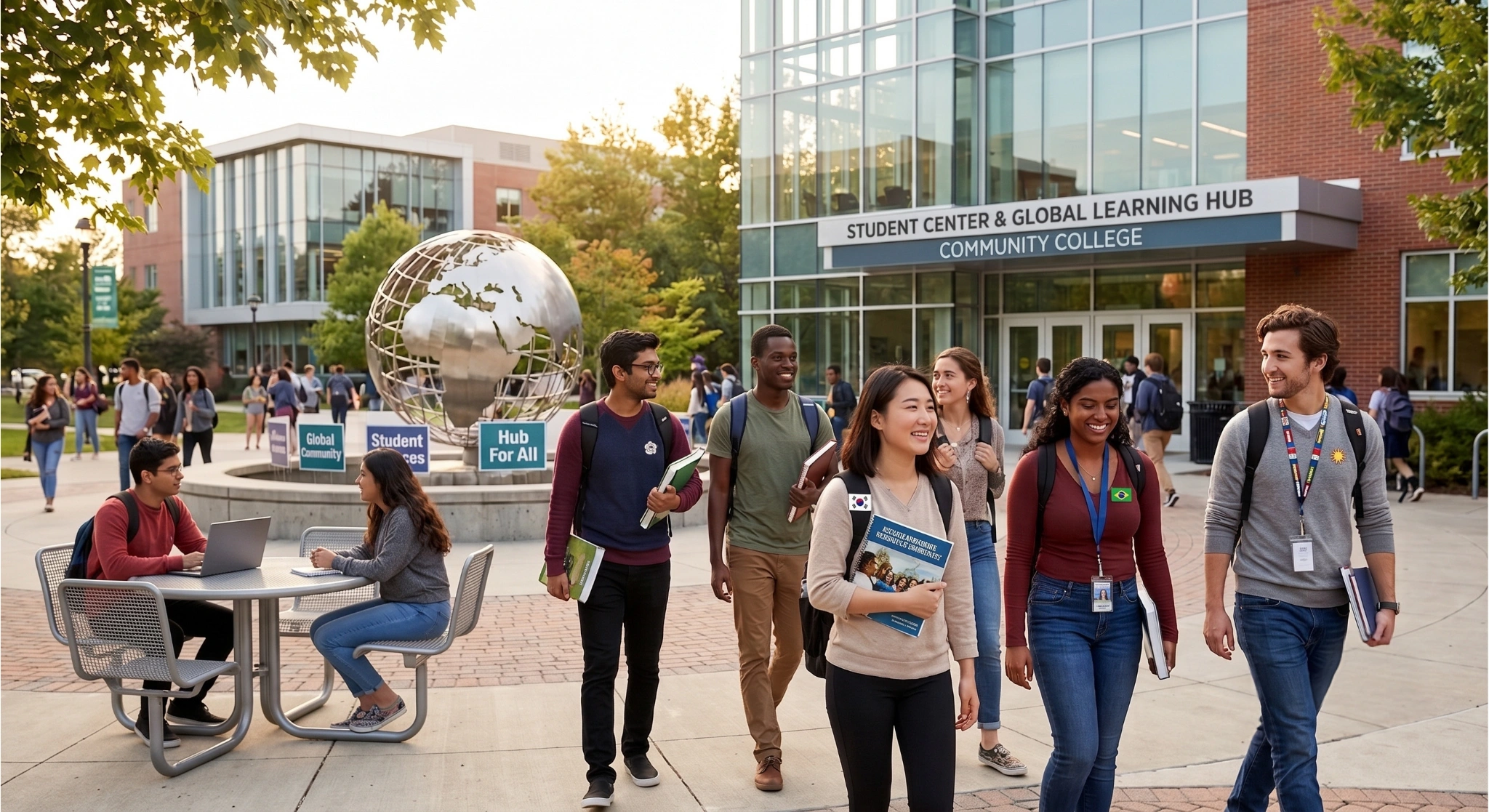
If your team still treats community colleges as a farm league for four year admissions, the enrollment numbers say otherwise. International enrollment at U.S. community colleges grew faster than at any other institution type in 2024/25, up 8% year over year according to the Open Doors 2025 release, on top of a 12.7% jump to 59,315 students the year before per the international enrollment report. For admissions offices building transfer pipelines and employers hiring international talent, that's a market worth tracking closely.
If a student from Southeast Asia, for example, couldn't afford a four year school straight out of high school, she might start at a community college instead, work part time, and transfer two years later with an associate degree and half the debt her peers carried. Multiply that story across thousands of students, and you get a pipeline that four year admissions teams and employers alike can't afford to overlook.
Country | Community College Standing | Trend |
|---|---|---|
Vietnam | Second largest source country | Consistently high for years |
South Korea | Top three source country | Steady for years |
China | About 5% of Chinese students overall | Small but stable |
Why community colleges deserve a bigger role in your strategy
Community colleges don't get much airtime in enrollment strategy conversations. Universities and their international offices tend to dominate the discussion, while two year schools get treated as an afterthought. That's a miss. These schools are quietly proving that international students don't need a big name campus to get real value. Low cost, practical training, and a direct line to local job markets can matter more to a family than prestige.
For admissions offices at four year institutions, this shows up as a built in transfer pipeline. For employers, it shows up as a pool of candidates who have already proven they can succeed in the U.S. system on a tight budget and a demanding schedule.
Community colleges also lean on each other more than most people realize, since no single two year school has the marketing budget of a major research university. A few things make that collaboration work:
Shared recognition and visibility that individual colleges couldn't get on their own
Access to grants and funding that support international programming
Peer learning, so colleges aren't reinventing the wheel on visa support or housing
Thought leadership platforms that put two year schools in the same conversations as universities
If you're an admissions officer building a transfer partnership, or an employer scouting talent, this collaboration matters to you too. It means the community college you're working with likely has more institutional support behind it than it gets credit for.
The overlooked study abroad pipeline
Here's a part of the story that often gets missed. Community colleges aren't just receiving international students, they're sending their own students overseas too, often students who never had the chance before.
The American Passport Project is a good example. It covers the cost of a first U.S. passport for Pell eligible students, many of whom are at community colleges and would never have considered study abroad otherwise. Since it launched in 2021, the program has reached around 6,000 students, working toward a goal of 10,000 by 2030.
For four year admissions teams, this matters because a transfer applicant may already have global experience on their record before they set foot on your campus. For employers, it's one more signal that community college graduates aren't a lower tier talent pool, they're simply an underexposed one.
Where students come from, and why Vietnam leads the pack
China, South Korea, and Vietnam remain the top source countries for international students at community colleges. A handful of two year schools, mostly in Texas, California, and Florida, host a big chunk of the total enrollment nationwide, which matters if you're deciding where to build a transfer agreement or recruit talent regionally.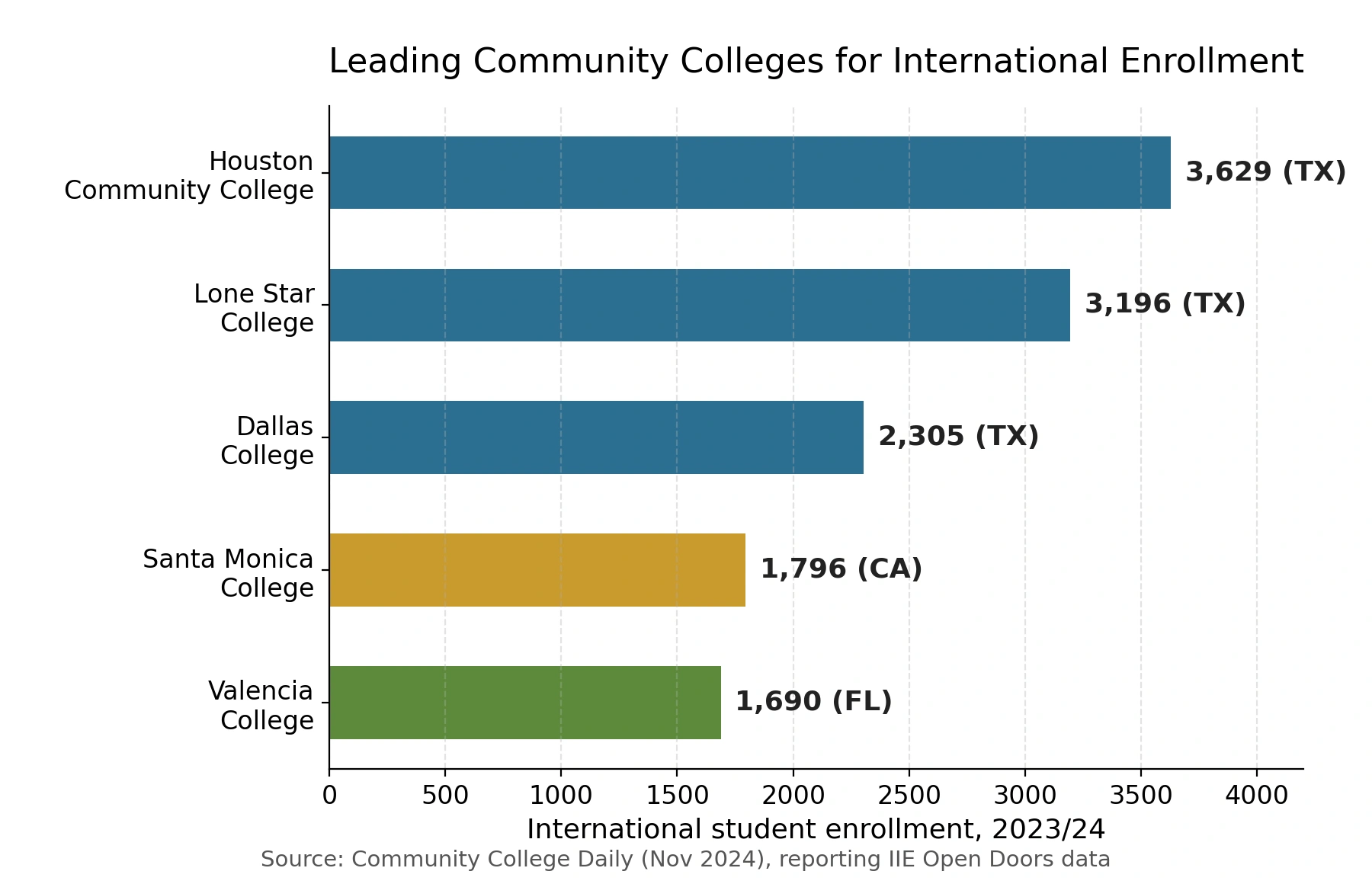
Demographics differ from four year international enrollment too. Community college international students are more likely to be women and more likely to be attending part time compared with the broader international student population. That's worth knowing if your admissions modeling or hiring pipeline assumptions are built around four year norms.
Vietnam explains a lot of this pattern on its own. It has ranked among the top community college source countries since 2010 and has held that position through shifts in the broader international education market. Cost is the biggest driver. Most Vietnamese students pay their own way, so a program that costs a fraction of a four year degree, with a clear path to transfer later, is an easy sell. Rising English proficiency and better options at home in Vietnam mean this pipeline probably won't stay this strong forever, which is worth factoring into any long range recruitment or hiring plan built around that country.
Who actually benefits from this growth
More international students at community colleges isn't just good news for the colleges. It ripples out in a few directions that matter to your work directly.
Four year institutions get a built in transfer pipeline, often through formal articulation agreements that guarantee admission after two years
Employers get access to a candidate pool that has already proven it can handle a U.S. academic system, a job, and often a language transition, all at once
Local students get more diverse classrooms and often better funded support services, since international programming tends to pull in resources that help everyone
International students who don't fit the traditional four year mold, because of cost, English level, or just not being ready for a huge campus, get a real, respected entry point
If a student, for example, didn't have the test scores or the tuition for a four year school straight away, two years at a community college could still get him there. With a strong GPA and an associate degree, he could transfer into a program he never would have gotten into as a freshman. From an admissions standpoint, that's exactly the kind of transfer applicant worth building a pipeline around.
The flip side: growing pains that come with growth
None of this comes without friction. If you're building a recruitment or transfer strategy around community colleges, a few real challenges keep showing up.
Students don't always know what a community college is. Plenty of countries have no equivalent system, so your recruitment materials need to explain the concept itself before a student will even consider it.
Visa officers don't always get it either. Some consular staff aren't familiar with two year schools as legitimate destinations, which can complicate visa interviews for your applicants. Some colleges now write support letters for students whose applications get denied, explaining the program and the student's ties to it. If you work with transfer applicants regularly, it's worth knowing this step exists.
Support needs run deep. Open admissions policies mean a wide range of English levels and academic backgrounds walk through the door. On top of that, dorms and residence halls are rare at these schools, so staff often end up helping students sort out housing too, on top of everything else. If you're evaluating a community college partner, ask how they handle this before you build a pipeline around them.
Mission tension is real too. Community colleges exist to serve their local area first. Leaning into international recruitment can sometimes feel like it's pulling focus and funding away from that core mission, and college leaders have to manage that balance carefully. Keep this in mind if you're pushing a partner college to scale up international enrollment faster than their budget supports.
Strategies for institutional success
The institutions and employers getting this right tend to approach it deliberately rather than reactively. Here's what that looks like from each side.
If you're on the community college side:
Build clear, documented transfer agreements with four year schools before you recruit heavily
Train front line staff on cultural sensitivity and basic visa processes
Create simple, plain language materials explaining what a community college actually is
Partner with local employers so international graduates have a real path to work experience
If you're on the four year admissions side:
Treat community college transfers as strong applicants, not backup options
Make credit transfer policies easy to find and easy to understand
Support the SEVIS record transfer process closely, since a mistake here can jeopardize a student's status
Reach out to local community colleges directly instead of waiting for students to find you
If you're an employer:
Don't assume a community college credential means less rigor, ask about the program and its transfer outcomes instead
Build relationships with career services offices at community colleges with strong international enrollment, in addition to four year schools
Factor visa status and work authorization timelines into your hiring calendar early
Across all three groups, the pattern is the same. Get leadership buy in early, since internationalization efforts tend to stall without it. Train staff across departments instead of leaving it all to one office. And build plans specific to the countries and schools you're actually working with, rather than running one generic approach everywhere. Vietnam is a good case study here precisely because the recruitment approach was so targeted, and that kind of focus tends to beat casting a wide net and hoping something sticks.
Evaluating transfer credit and international candidates
If you're an admissions officer weighing a transfer applicant, or an employer weighing a candidate, a few questions matter more than the name of the school. Is the community college SEVP certified, meaning it can actually issue visa paperwork? What does the transfer pathway look like, and is it a formal agreement or just a vague promise? What support services exist for housing, language, and day to day life, since that tells you how prepared a transfer student or new hire is likely to be?
Where this leaves admissions and hiring teams
Community colleges aren't a farm league anymore, and they aren't a fallback option either. For admissions offices, they're a proven transfer pipeline. For employers, they're an untapped pool of talent that has already handled cost pressure, a demanding schedule, and often a language transition, all at the same time. Build a real partnership around that, instead of an afterthought, and you'll see the payoff.
 How Universities Use Zero-Waste Swap Programs to Cut Student Costs
 How Industry Partnerships Shape Modern Curricula
 How Post-COVID Aid Programs Help Universities Rebuild Admissions
 Beyond the Acceptance Rate and How Colleges Decide Who Gets In
 How Leveraging Job Placement Strategies Can Reenroll Returning Students