If you work in enrollment, you already know your published price drives families away. What gets less attention is the internal problem behind communicating tuition: admissions, financial aid, and the business office rarely agree on what number to share, when to share it, or who gets the final say.

Families make up their minds fast. Sallie Mae's How America Pays research found that 79% of families had crossed a school off their list because of cost, while 47% paid less than sticker price. The National Association of College and University Business Officers (NACUBO) expects the average tuition discount rate for first-time undergraduates to reach 57.1% in 2025-26.
Agree on a Price Calendar Across Three Offices
I'd start with the org chart, not the marketing plan. Admissions gets judged on applications and deposits, so it wants cost information in front of families as early as possible. Financial aid would rather wait until FAFSA data is verified, since a number that changes in May leads to complaints and appeals. The CFO is watching the discount rate, and with good reason: NACUBO found that average net tuition revenue from undergraduates at private nonprofits dropped 1.9% after inflation in 2024-25.
Award letter timing is where these goals clash, and federal hiccups don't help. In the 2024-25 cycle, colleges didn't get FAFSA data until the first half of March, and the National College Attainment Network warned that this would push many aid offers into April. A shared calendar signed by all three offices sets fixed dates for publishing estimated net cost, sending final offers, and approving changes.
Show Families a Real Price Before They Apply
The University of Michigan's HAIL experiment is the best evidence I know for early price messaging. Michigan sent high-achieving, low-income students a guarantee of free tuition before they applied. Their expected aid didn't actually change. According to the NBER working paper, 68% of the students who received the guarantee applied, versus 26% of the control group, and 27% enrolled, versus 12%. Today Michigan states its Go Blue Guarantee in plain terms: free tuition for in-state families with incomes and assets up to $125,000.
You can use the same idea without a free tuition promise. Start with your net price calculator, which is often hard to find, slow on a phone, or built on old aid data.
Systems tend to be the real holdup. Admissions outreach usually runs through a CRM such as Slate, while aid data sits in Ellucian Banner or Oracle's PeopleSoft Campus Solutions. If those platforms don't share net cost ranges by income band, nobody in admissions can drop a reliable number into a search email without asking aid staff to pull it manually.
Rewrite the Award Letter Before You Redesign It
The U.S. Government Accountability Office reviewed a national sample of aid offers and found that about 41% of colleges didn't include a net price, while about 50% understated it, often by counting loans as if they lowered the bill. The GAO aid offer report also found that only 3% of colleges used the U.S. Department of Education's College Financing Plan as their main offer. New America and uAspire's award letter analysis found 136 different names for the unsubsidized loan.
The State University of New York took this on years ago by moving all 64 campuses to a standard award letter for 2013-14, which let families compare SUNY offers line by line. Letters often come out of Banner or PeopleSoft templates with fixed fields, and any layout change lands in an IT queue. I'd focus on the wording you control: a single net cost figure at the top, grants and loans kept apart, plain labels like "a loan you pay back," and renewal rules spelled out. Then hand the draft to a few first-year students and ask what the family owes. If you get different answers, it needs more work.
Prepare for Families Who Hit the Parent PLUS Cap
As of July 1, 2026, new Parent PLUS loans are limited to $20,000 a year and $65,000 total per dependent student, according to the University of Washington's loan limit update.
Many families will run into the lifetime cap before the annual one. A family covering a $15,000 gap each year stays under the yearly limit, but four years adds up to $60,000, and one tuition increase or extra semester pushes them past $65,000. Families with a gap above $20,000 a year are short from the very first bill. The damage tends to show up in year two, when a family that scraped together the first payment can't manage the second and the student doesn't come back.
Your aid office should identify every admitted student with a gap above $20,000 a year before May 1, work out with finance how much institutional gap funding is realistic, and print four-year borrowing totals on the award letter. If you share private loan information, follow federal disclosure rules and keep the presentation neutral.
Stay in Contact Through the Summer
Harvard's Center for Education Policy Research estimates summer melt rates of 10% to 40% among college-bound students, with low-income and first-generation students most affected.
Georgia State University's melt rate had risen from 12% to nearly 19% when it tried Pounce in 2016, a texting chatbot that only messaged admitted students about tasks they hadn't finished. In a randomized trial covered by Campus Technology, melt in the treatment group came in 21.4% lower than in the control group, and fewer than 1% of student messages needed a staff member to step in.
What made that work was accurate data. Missing documents and holds usually live in Banner or PeopleSoft, while texting tools plug into Slate. When those systems don't sync every day, students get reminders about forms they've already sent, and they start ignoring you. International admits need reminders even earlier, because the I-20, visa appointments, and transcripts from schools abroad can take weeks.
Publish Earnings for Each Major
A single placement rate for the whole campus doesn't help a nursing student or a philosophy student. The University of Texas System has shared program-level results since 2014 through its seekUT tool, which lists median earnings and student debt for graduates in 350 areas of study.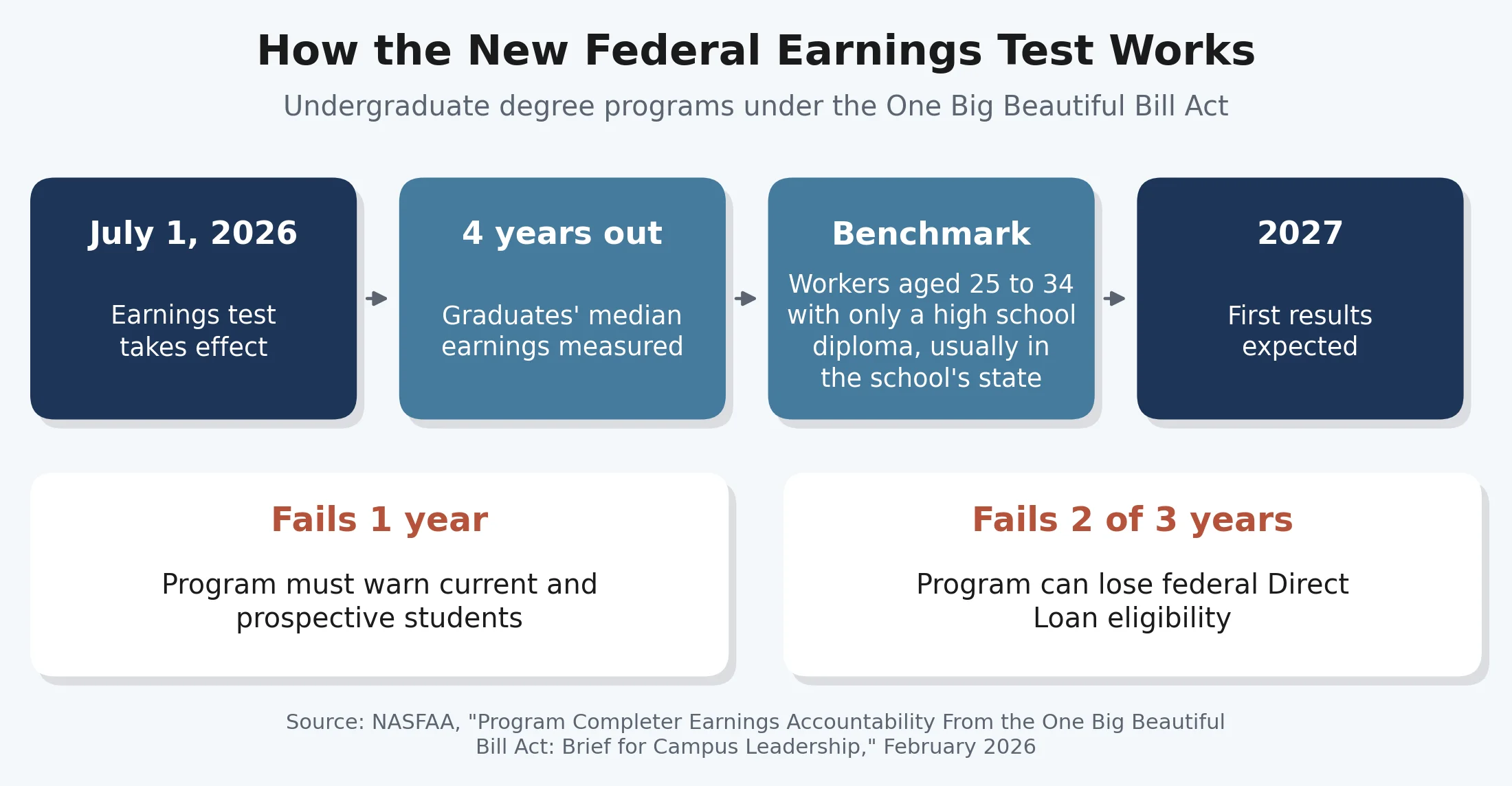
Federal rules are moving in the same direction. Under the One Big Beautiful Bill Act, NASFAA's leadership brief explains, undergraduate programs are judged on graduates' earnings four years after completion, compared with working adults aged 25 to 34 who only finished high school. A program that fails once has to warn current and prospective students, and one that fails two years out of three can lose federal Direct Loan eligibility. If your school doesn't have its own data, the federal College Scorecard data covers earnings by field of study.
Connect Cost to Return
Families now ask if the degree will pay off, not only if they can afford it. Counselors often have students weigh curriculum, campus, community, career, and cost, and colleges usually explain the last two least clearly.
Berea College in Kentucky is an outlier, but it shows what this looks like. Every admitted student receives a no-tuition scholarship and works a paid campus job. Washington Monthly's Berea coverage reported a yearly net price of $3,395, average graduate debt near $2,500, and earnings about $5,000 higher than students' backgrounds would predict. Most colleges can't replicate the model. Any college can list net price, typical debt, and graduate earnings together, with sources.
Bring Families Into the Conversation
Students named in-person events as their most trusted source in the college search in EAB's student surveys. An award letter review night or a net cost Q&A with aid staff will do more for your price message than another campus tour. Paid, trained student ambassadors who can explain grants versus loans help too.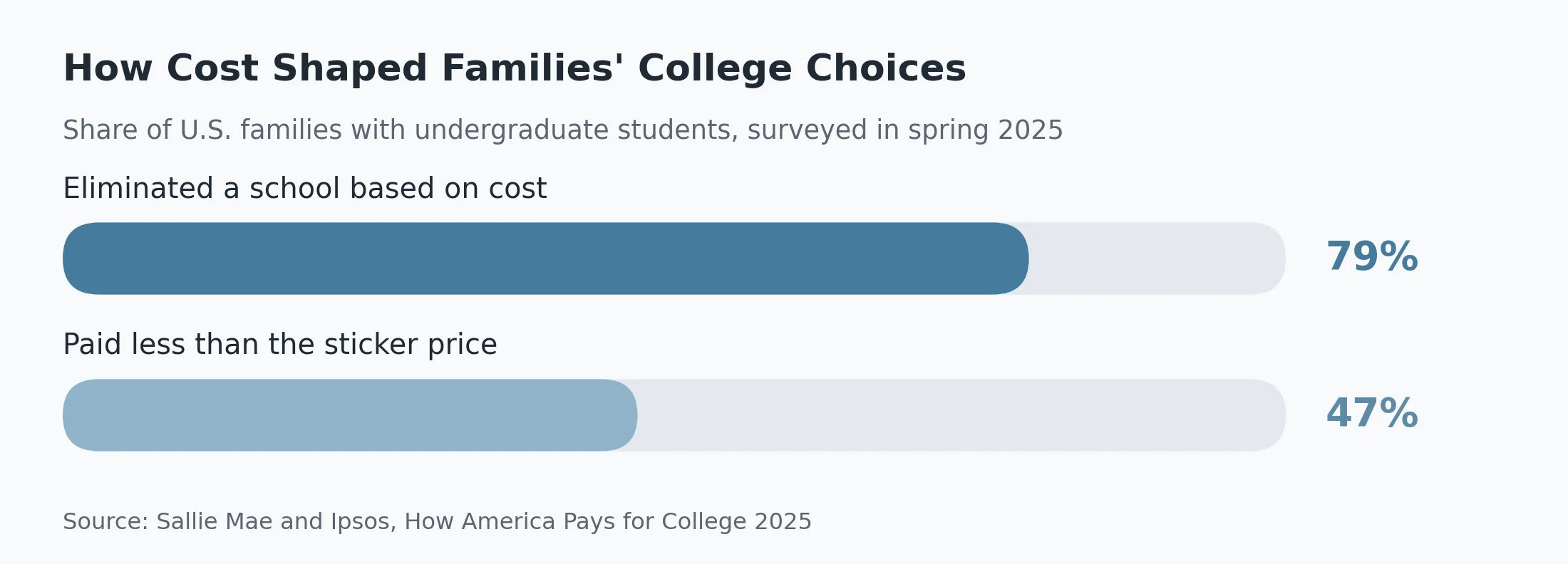
Plan Around the Obstacles
Aid offices juggling verification, appeals, and the new Parent PLUS rules seldom have time to review marketing copy at the height of the season. Changes to letter templates and calculators depend on vendor and IT schedules. A CFO focused on net tuition revenue may push back on publishing net cost by income band. Settle those disagreements before the cycle begins.
Where to Begin
Choose one change you can make before the next round of award letters, such as adding a four-year borrowing total, and have admissions, aid, and finance approve it together. Let this year's melt and retention numbers guide what you tackle after that.
 How Politics Is Shaping College Enrollment
 How Top Performers Land US Job Offers
 The College Majors Foreign Students Regret Choosing
 The Tightest Job Market in Years for College Grads
 How Universities Are Adapting Health Programs to a Moderating Job Market