
The college essay carries more weight in 2026 than it has in years. Acceptance rates at Harvard, MIT, and Stanford remain below 4% for the Class of 2030, while the Common Application reported a 9% jump in total application volume for the 2025-2026 cycle compared to the previous year. With so many applicants posting similar GPAs and test scores, the personal statement is often the single document that separates an admit from a rejection.
This guide covers everything you need: the current prompts, what admissions officers actually read for, how AI is changing the process, and a timeline that keeps you ahead of your deadlines.
How Competitive Is Admissions in 2026?
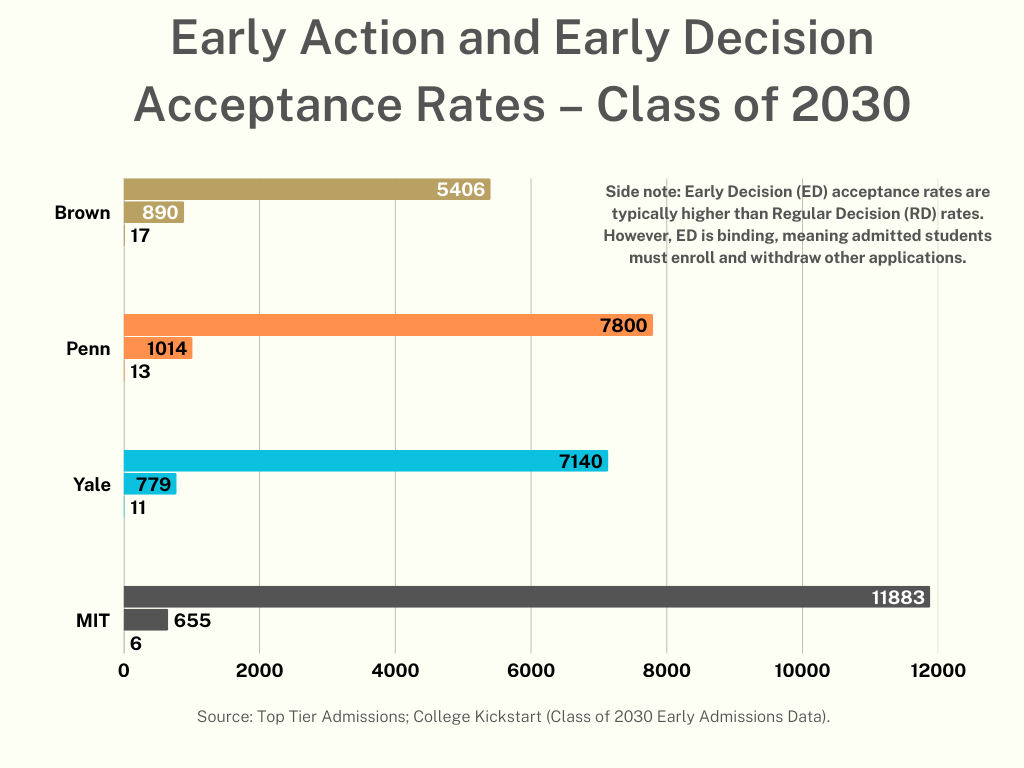
Before getting into the essay itself, it helps to understand the numbers you're up against. The table below shows early admission rates for key schools in the Class of 2030 cycle, drawn from data compiled by Top Tier Admissions and College Kickstart.
School | Early Round | EA/ED Applications | Admitted | Acceptance Rate |
|---|---|---|---|---|
MIT | Early Action | 11,883 | 655 | 5.5% |
Brown | Early Decision | 5,406 | 890 | 16.5% |
Columbia | Early Decision | 5,497 | Not released | — |
Penn | Early Decision | ~7,800 | ~1,014 | ~13% |
Yale | Restrictive EA | Not released | Not released | — |
Early decision rates are meaningfully higher than regular decision at most schools. At highly selective institutions, ED acceptance rates consistently fall between 12% and 19%, compared to single-digit RD rates. If a school is your top choice, applying early is one of the most reliable ways to improve your odds.
The 2025-2026 Common App Prompts
The Common Application confirmed that its essay prompts are unchanged for the 2025-2026 cycle. The seven options are:
Some students have a background, identity, interest, or talent so meaningful that their application would be incomplete without it. Share your story.
Recount a time when you faced a challenge, setback, or failure. How did it affect you, and what did you learn?
Reflect on a time when you questioned or challenged a belief or idea. What prompted your thinking? What was the outcome?
Reflect on something someone has done for you that made you happy or thankful in a surprising way. How has this gratitude affected or motivated you?
Discuss an accomplishment, event, or realization that sparked personal growth and a new understanding of yourself or others.
Describe a topic, idea, or concept so engaging that it makes you lose track of time. Why does it captivate you?
Share an essay on any topic of your choice.
Two structural changes are worth noting. The "Community Disruption" section has been renamed "Challenges and Circumstances," widening its scope to include housing instability, family circumstances, discrimination, and other factors affecting your education. The Additional Information section has also been cut from 650 words to 300.
One thing most applicants don't realize: admissions officers rarely pay attention to which prompt you select. If you're torn between two options, choose "topic of your choice" and write the essay you actually want to write.
What Admissions Officers Read For
Admissions readers at selective schools see thousands of essays from applicants with nearly identical academic profiles. The essay is often where decisions get made. Here is what they're actually looking for.
Authenticity
The best essays sound like the person who wrote them. Admissions officers are not searching for perfect prose or a specific type of story. They want to hear yours, in your voice. Too many applicants write what they think colleges want to hear. The result is an essay that feels hollow, no matter how polished it is.
Self-Awareness and Reflection
Strong essays do more than narrate events. They show how you've processed an experience, what you took from it, and how it shaped the way you think. The qualities readers value most include intellectual curiosity, empathy, initiative, and genuine self-reflection. An essay that demonstrates emotional intelligence will consistently outperform one that just lists accomplishments.
Specificity
Concrete detail transforms forgettable essays into memorable ones. Instead of writing that you "learned responsibility," show a single moment that demonstrates it. Instead of saying a trip changed your perspective, describe one conversation or observation that shifted something in you. Admissions officers read thousands of essays filled with abstractions. Specific scenes, sensory details, and real moments are what stick.
A Clear Narrative Arc
Every essay needs a beginning, middle, and end. The opening lines matter most. A strong lead puts the reader in an accept mindset from the start. A weak one is hard to recover from. Your essay should build toward insight or resolution rather than wandering through unconnected ideas.
Voice and Writing Quality
Your essay should read like natural speech refined for clarity, not an academic paper. Humor, emotion, and personal quirks make essays stand out. A distinctive voice, whether playful, introspective, or direct, always beats formal prose.
Topics That Have Earned Admission
Successful essays cover an enormous range of subjects. Essays that have earned admission to top universities include pieces about grocery lists, laptop stickers, rock collections, working at a deli, translating for family members, and finding meaning in spreadsheets.
What these essays share is not their subject matter but their depth of insight and authentic voice. Smaller, less formal moments often produce more surprising writing precisely because they are unexpected. Admissions officers have read thousands of essays about mission trips, championship games, and prestigious summer programs. They have read far fewer about the rituals of a Sunday dinner or the particular satisfaction of organizing a closet.
Common Pitfalls to Avoid
Generic openings and clichés signal an essay that won't stand out.
Essays that dwell on trauma without reflection belong in the Additional Information section, not in the personal statement.
Essays that praise a grandparent, coach, or mentor often reveal nothing meaningful about the applicant. Keep the focus on you.
Rehashing activities already listed in your application wastes the space. Use the essay to reveal values and perspectives that don't appear anywhere else.
AI and the 2026 Admissions Process
AI is reshaping college admissions from both sides. Students are using it to write essays, and colleges are using it to read them.
How Colleges Are Using AI
According to a survey by Intelligent, 50% of admissions offices were already using AI in their review process by 2023, with projections reaching 80% by 2024. Virginia Tech introduced a hybrid approach for the 2025-2026 cycle, pairing one human reviewer with an AI system for each application. When the two disagree by more than two points on a 12-point scale, a second human reviewer steps in.
The National Association for College Admission Counseling updated its ethics guide in fall 2025 to add guidance on AI, urging institutions to use it in ways that align with transparency, integrity, and fairness. Emily Pacheco, founder of NACAC's AI and admission special interest group, described the current state as "humans and AI working together."
AI Detection and What It Means for Your Essay
Several elite schools have issued explicit bans on AI-generated content in applications. Brown University prohibits AI use under any circumstances in application materials. Georgetown maintains a similarly strict position. Other schools, including Caltech, Cornell, and the University of California system, allow AI for limited purposes such as grammar checking but require that the substance of the essay come entirely from the student. The Common App updated its fraud policy to explicitly classify submitting AI-generated content as your own work as academic fraud.
Detection tools used by colleges include GPTZero, Originality.ai, and Turnitin, though their reliability varies. A 2025 working paper from the University of Chicago's Becker Friedman Institute found that different tools produce very different false positive rates, raising equity concerns for non-native English speakers. For this reason, most schools treat detection software as a triage tool, not a final verdict. Flagged essays receive additional human scrutiny.
Write your own essay. One grounded in lived experience and personal detail will always read more convincingly than a polished but impersonal one, regardless of whether a detection tool flags it. Admissions officers who read hundreds of essays per cycle develop an intuitive sense for writing that lacks authentic personality.
Supplemental Essays: What Changes by School
Supplemental essays require more targeted responses than the Common App personal statement. Word limits typically run from 150 to 400 words, and each prompt must be answered directly.
"Why This College" Essays
Success here demands genuine research. Name specific programs, professors, courses, or opportunities that connect to your goals. Generic praise for a school's reputation does nothing to distinguish you from thousands of applicants making the same claims. Use Scholaro's school search tool to compare programs across institutions before you write.
Community and Contribution Essays
Many schools ask how you'll contribute to campus life, often tying the question to institutional values. Boston College, for example, asks applicants to connect their experiences to Jesuit traditions including collaboration and respect. Blend personal authenticity with a real understanding of what the school prioritizes.
The Post-SFFA Identity Prompt
Two years after the Supreme Court's 2023 ruling banning race-conscious admissions, identity and background prompts remain the most common supplemental essay type, appearing at more than 300 institutions reviewed for the 2025-2026 cycle. Research from College Transitions identified 19 colleges that dropped or modified diversity-related prompts, including the University of Virginia, but the identity prompt category itself has not gone away.
These prompts now function like an updated version of the "Why Us" essay, with a key difference: they ask what you'll contribute, not what the school offers you. Focus on how your background shaped your perspective, growth, or choices. Avoid listing cultural practices. Zoom in on a turning point that reveals how your experiences will enrich campus life. Scholaro's GPA conversion guide can help you understand how your academic record translates across different grading systems if you've studied abroad.
Video Introductions
Schools including Brown, University of Chicago, and Washington University St. Louis now offer optional 90-second video submissions. These are not yet standard, but the format is growing. Keep your video authentic, concise, and focused on something that doesn't already appear in your written application.
Building Your Application Timeline
Starting early is the single most practical thing you can do.
Summer before senior year: Begin brainstorming and drafting your Common App personal statement. Reflect on moments that shaped your identity, values, or perspective. Read successful essay examples for inspiration, but do not try to replicate them.
Early September: Aim to have your personal statement finalized. This frees you to focus on supplemental essays for each target school before Early Decision and Early Action deadlines arrive.
Drafting approach: Write a longer draft first, around 950 words, then cut to the 650-word limit. The material you remove often clarifies what matters most. Plan to revise three to five times. Fewer revisions usually means insufficient refinement. More than five risks losing the natural voice that makes essays compelling.
Final check: Have a teacher, counselor, or trusted adult proofread your essay before you submit. After rereading your own words multiple times, you become blind to errors and unclear sentences. Confirm that your supplemental essays answer each prompt directly, that your personal statement does not duplicate other sections of your application, and that all word counts fall within the specified limits. Scholaro's GPA calculator can help verify how your grades convert if you're applying from outside the U.S.
Final Thoughts
A strong college essay does one thing: it tells admissions officers something meaningful about you that they cannot find anywhere else in your application. It doesn't need to describe a dramatic event or a life-changing experience. It needs to be honest, specific, and clearly yours.
Start early, revise thoughtfully, and write the story only you can tell.
 5 ways colleges can make career prep 'unavoidable' for students
 The Real Economics Behind Entry-Level Gigs
 Can 3-Year Degrees Solve the Teacher Shortage?
 Does College Public Speaking Really Matter in Today’s Job Market?
 Strategies for Communicating Tuition and Outcomes to Prospective Students