Career prep used to sit off to the side. A workshop here, a resume clinic there, maybe a job fair once a semester. That model is falling apart. Employers now hire on skills, not GPA, and students who never touch a career office are graduating without proof they can do the job. If your school wants career prep to actually stick, it can't be optional. It has to show up everywhere a student turns.
Here are five ways to make that happen.
Area | Old model | Unavoidable model |
|---|---|---|
1. Curriculum | Career prep as an optional elective | Skills explicitly mapped in required syllabi |
2. Experience | Internships left to student initiative | Hands-on work integrated into the degree |
3. Analytics | Single exit survey at graduation | Continuous tracking from freshman orientation |
4. Advising | Passive office waiting for drop-ins | Active outreach inside classrooms |
5. Articulation | Hidden skills implied by grades | Specific skill translation for resumes and portfolios |
Build Career Skills Into Every Class
Career prep works better when it lives inside the classes students already have to take. Not as an add-on. As part of the grade.
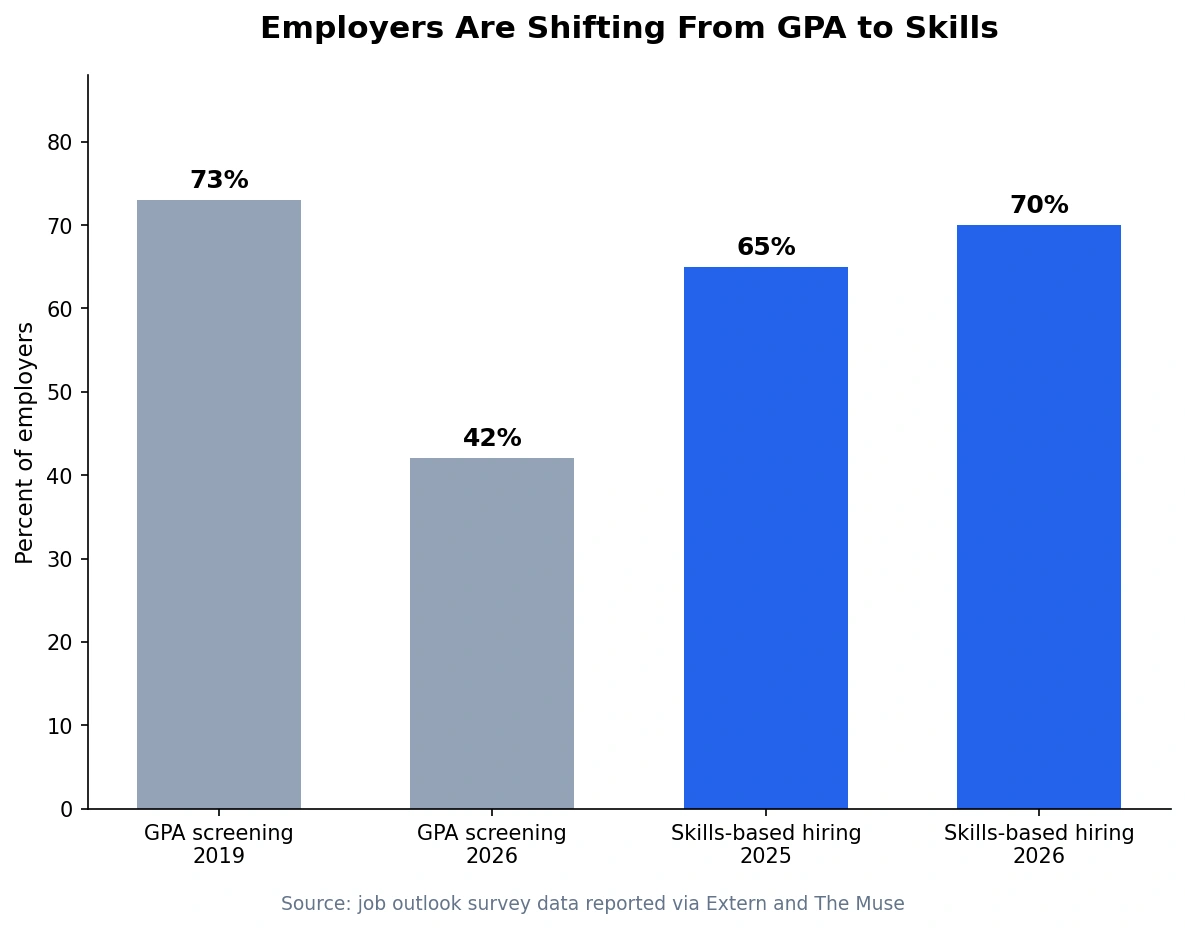
Employers have already made this shift. GPA screening for entry-level hires dropped from 73% in 2019 to around 42% now. Skills-based hiring went from 65% to 70% in the same stretch. That's a big swing in a short time, and it means resumes built on grades alone are losing ground fast.
If an employer isn't checking grades anymore, a transcript alone won't get a student in the door. That's why some schools are naming the skill inside the syllabus itself. Rather than teaching teamwork, communication, or problem-solving as background noise, a course lists it out loud, right next to the grading rubric. One computer science department now asks its faculty to name three transferable skills on every syllabus in the program.
This is design work, not a marketing exercise. A professor has to sit down and decide which skill a specific assignment is actually building, then grade for it on purpose. A few ways that shows up in practice:
A rubric names the skill next to the score, so a group project grades collaboration and communication as clearly as it grades the final report.
A course syllabus lists three or four competencies up front, the same way it lists learning objectives.
A department reviews its course list once a year and checks that the required skills actually show up somewhere in the sequence.
If a professor, for example, designs a group research project and grades it against a rubric for collaboration and data analysis, students build those skills either way. Naming it just makes the skill visible instead of accidental.
One school folded AI literacy into every single course rather than offering it as one standalone class. That's the direction things are heading. Career skills stop being a separate unit and start being part of the coursework.
Turn Real Experience Into a Requirement
Internships shouldn't be something a student stumbles into if they happen to have the time and the connections. Build the experience into the degree path itself.
Dual credit and work-based learning programs are already proving this works at scale. One state program alone put close to 100,000 students into combined college-and-work pathways in a single year, combining college credit with hands-on training in real workplaces.
Students earn credit and workplace hours at the same time, not one after the other.
Local employers get a steady pipeline of trained talent instead of hiring blind.
Students figure out what they don't want to do before they've spent years training for it.
One regional program connects high schoolers to paid work-based learning in health care, manufacturing, and public service, letting them stack up credit and job skills at the same time.
If a student, for example, spends a semester rotating through a few different work placements before picking one to focus on, they walk away with a much clearer sense of the field than any lecture could give them. That's the whole point. Let students test the job before they commit to the career.
Track Progress From Year One, Not Only Graduation Day
Most schools measure career readiness once, right at the end, with an exit survey nobody really wants to fill out. By then it's too late to fix anything.
Graduates who called their career services "very helpful" were nearly 6 times more likely to say their school prepared them for life after college. But the experience isn't the same for everyone. Humanities students report far less satisfaction with career support than engineering students do.
That gap is a signal, not an excuse to write humanities students off. Some schools now use a competency assessment tool to measure where students actually stand, instead of guessing based on major alone. Catching a gap in year two costs a lot less than catching it in year four.
Start the tracking at orientation, not senior year, so gaps show up while there's still time to close them.
Break the data out by major, since the same career prep doesn't land the same way for every field.
Share the numbers with faculty and advisors too, so more people can act on what the data shows.
Meet Students Where They Already Are
Here's the awkward truth. Most students never walk into the career center at all.
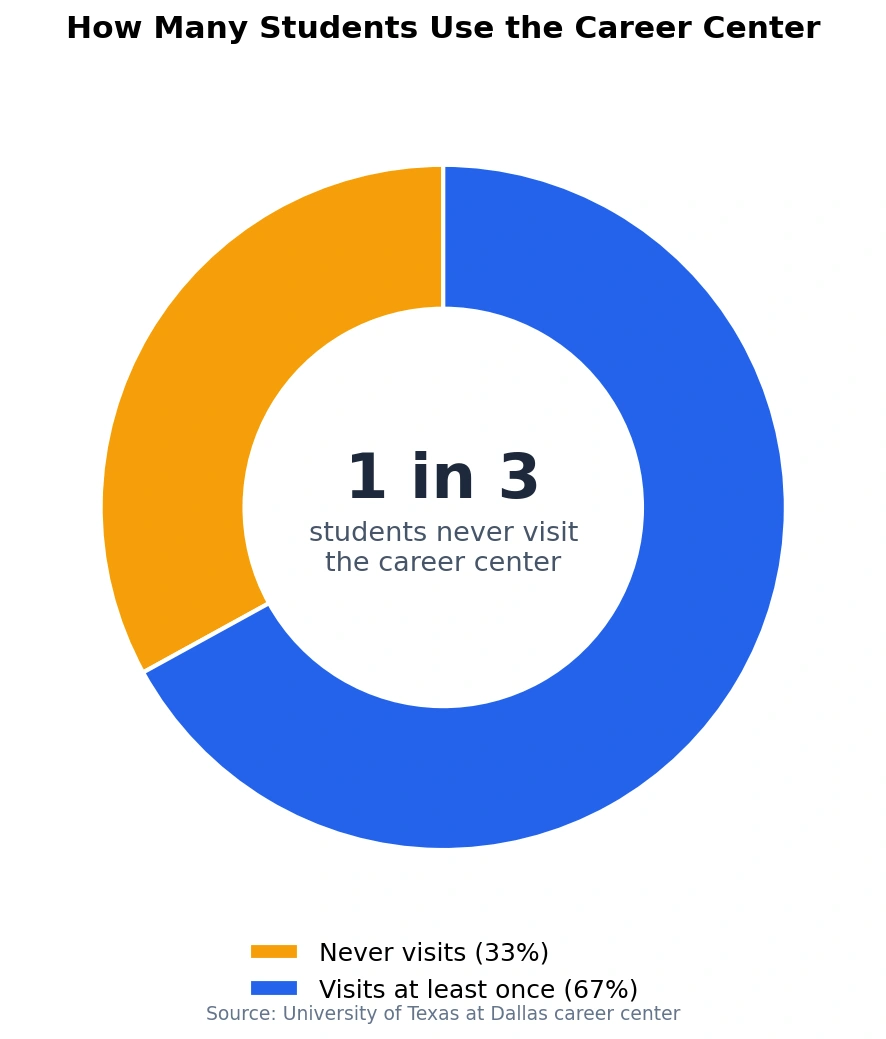
A third of all students never set foot in the career center before they graduate. Meanwhile, most faculty get asked for career advice anyway, even though it's not their official job.
So stop waiting for students to come to the office. Bring the advising to them instead.
Fold career conversations into orientation, before students even settle into their first class.
Train faculty to point out transferable skills inside assignments, since students already trust professors on this.
Push advising check-ins into required courses instead of leaving them to a walk-in office nobody visits.
If a student, for example, never plans to set foot in a career center on their own, a five-minute conversation with a professor about how their coursework connects to a real job might be the only career advice they ever get. Make that conversation part of the structure, not a lucky accident.
Turn Coursework Into Resume Lines
A group project isn't worth much on a resume until someone gives it a name. Section one is about how professors design the work. This part is about what the student does with it after: capturing it, translating it, and packaging it somewhere an employer will actually see it.
Short, structured work experiences show this translation works. Almost all students in one micro-internship program reported measurable gains in at least one career skill, and most improved in three or more. That's a strong return for a few weeks of structured work.
Turn a class project into a resume line by naming the action and the result, beyond the assignment title.
Stack short-form credentials or micro-internships onto a transcript so a skill has proof behind it, beyond a claim.
Keep a running digital portfolio so a student isn't scrambling to remember what they did three semesters ago.
Some schools now use student portfolio tools to help students pull their coursework, jobs, and clubs into one place an employer can actually read, instead of leaving it scattered across old assignments and forgotten group chats.
This translation gap is especially wide for international students, who often run into unfamiliar job market terms on top of everything else. Tools like credential evaluation services and digital portfolios close that gap by turning foreign credentials and coursework into terms a domestic recruiter recognizes right away. Scholaro's credential evaluations work the same way, turning a degree earned abroad into something a hiring manager understands at a glance.
If a student, for example, spent a semester building a small marketing campaign for a class project, that's more than a grade now. That's "developed and executed a marketing campaign," sitting right at the top of a resume.
Build It Into the Structure
Career prep sticks when it's built into the structure, not stapled on top of it. Put skills in the syllabus. Put experience in the degree. Track progress early. Show up where students already are. Give every assignment a name an employer will recognize.
 The Real Economics Behind Entry-Level Gigs
 Can 3-Year Degrees Solve the Teacher Shortage?
 Does College Public Speaking Really Matter in Today’s Job Market?
 Strategies for Communicating Tuition and Outcomes to Prospective Students
 How Politics Is Shaping College Enrollment