

Landing your first job abroad feels like the finish line. You've studied in a foreign country, survived campus life in an unfamiliar culture, and earned a degree that proves you can handle it. Then day one arrives, and nothing feels the way you expected. That's not failure — that's career shock and culture shock hitting at the same time. Most graduates prepare for one and get blindsided by both.
Understanding what each one is, how they differ, and where they overlap is the first step to getting through your first year with your sanity and your career intact.
What Culture Shock Actually Is
Culture shock is not a single dramatic moment. It builds slowly from a series of small frictions — a misread tone in a meeting, a social custom you didn't know existed, a joke that doesn't land. It's the cumulative impact of moving from a familiar culture into an unfamiliar one, including the loss of the people you'd normally turn to when things feel uncertain, as this UKCISA guide explains.
It affects everyone. Prior travel, language ability, and life experience reduce the severity but don't prevent it. The disorientation comes from being cut off from your cultural reference points — the unspoken rules about how to behave, what to say, and what things mean.
In a work setting, the stakes are higher. You're not just adjusting to a new country. You're adjusting to company culture layered on top of country culture. Shorelight's student research notes that double adjustment is what makes the first job abroad harder than the degree that preceded it.
Four Forms of Culture Shock You'll Actually Encounter
Culture shock doesn't arrive as one uniform experience. For international graduates entering the workforce, it tends to show up in four distinct forms.
Social culture shock covers the unwritten rules of everyday interaction — personal space, eye contact, humour, punctuality, how people greet each other, and what counts as polite versus cold. These aren't taught anywhere. You absorb them by watching, getting it wrong, and adjusting.
Language and communication shock goes well beyond vocabulary. It includes professional register, indirect feedback, workplace slang, the ability to follow fast conversations under pressure, and knowing when silence means agreement versus discomfort. Even fluent English speakers report this, because classroom English and office English are different languages.
Workplace culture shock covers hierarchy, meeting norms, feedback styles, and the unspoken rules around things like how much you're expected to push back on a manager's ideas, whether you speak up in meetings or wait to be asked, and what professional dress actually means in practice. Communication styles vary significantly — some cultures prefer direct, structured exchanges; others rely on ambiguity and subtext, as Expatica's expat guide highlights.
Reverse culture shock is the one nobody warns you about. After months of adapting abroad, returning home can feel just as disorienting as arriving. Your values have shifted. Your habits have changed. The place you left feels unfamiliar. The W-curve model captures this — adjustment abroad and re-entry home follow the same emotional arc.
From Euphoria to Equilibrium: How Culture Shock Unfolds
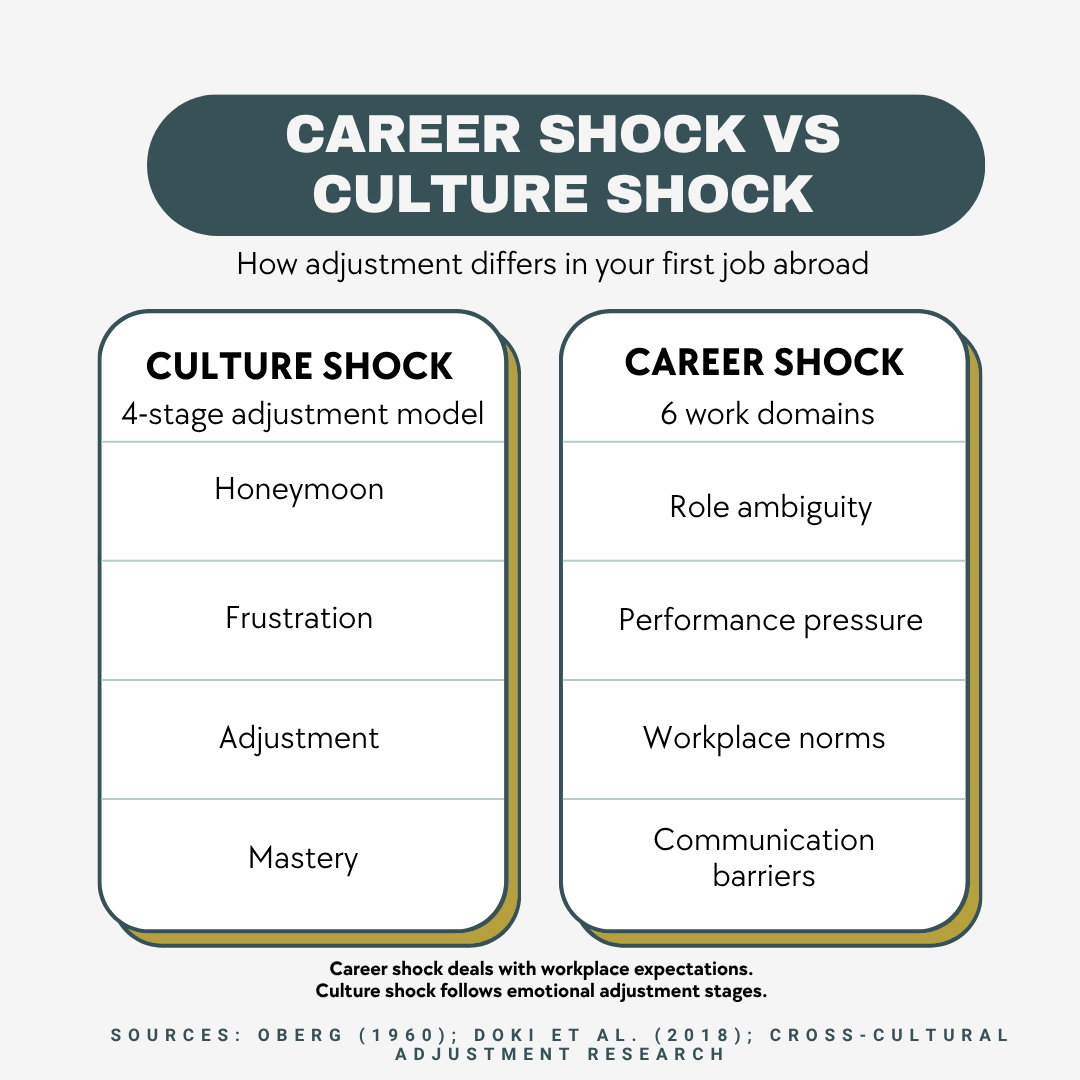
Culture shock follows a recognizable pattern. Oberg's adjustment research maps it across four stages:
Honeymoon. Everything is new and interesting. You're energized, optimistic, and quick to find similarities with home. This phase can last weeks or months — and on a short study abroad stint, it might never end.
Frustration. Reality sets in. Small differences start to feel like large obstacles. Miscommunications stack up. You may feel homesick, irritable, or tempted to withdraw. This is the hardest phase, and in a workplace, it's where professional relationships and performance take the most strain.
Gradual adjustment. You start reading cultural cues you previously missed. Confidence returns. Routines settle. You're no longer spending mental energy on things that now feel automatic.
Adaptation. The new environment feels normal. You can operate across both cultures. Some people reach this point within a year; others take longer, depending on how far their home culture sits from the host culture and how much they've pushed themselves into uncomfortable situations.
These stages don't move in a straight line. You can cycle back. A setback at work or a difficult social interaction can pull you back into frustration even after you thought you'd moved through it.
What Career Shock Is — And Why It Hits Graduates Hard
Career shock — sometimes called reality shock or shift shock — is the gap between what you expected your first job to be and what it actually is. Emerald's reality shock research defines it clearly: when a new employee's expectations, formed before joining an organization, differ significantly from what they find when they arrive.
For any new graduate, that gap is normal. The interview process is mutual selling — you present your best self, they present their best version of the role. Once you start, both sides see what's behind the curtain.
For foreign graduates, the gap is wider. You can't rely on a home-country professional network to calibrate your expectations. You may not know how feedback is typically delivered in this country, how performance is measured, or what "showing initiative" actually looks like in this workplace. Working abroad stress research identifies six core stressors — communication, cultural differences at work, daily life logistics, family and colleague relationships, financial pressures, and social inequality — none of which resolve quickly, and all of which compound career shock.
Common triggers include entry-level tasks that feel beneath your qualifications, slower career progression than expected, minimal mentorship, and a workplace hierarchy that operates nothing like what you anticipated. Feldman and Tompson's graduate study found that this dual burden — entry shock from school to work, plus culture shock from the country itself — creates a uniquely high-pressure transition that most organizations are not equipped to support.
What Culture Shock Felt Like During Your Degree — And Why Work Is Different
If you studied abroad before working abroad, you already have a reference point for culture shock. The campus environment has a built-in safety net: international student offices, peer communities, structured schedules, and the shared experience of being a student in a foreign place.
The symptoms are well-documented — homesickness, anxiety, sleep problems, withdrawal, and irritability. International student mental health research consistently identifies anxiety and stress as the most frequently reported issues, particularly in the first semester.
The workplace strips away most of that safety net. There's no international student office. Your colleagues aren't necessarily going through the same thing. A rough semester might affect your grades; a rough first quarter at work affects your professional reputation, your team relationships, and potentially your visa status. The pressure is different in kind, not just degree.
What No One Tells You About Working Abroad
Globalization doesn't immunize you. Even if you've spent three years studying in another country, the shift to full-time employment is a different experience. This UTS careers account puts it plainly: living abroad is worlds apart from being a tourist in the same place. Even mundane tasks — paying bills, navigating public transport, grocery shopping — carry more weight when you're doing them as a working adult without a support system.
Loneliness looks different at work. You don't have a campus social structure to fall back on. Building genuine workplace relationships across cultural lines takes sustained effort and a tolerance for awkward early interactions that most people underestimate.
Your foreign degree does not guarantee automatic respect. Credential systems vary. You may need to prove yourself more explicitly than local graduates, and that reality can feel deflating if you weren't prepared for it.
Weekends abroad aren't what you imagined. Less spontaneous socializing, more admin — laundry, banking, finding a doctor, figuring out how taxes work.
And then there's the career expectation gap. International experience helps, but honest study abroad research makes clear that knowing how to articulate what you learned — and how it's relevant to the role — matters more than having the experience itself.
What Shapes How Hard the Transition Is
Not everyone experiences career shock and culture shock at the same intensity. Several factors determine how steep the adjustment is.
Cultural distance is the biggest one. The further your home culture sits from your host country across dimensions like hierarchy, communication style, and attitudes toward individualism, the harder the adjustment.
Language proficiency matters beyond the classroom. Workplace communication under pressure — fast conversations, informal banter, reading tone in written messages — requires a fluency that academic English doesn't fully prepare you for.
Support structures make a significant difference. Whether your employer offers cultural onboarding, whether you have a mentor who explains unwritten rules, and whether you have any community outside work all affect how quickly you stabilize.
Visa pressure adds a layer that domestic graduates don't face. When your right to remain in the country is tied to your employment, it becomes harder to set limits, speak up about problems, or walk away from a poor fit.
Personality plays a role too. NACADA's cross-cultural research consistently finds that openness to new experiences and willingness to put yourself in uncomfortable social situations accelerates adjustment — not because it prevents discomfort, but because it generates the interactions that teach you how things actually work.
Getting Through Both Shocks
The most practical thing you can do is separate the two. Diagnosing whether what you're feeling is cultural disorientation or unmet career expectations changes your response entirely.
If it's culture shock, the answer is time, social interaction with people from the host culture, and resisting the urge to retreat entirely into expat communities. If it's career shock, the answer is an honest conversation with your manager about expectations — framed not as complaint, but as a desire to understand how success is measured in this role.
Give yourself a 90-day buffer. TopResume's new hire research is clear that the first three months are an extended onboarding period, not a representative sample of the job. Decisions made in week two based on week-two feelings are often ones people regret.
Build internal relationships deliberately. The colleague who takes ten minutes to explain how things really work here is often more valuable than any formal onboarding document.
Know when to get help. Persistent anxiety, inability to concentrate, or depression that lasts beyond a few weeks are signals that professional support is needed — not a sign you're not cut out for this.
Two Shocks, One Transition
Career shock and culture shock are not the same thing, but they arrive together and they feed each other. Culture shock makes you feel out of place in the country. Career shock makes you feel out of place in the job. When both hit at once, it's easy to conclude you made the wrong choice.
Most of the time, you didn't. You're just further into a real adjustment than you expected to be. The graduates who manage both well aren't the ones who don't feel them — they're the ones who recognize what's happening and give themselves time to move through it.
 How Universities Use Zero-Waste Swap Programs to Cut Student Costs
 How Industry Partnerships Shape Modern Curricula
 How Post-COVID Aid Programs Help Universities Rebuild Admissions
 Beyond the Acceptance Rate and How Colleges Decide Who Gets In
 How Leveraging Job Placement Strategies Can Reenroll Returning Students