
Balancing a job with going back to school is hard. Online degree programs for working adults are designed to make it manageable. According to the NCES enrollment data, adult learners made up 24% of undergraduate enrollments in fall 2023. If you're one of them, picking the right program comes down to a few key factors:
Flexibility : asynchronous schedules that fit around your job, not the other way around
Cost : tuition per credit, transfer credit policies, and financial aid options
Accreditation : regional accreditation is required for credit transfers, most employer reimbursement programs, and federal financial aid
Career alignment : how well the degree maps to where you want to go professionally
Feature | What to Look For |
|---|---|
Schedule format | Asynchronous (self-paced) vs. synchronous |
Transfer credit policy | Up to 90 credits accepted at some schools |
Credit for work/military experience | Prior learning assessments (PLAs) |
Tuition per credit (undergrad) | $170–$659 depending on school |
Financial aid eligibility | FAFSA-eligible, employer reimbursement |
Program length | 2–4 years; accelerated options available |
What Makes an Online Program Work for Working Adults
Asynchronous delivery means no set class times. You log in and complete coursework on your own schedule: evenings, weekends, early mornings. This is the single biggest differentiator for people managing full-time jobs.
Transfer credit flexibility cuts both time and cost. Charter Oak State College accepts up to 90 credits toward a bachelor's and awards credit for standardized tests, military experience, and prior learning. Thomas Edison State University goes further, accepting credits from professional certifications and on-the-job training.
Competency-based education (CBE) lets you progress based on what you know, not how long you've been enrolled. If you already have relevant experience, you can accelerate through familiar material and focus time where you need it.
Support outside business hours matters too. If you can only reach your academic advisor between 9 a.m. and 5 p.m., that's a problem. Look for advising, tutoring, and technical support that fits a working adult's schedule.
How These Features Add Up
A student works full-time as a healthcare administrator and has 60 prior college credits, plus military service documentation. He enrolls in an online bachelor's program at a school that accepts prior learning credits and runs on eight-week asynchronous terms. His 60 transferable credits cut the program roughly in half. His military training earns him another 12 credits through prior learning assessment, bringing his remaining coursework down to about 48 credits. He logs in evenings and weekends, reaches his advisor by email at 10 p.m. when needed, and finishes his degree in under two years without stopping work.
Key Features to Look For
Use this checklist when comparing programs:
Criteria | Why It Matters |
|---|---|
Regional accreditation | Required for credit transfer and most employer recognition |
Prior learning assessment (PLA) | Converts work experience into academic credit |
Employer tuition partnerships | Some schools bill your employer directly |
Career services access | Online students should get the same resources as on-campus peers |
24/7 technical support | Essential when you're studying outside normal hours |
Fixed or locked tuition rates | Locks in costs so they don't rise mid-degree |
Accreditation is non-negotiable. Before applying anywhere, confirm the school holds regional accreditation and participates in federal financial aid programs. You can verify both through the U.S. Department of Education database.
Top Online Colleges for Working Adults
These schools consistently rank well for flexibility, affordability, and support tailored to non-traditional students. The chart below compares undergraduate tuition per credit across six strong options.
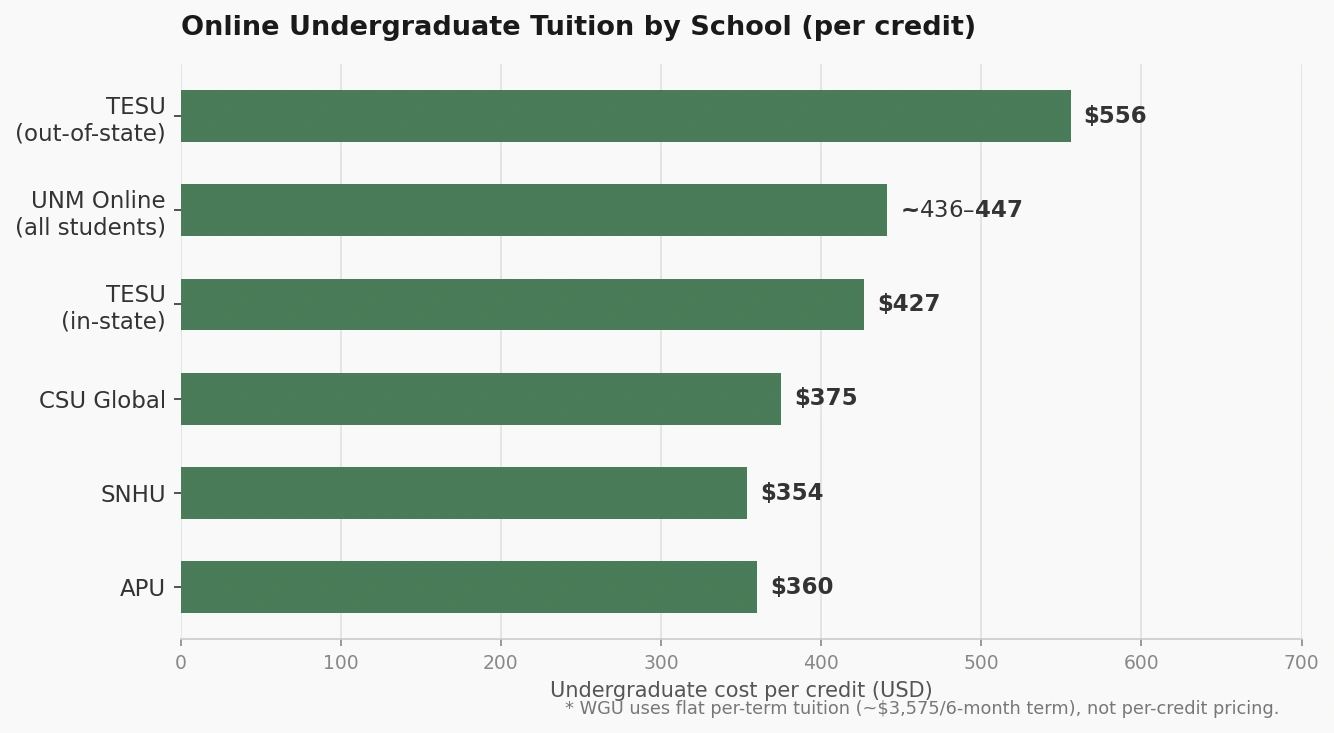 APU: $360/credit (standard rate), $250/credit for military. Strong track record with veterans and active service members.
SNHU: $354/credit, no undergraduate application fee, over 200 degree and certificate programs.
CSU Global: $375/credit, locked-in tuition rate for the life of your degree, no hidden fees.
TESU: $427/credit for New Jersey residents, $556 out-of-state. Accepts a wide range of prior learning credits from professional experience and military training.
UNM Online: approximately $436–$447/credit for all students regardless of residency, via its Accelerated Online Program rate.
WGU: flat per-term tuition of around $3,575 per six-month term, covering unlimited coursework. Rewards students who can move fast.
Top Career-Focused Online Degrees
Three fields consistently deliver strong employment outcomes and salary growth for working adults.
Business Administration is the most versatile option. It builds skills in leadership, strategic planning, financial management, and operations that apply across industries. Many programs award credit for prior work experience, which accelerates the timeline for adults with professional backgrounds. It's also one of the more flexible formats, built around reading, writing, and discussion rather than timed exams or lab requirements.
Computer Science and Information Technology offer the highest salary ceilings. Roles in software engineering, systems analysis, data science, and AI development carry median salaries ranging from $100,000 to $133,000, with senior positions well above that. These programs are in high demand from employers across most sectors.
Cybersecurity is one of the fastest-growing fields in the country. The BLS projects 29% job growth from 2024 to 2034 for information security analysts. Many online programs align their coursework with industry certifications like CompTIA Security+ and CISSP, giving graduates dual credentials.
Degree | Median Salary Range | Best For |
|---|---|---|
Computer Science | $100,000–$133,000 | Tech career switchers |
Cybersecurity | $90,000–$125,000 | IT professionals seeking advancement |
Business Administration | $65,000–$110,000 | Broad career mobility |
How to Make College More Affordable as a Working Adult
Cost is one of the biggest barriers to going back to school. Online students have access to the same financial aid as traditional students, plus a few options specific to working adults.
Start with FAFSA
The Free Application for Federal Student Aid (FAFSA) is the starting point for all federal aid. Online students qualify for the same grants, loans, and work-study programs as on-campus students, provided the school is accredited and Title IV-eligible. The 2026–27 FAFSA opened in December 2025. File as early as possible; some aid is first-come, first-served.
Pell Grant: Need-based grant for undergraduates; the maximum award for 2025–26 is $7,395 and does not need to be repaid
Federal Direct Loans: Available to undergraduate and graduate students; subsidized loans do not accrue interest while you're enrolled
Federal Work-Study: Available to online students even if you don't live near campus
Employer Tuition Reimbursement
Many employers offer tuition reimbursement as a standard benefit, paid out after you complete a course in good standing. Some have direct-bill arrangements with specific schools; ask HR before you choose a program.
Transfer Credits and Prior Learning Assessments
Every credit you transfer in is a credit you don't pay for. If your school offers prior learning assessments, you can earn credit for work experience, military training, or professional certifications at a fraction of the course cost.
Competency-Based Programs
CBE programs charge per term, not per credit. Complete more coursework in a term and your effective per-credit cost drops. WGU is the most well-known example.
Frequently Asked Questions
Can I get financial aid for an online degree?
Yes. Most students in accredited online programs qualify for the same federal, state, and private financial aid as traditional students. Complete the FAFSA to find out what you're eligible for.
Will employers take my online degree seriously?
According to BestColleges' 2025 report, 90% of online program graduates say their degree has had or will have a positive return on investment, and 79% of graduates feel their program prepared them well for their first job. Employer acceptance of online degrees has grown significantly, particularly from regionally accredited schools.
How long does it take to finish a degree while working?
It varies. Accelerated programs can wrap up in two years or less. Standard bachelor's programs typically run two to four years part-time. CBE programs have no fixed timeline; you move as fast as you can demonstrate competency.
Can part-time students get financial aid?
Yes. Part-time students qualify for federal financial aid, including Pell Grants and Direct Loans, as long as they're enrolled at least half-time, which typically means 6–12 credits per semester for undergraduates.
What's the difference between asynchronous and synchronous courses?
Asynchronous: no set meeting times, you work within module deadlines. Synchronous: scheduled virtual sessions at fixed times. Most programs for working adults are asynchronous. Check before you enroll.
Is accreditation really that important?
Yes. Regional accreditation is required for most credit transfers, employer tuition reimbursement programs, and professional licensure. Confirm accreditation status before applying anywhere.
How to Choose the Right Program
Start with these four questions:
What's your career goal?
Pick a degree that maps directly to it. Don't pursue a general degree if a specific one would serve you better.
How many credits can you transfer?
This changes your total cost and timeline significantly. Request a transfer credit evaluation before committing.
What's your realistic weekly time commitment?
Most online programs expect 15–20 hours of study per week. Be honest about what's sustainable alongside work.
Is the school regionally accredited and eligible for FAFSA?
If not, rule it out.
For national programs with strong flexibility and affordability, SNHU, WGU, and TESU are consistent performers across most fields. The National Student Clearinghouse tracks enrollment trends and outcomes data that can help you evaluate how graduates from specific programs fare in the job market, a useful data point before committing.
 5 ways colleges can make career prep 'unavoidable' for students
 The Real Economics Behind Entry-Level Gigs
 Can 3-Year Degrees Solve the Teacher Shortage?
 Does College Public Speaking Really Matter in Today’s Job Market?
 Strategies for Communicating Tuition and Outcomes to Prospective Students