A college sophomore stops logging into the learning management system mid-October. She misses two assignments. Then three. By the time a faculty member notices and emails the advising office, she has already mentally checked out. She withdraws two weeks later. No one saw it coming, because no one was looking at the right data in time.
That kind of story is exactly what AI student risk monitoring is built to prevent. These systems watch for the early warning signs that humans miss, and they flag them before the situation becomes unrecoverable.
Here is what university leaders need to know about how these tools work, what they do when they find a problem, and what you need to watch out for when you sign a vendor contract.
What traditional advising misses
Traditional early-alert systems depend on faculty reporting. A professor notices a student is struggling and submits a flag. That flag lands in an advising queue. The advisor follows up, maybe within a week, maybe longer.
The problem is the gap. By the time a human notices something is wrong and acts on it, weeks have often passed. In that window, a student's situation compounds. A missed assignment becomes a missed exam. A financial aid question becomes a hold. A hold becomes a reason to stop showing up.
AI monitoring closes that gap by watching the data continuously.
What traditional advising catches | What AI monitoring flags | How early |
|---|---|---|
Faculty email about missed exams | Drop in LMS login frequency | 2 to 4 weeks earlier |
Student visits advising office | Missed assignment pattern | Days after first miss |
End-of-term grade reports | Grade trajectory decline | Mid-semester |
Financial aid office referral | Aid hold or status change | Same day it changes |
Missed advising appointment | No advising contact in 30+ days | Automatic flag |
How AI tracks risk
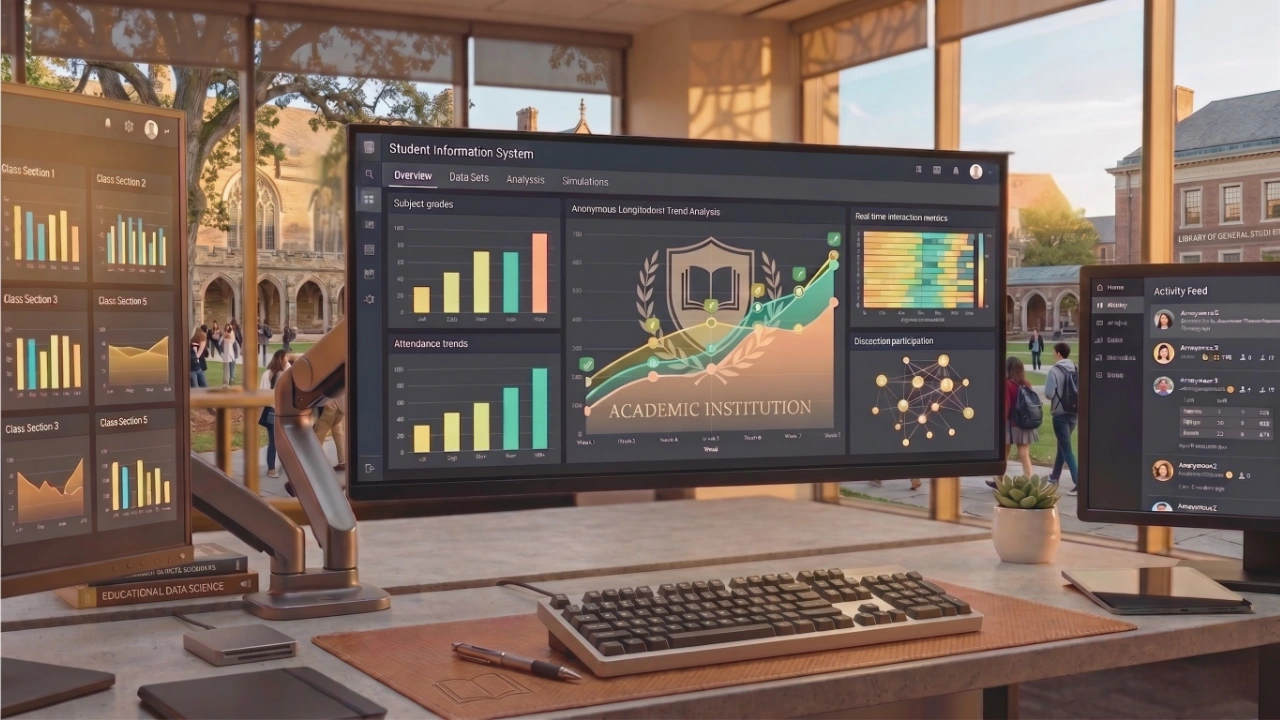
The system ingests data from across campus and runs it through a predictive model. The data points it monitors typically include:
LMS login frequency and time-on-platform
Assignment submission patterns
Attendance records
Financial aid status and holds
Advising appointment history
Current grade trajectory compared to course averages
Each data point feeds into a risk score. According to Scientific Reports research, modern AI systems combine decision trees, random forests, support vector machines, and neural networks to improve prediction accuracy across different types of students and learning environments.
Those model types matter because traditional systems only flag a student when a single metric crosses a threshold, like a failing grade. Machine learning models work differently. They look at the interaction between multiple subtle shifts at once. A student logging into the LMS late at night, combined with a slight delay in assignment submissions, can register as elevated risk even if their current grade is still a B. No single signal triggers the alert. The combination does.
The key point for institutional leaders: the model is only as good as the data you feed it. An AI platform connected to your LMS, student information system, and financial aid database will perform very differently from one that only sees grades.
A community college connects its AI platform to four data sources: its LMS, financial aid system, attendance tracker, and advising notes. Within weeks, it could start surfacing at-risk students who had never appeared on any advisor's radar. That is exactly the kind of gap these platforms are built to close.
Bias and alert fatigue
There is a problem that does not get enough attention in vendor demos. AI models are trained on historical data. If that data reflects patterns where certain student populations had lower retention due to systemic barriers, the model can absorb those patterns and over-flag students from those same groups going forward. The result is not better support. It is a flood of low-confidence alerts that advisors start ignoring.
Universities must audit vendor models on a regular basis to verify they are not disproportionately flagging minority or low-income students based on historical trends rather than active behavior. Ask any vendor how they test for demographic bias in their prediction outputs. If they do not have a clear answer, that is a red flag.
From tracking to intervention
Flagging a student is not the same as helping them. The real value of these platforms is what happens after the risk score crosses a threshold.
1
Cross the Threshold System Level
The AI detects a pattern of compounding risk signals, such as missed logins combined with a financial hold, and updates the student's risk profile.
2
Automated Nudge Student Level
The system sends a personalized text or email to the student to offer help before a human steps in.
3
Dashboard Escalation Advisor Level
The alert lands on the advisor's dashboard with full context: what triggered it, course averages, and historical notes.
4
Coordinated Outreach Cross-Campus Level
If the student does not respond, the system triggers workflow alerts to adjacent departments like housing, financial aid, or mental health services.
Georgia State University's results show what is possible. After implementing a predictive analytics system that monitors over 800 risk factors across its student population, the university reported a 4% increase in retention and a 7 percentage point improvement in four-year graduation rates, according to Georgia State's student success program. The gains were largest among low-income and first-generation students.
A first-generation student stops submitting assignments in week four. He is working 35 hours a week and has hit a financial aid delay. His advisor receives an automated flag on day six, calls him that afternoon, and connects him with emergency aid disbursement. He finishes the semester. Without that alert, his situation would not have surfaced until after midterms.
Platforms doing this right now
Several platforms have built real traction in higher education. They differ in how deeply they integrate with existing campus systems and how much of the intervention workflow they automate.
Platform | Key strength | Notable feature |
|---|---|---|
EAB Navigate / Starfish | Advising workflow integration | Early alert plus cohort management |
Civitas Learning | Institution-specific AI models | Real-time risk dashboards |
Per Watermark Insights, EAB's Starfish focuses on early alerts and intervention, while Civitas Learning's Student Impact Platform uses data analytics to surface real-time risk indicators and coordinate advisor action. One practical tradeoff to know: EAB's tools are separate platforms, so you need both Navigate and Starfish for full coverage, which increases cost and implementation complexity.
Vendor selection checklist
Before you sign anything, run every vendor through these three questions.
Data interoperability. Does the platform offer native APIs for your specific LMS and student information system, or will it require custom middleware? Canvas and Blackboard integrations are not the same. Banner and Workday are not interchangeable. Get specifics.
Model customization. Is the predictive model trained on a generic national dataset, or on your institution's own historical student demographics and outcomes? A model built on another institution's data may not reflect your student population at all.
Right to delete. Does the contract guarantee total erasure of student records within 30 days of contract termination, or does the vendor retain rights to anonymized usage logs? That distinction matters for FERPA compliance and for your students.
Platforms and data security
This is where many institutions sign contracts without reading carefully enough.
Any AI platform that accesses student records must comply with FERPA. That compliance is not automatic. According to IBL's FERPA guidance, an AI vendor qualifies as a school official under FERPA only if they:
Perform a function the institution would otherwise carry out
Operate under direct institutional control
Use student data only for the specified purpose
Commit to security standards and data deletion provisions
If the contract does not spell all of that out explicitly, you have a compliance gap.
Beyond FERPA, there is a broader security risk. A December 2024 breach at PowerSchool reportedly exposed records belonging to an estimated 62 million students, showing that even large, established vendors carry real vulnerability. Ask every vendor where data is stored, who can access it, and what happens to student records when the contract ends. If they hedge on any of those questions, that tells you something.
There is also the question of data aggregation. Some platforms pool anonymized data across partner institutions to build benchmarks and research reports. Your institution's data contributes to that pool. Know what you are agreeing to before you sign.
A provost signs a three-year platform contract without reviewing the data-sharing clause. Eighteen months in, she learns that student performance data has been used in vendor-published research without institutional consent. The contract technically allows it. Renegotiating costs the institution six months of legal fees. Reading the fine print before signing would have prevented all of it.
The transparency question
Students have opinions about being monitored, and those opinions matter for how well the system works.
A 2026 CHI study found that students ranked autonomy and privacy as their top ethical concerns, ahead of accuracy and fairness. When students feel surveilled without context, they disengage from outreach. When they understand why they are being contacted and how the system works, response rates go up.
Transparency is not just an ethical position. It is a practical one. Students who know the system is there to support them, not police them, are more likely to pick up the phone when an advisor calls.
AI student risk monitoring works when good data meets fast human follow-through. The institutions getting results have both. The ones getting burned are signing contracts without reading the fine print.
 Strategies for Communicating Tuition and Outcomes to Prospective Students
 How Politics Is Shaping College Enrollment
 How Top Performers Land US Job Offers
 The College Majors Foreign Students Regret Choosing
 The Tightest Job Market in Years for College Grads