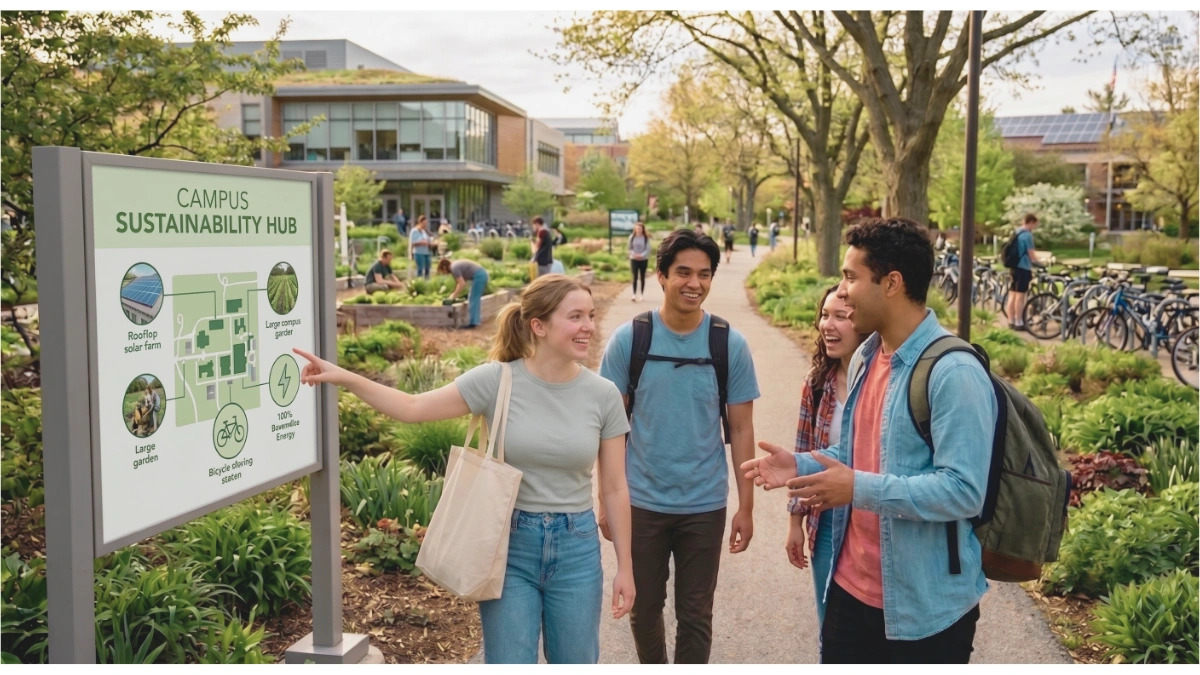
Higher education is heading into one of the most difficult enrollment periods in decades. According to the NCES enrollment data, undergraduate enrollment fell 15% between 2010 and 2021, and recovery projections remain modest. Traditional recruitment levers are losing their edge. But one area is quietly separating institutions that are holding enrollment from those losing ground: sustainable campuses.
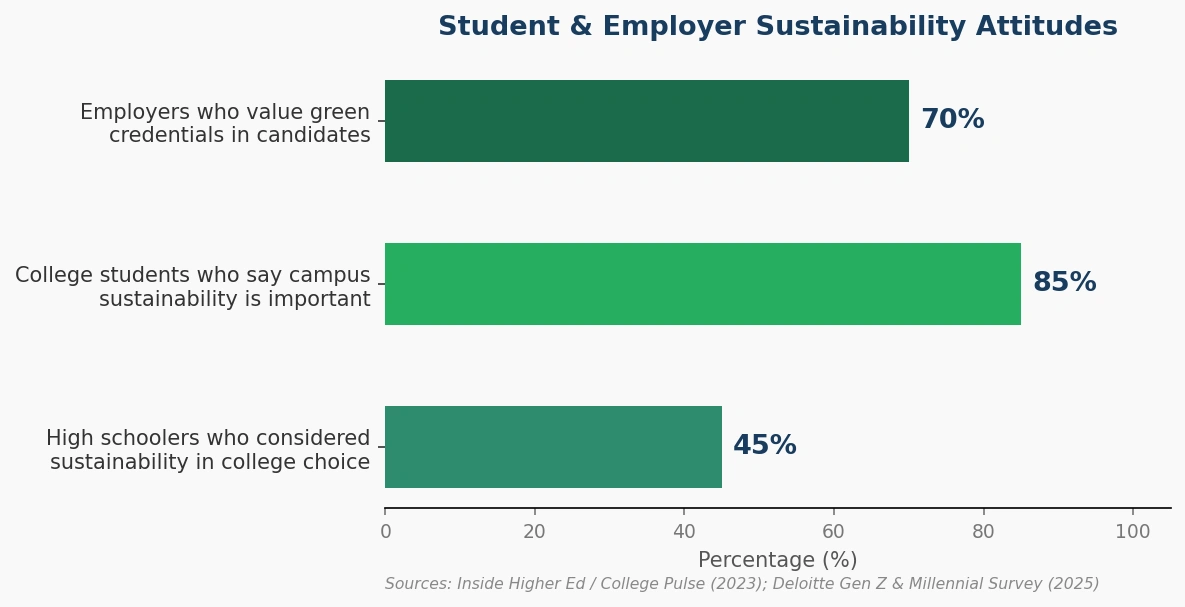
According to a 2023 Student Voice survey conducted by Inside Higher Ed and College Pulse, 45% of high school students considered environmental sustainability in their college enrollment decision, and 85% of current college students say it's at least somewhat important for their campus to prioritize it. If your institution isn't treating sustainability as a recruitment asset, you are ceding ground to those that are.
The 4 Pillars of Campus Sustainability
Before you can market it, you need to build it. A credible sustainability program covers four areas:
Operations: energy, buildings, water, waste, and food systems
Curriculum: sustainability integrated across departments, not confined to one major
Research: applied projects with measurable environmental outcomes
Community engagement: student clubs, local partnerships, and public accountability
The STARS framework (Sustainability Tracking, Assessment and Rating System), run by AASHE, is the standard measurement tool across all four areas. Operations carries the highest overall point value in the STARS system, but Curriculum is the primary differentiator for student recruitment because it directly shapes the academic experience students are paying for.
Why So Many Students Care About This
A 2021 global study published in The Lancet Planetary Health, surveying 10,000 young people aged 16 to 25 across 10 countries, found that nearly 60% described themselves as very or extremely worried about climate change, and 45% said climate anxiety negatively affected their daily functioning. That level of concern translates directly into enrollment behavior.
Your admissions office is already fielding sustainability questions from prospective students and families. The institutions that answer with specifics rather than generalities are converting more of those prospects.
A student interested in urban planning is weighing two schools with similar programs and tuition. One has a published carbon reduction target, LEED-certified residence halls, and a student-run sustainability council. The other has a short paragraph on its website about its “commitment to the environment.” That student shortlists the first school before ever scheduling a visit. This filtering is happening at scale across your applicant pool right now.
The chart below shows how strongly sustainability attitudes shape student and employer decisions.
Your campus infrastructure is a recruitment signal whether you treat it as one or not. LEED (Leadership in Energy and Environmental Design) is a globally recognized green building certification system, developed by the U.S. Green Building Council, that rates buildings across six categories: energy and atmosphere, water efficiency, materials and resources, indoor environmental quality, sustainable sites, and innovation. A 2018 GSA study of its sustainably designed buildings found they use less energy and water, cost less to maintain, and have more satisfied occupants than conventional buildings.
For leadership making the financial case internally, campus solar PV installations typically pay back in under nine years. Energy savings from retrofitting older buildings free up budget for student services, financial aid, or faculty hiring. Sustainability and fiscal responsibility are not competing priorities.
These physical assets are also underused recruitment tools. Route prospective students through LEED-certified buildings on campus tours. At orientation lunches, call out the zero-waste sorting stations. Let the infrastructure speak during the visit, not just in the brochure.
A first-year student who joins an environmental coalition in their first week is already building a sense of belonging before they’ve finished unpacking. That belonging drives retention just as much as recruitment, which means your sustainability programs are doing double duty.
Sustainability as Career Preparation
Students aren’t choosing sustainable campuses purely on principle. They’re calculating employability.
According to the BLS Occupational Outlook, environmental engineers are projected to see 4% job growth from 2024 to 2034, with environmental scientists on the same trajectory. Deloitte’s Deloitte 2025 survey of more than 23,000 respondents across 44 countries found that 70% consider a company’s environmental credentials important when evaluating a potential employer.
A biology student who spent two years on a campus-led wetlands restoration project has something concrete to show environmental consulting firms. That applied experience carries more weight than a course listing. Institutions that embed this into curriculum and research outcomes, not just elective offerings, are doing right by their students and differentiating themselves to prospective applicants at the same time.
The Pitfall of Greenwashing
This is where institutions lose credibility fast. A 2021 McKinsey survey found that 88% of American Gen Z consumers don’t trust brands’ environmental, social, and governance (ESG) claims. Your applicants apply the same scrutiny to higher education. They want evidence, not ambition.
What weak looks like: Posting a press release announcing a “zero-waste goal by 2040” with no data and no follow-up. Featuring sustainability in recruiting materials while burying your STARS score three clicks deep on a sub-page most applicants never reach.
What authentic looks like: Publishing a regularly updated public dashboard showing energy usage, water consumption, and carbon offset progress, even when the numbers aren’t perfect. Letting students lead and author sustainability reports publicly. Transparency builds trust faster than polished messaging.
The Cross-Campus Playbook
Admissions directors rarely control dining contracts or building upgrades. But you don’t need to. You need alignment with the people who do.
Form a monthly sync with your Campus Sustainability Officer. Keep marketing materials updated with recent green milestones, new STARS submissions, and completed infrastructure projects. Stale sustainability claims are almost as damaging as no claims at all.
Run a targeted yield email campaign. Send accepted students who indicated interest in environmental sciences, policy, or outdoor recreation a dedicated series on your campus eco-initiatives. These students are already primed to respond.
Audit your digital footprint. If your STARS score and Princeton Review Green Rating are buried in a sub-menu, move them to the primary admissions landing page.
Train your tour guides. “Our dining hall sources 30% of its ingredients from farms within 50 miles” lands differently than “we care about sustainability.” Specifics build credibility.
Showcase student research. Feature undergraduates working on green initiatives in recruitment mailers. Prospective students respond to peers, not to institutional voice.
What Comes Next for Your Campus
Sustainable campuses don't win students through goodwill. They win because applicants want proof, employers want green skills, and lower energy costs free up money for other priorities. The enrollment cliff is here. Schools that build real programs, track the numbers, and put that proof where applicants can see it will pull ahead of schools that don't.
 How Universities Use Zero-Waste Swap Programs to Cut Student Costs
 How Industry Partnerships Shape Modern Curricula
 How Post-COVID Aid Programs Help Universities Rebuild Admissions
 Beyond the Acceptance Rate and How Colleges Decide Who Gets In
 How Leveraging Job Placement Strategies Can Reenroll Returning Students