
Universities are racing to launch AI degree programs. Carnegie Mellon started its program in 2018. MIT followed in 2022. UPenn launched its B.S.E. in Artificial Intelligence in fall 2024. But the job market those programs prepare you for has fundamentally shifted — and the brochures won't tell you that.
What You're Actually Getting Into
Before committing to an AI degree, here's a snapshot of what the job market looks like right now:
Factor | Data Point | Source |
|---|---|---|
Median AI job salary (2024) | $157,000 | Illinois Tech |
Computer research scientist median | $171,200 | BLS, May 2024 |
Entry-level AI engineer positions | 2.5% of all postings | 365 Data Science |
Entry-level tech hiring decline (2024) | Down 25% at top 15 firms | IEEE |
2025 grads securing full-time field jobs | 30% | CNBC |
AI project failure rate | 70–85% | NTT Data / RAND |
Projected AI job growth (2023–2033) | 26% | BLS |
The pay ceiling is real, but reaching it takes years of experience you don't have yet. Plan accordingly.
The Entry-Level Problem
Entry-level hiring has collapsed. At the 15 biggest tech firms, entry-level hiring fell 25% from 2023 to 2024. UK tech graduate roles dropped 46% in 2024. Overall programmer employment in the U.S. fell 27.5% between 2023 and 2025, according to the Bureau of Labor Statistics.
Only 30% of 2025 graduates secured full-time jobs in their field, per CNBC. They submitted more applications than the previous class and received fewer offers.
The reason isn't a mystery. AI tools now handle many tasks companies previously assigned to junior employees. The work that helped new graduates learn and prove themselves is being automated first.
A 2025 IDC/Deel survey found that 66% of global enterprises plan to cut entry-level hiring due to AI automation — across media, retail, healthcare, and professional services. That's not a tech-specific problem anymore.
What an AI Degree Actually Gets You
A degree still matters. Despite talk of skills-based hiring, research shows most employers haven't followed through on promises to hire candidates without degrees. The highest-paying jobs still require credentials.
What it doesn't get you is a guaranteed job. A bachelor's in AI gives you foundational knowledge, technical skills, and a credential that opens doors — it doesn't walk you through them.
That said, the right AI skills still command serious pay. According to Glassdoor, the median total pay for AI engineers in the U.S. sits above $138,000. Senior roles at companies like Meta and Apple report ranges up to $456,000 in total compensation.
The degree level you pursue also shapes your options:
Bachelor's qualifies you for entry-level roles: data scientist, machine learning engineer, software engineer, robotics engineer
Master's opens senior roles, consultancy, and research positions
MBA in AI targets strategy, business analysis, and AI consultancy tracks
The Salary Reality
The headline numbers you see in recruiting materials are real — but context matters.
Netflix posted an AI product manager role ranging from $300,000 to $900,000. Technical director AI/ML positions have listed at $450,000 to $650,000. Those figures represent total compensation including equity, not base salary. They also require years of specialized experience no new graduate has.
A more realistic trajectory:
Entry-level AI/ML roles: $85,000–$125,000
Mid-level AI engineer (2–6 years): $125,000–$190,000
Senior AI engineer: $170,000–$300,000+
Robotics engineer median (all levels): $140,000, per Glassdoor
Most AI product managers earn $150,000 to $200,000 at senior levels. Plan for a realistic ramp, not a $900,000 starting offer.
Where Robotics Fits In
The robotics sector offers a more stable hiring picture than pure AI software roles. Michigan leads the nation with 27,632 industrial robots — 12% of the national total — per Brookings. Macomb County alone supports 30,000 robotics jobs, 253% above the national average.
The auto industry employs nearly half of all industrial robots. California leads in robotics engineer job postings. Globally, 542,000 industrial robots were installed in 2024, more than double the figure from ten years prior.
For robotics-focused graduates, the job market is more active. Top employers include Tesla, GM, Ford, Apple, and Boeing — all of which recruit directly from programs at University of Michigan (#2 globally for its M.S. in Robotics) and Carnegie Mellon (#1 for graduate programs).
Why 85% of AI Projects Fail
Between 70% and 85% of AI projects fail to meet expected outcomes, according to NTT Data. RAND puts the failure rate above 80% — twice the rate of non-AI tech projects. In 2025, 42% of companies abandoned most AI initiatives, up from 17% in 2024.
The reasons are not technical. Poor data quality is cited by 92.7% of executives as the biggest barrier. Leadership failures drive 84% of project collapses.
This creates a real career signal: companies need people who understand why AI fails, not just how to build it. Project management, communication, and strategic thinking are differentiators in this market. A technical degree without those skills leaves you exposed.
Skills That Hold Their Value
McKinsey estimates that roughly 30% of work hours could be automated by generative AI by 2030. STEM professionals face the biggest jump — automation potential rises from 14% to 30% of their work. That's not elimination, but it does mean the tasks you're hired to do will shift.
Microsoft researchers, analyzing conversations from 200,000 users of their AI assistant, identified the safest categories of work:
Physical work in unpredictable environments (plumbers, electricians, skilled trades)
Roles requiring trust and human connection (nursing, therapy, early childhood education)
Complex judgment and leadership (project managers, executives)
Nurse practitioners are projected to grow 52% from 2023 to 2033. Skilled trades face ongoing demand due to aging infrastructure.
For AI graduates, the practical implication: pair your technical skills with areas that resist automation. Communication, leadership, ethical reasoning, and domain expertise in healthcare, finance, or engineering all add resilience to your profile.
Choosing the Right Program
Not all AI programs are equal. Before committing, ask the program for graduate employment data showing job placement within six months. Check industry connections and internship pipelines. Prioritize hands-on project experience over theoretical coursework alone.
Top-ranked options include:
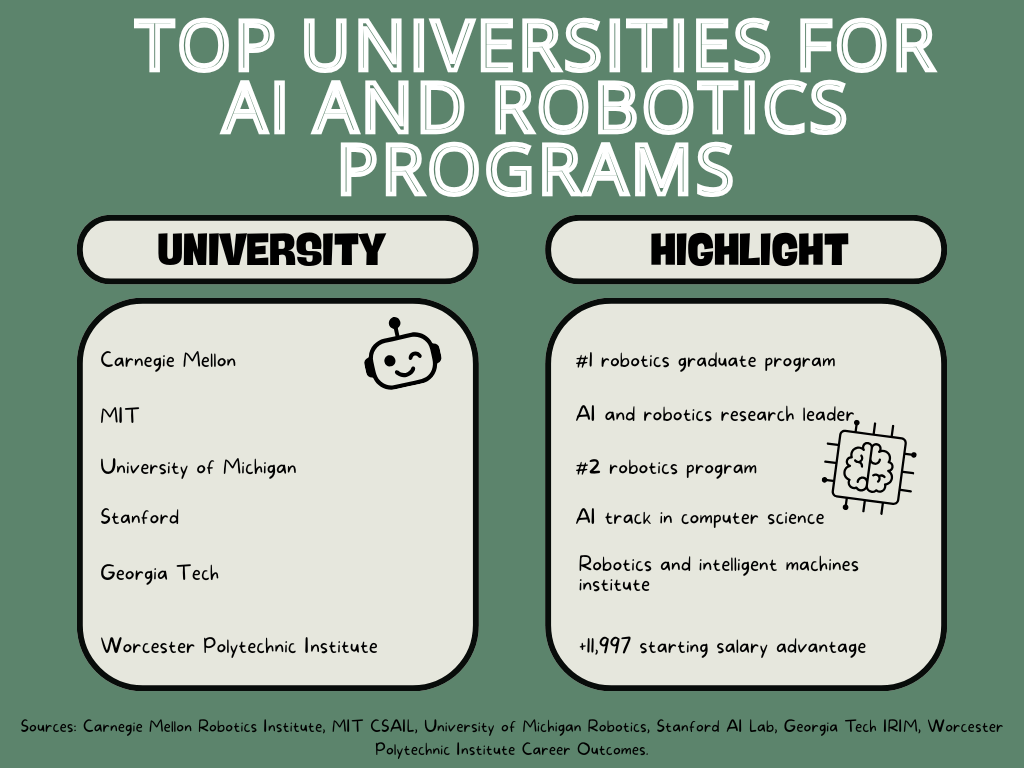
Carnegie Mellon — #1 graduate robotics program, Robotics Institute founded 1979
MIT — leading AI and robotics research
University of Michigan — #2 globally for M.S. in Robotics; strong industry pipeline
Stanford — AI/robotics track through Computer Science
Georgia Tech — Institute for Robotics and Intelligent Machines
Worcester Polytechnic Institute — graduates earn $11,997 above average starting salary
Also consider a computer science degree with an AI concentration. It offers more flexibility than a standalone AI degree and is the qualification type mentioned in nearly 61% of AI engineer job postings.
Is an AI Degree Worth It?

Compared to no degree and no plan — yes. You get foundational knowledge, a credential employers still check, and access to a job market that pays well at every level above entry.
Compared to the expectation of a guaranteed six-figure job on graduation day — no. The entry-level market has contracted. Only 2.5% of AI engineering job postings target candidates with zero to two years of experience.
The graduates who succeed combine technical knowledge with skills that resist automation. They understand why AI projects fail. They adapt as the field shifts — and it will keep shifting. Your current knowledge has roughly a 3–5 year shelf life, so build the habit of updating it.
The high salaries exist. The growth is real — the BLS projects 26% job growth in computer and information research roles through 2033, far above the 4% national average. But neither materializes without a realistic plan and the human skills no algorithm replaces.
 How Universities Use Zero-Waste Swap Programs to Cut Student Costs
 How Industry Partnerships Shape Modern Curricula
 How Post-COVID Aid Programs Help Universities Rebuild Admissions
 Beyond the Acceptance Rate and How Colleges Decide Who Gets In
 How Leveraging Job Placement Strategies Can Reenroll Returning Students