
The AI librarian is one of the newer roles showing up in academic hiring. It is also one of the more misunderstood ones. Before your institution decides to create the position, or dismisses it as a trend, it helps to understand what the role actually involves, how it fits into your existing library structure, and what happens if you ignore it altogether.
Students are already using AI tools your library may not have evaluated, faculty are asking questions your current staff may not be equipped to answer, and the Association of College and Research Libraries formally published an AI competency framework in October 2025. The question is no longer whether this matters. It is whether your institution has someone on staff who can act on it.
Question | Short Answer |
|---|---|
Will AI replace librarians? | No, but it is deeply reshaping their day-to-day operations. |
Do librarians still need a degree? | Yes, a traditional MLIS remains the foundation, now paired with AI literacy. |
What does an AI librarian do? | Delivers AI literacy programming, evaluates tools, and builds policy. |
Will AI make college irrelevant? | Unlikely. It shifts the focus from content generation to critical evaluation. |
Does your campus need one? | Dependent on your student adoption rates and faculty training gaps. |
What an AI Librarian Actually Does
Think of the AI librarian as the person on campus who sits between your students, your faculty, and the wave of AI tools now built into every major research platform.
Their day-to-day work typically covers:
Teaching AI literacy workshops for students and faculty
Evaluating new AI-powered research tools before the library adopts them
Advising on academic integrity policy as AI use in coursework grows
Managing chatbot and discovery integrations in the library system
Serving as a liaison to departments experimenting with AI in the classroom
Consider a student who submits a research paper built almost entirely on AI-generated summaries pulled from a library discovery tool, none of them verified, some of them wrong. This is not a hypothetical. It is the kind of situation that an AI librarian is specifically hired to get ahead of, through instruction, policy, and tool oversight.
At one liberal arts college, the library recently launched an Innovation Lab under its new AI librarian, running AI research guidance sessions alongside hands-on workshops on citation verification and source evaluation. The role is not just about fielding questions. It is about building campus infrastructure around responsible AI use, as documented in this AI librarian profile.
The Degree Question
A traditional librarian position requires an ALA-accredited Master of Library and Information Science (MLIS). That has not changed for AI librarian roles, but there is more on top of it.
Institutions hiring for this role are looking for candidates who can also demonstrate:
AI tool evaluation and critical assessment skills
Data literacy and basic prompt engineering
Instructional design for AI literacy programming
Familiarity with academic integrity frameworks in an AI context
It is worth being specific about what AI fluency means here, because it is often misunderstood. This is not about writing Python code or managing server infrastructure.
AI fluency for a librarian means understanding how algorithmic bias enters information retrieval systems and skews search results, how data shared with large language models (LLMs) creates privacy exposure for users, and how semantic search differs from traditional Boolean database indexing. Boolean indexing runs searches on exact keyword matches using operators like AND, OR, and NOT, rather than interpreting meaning or context. Semantic search, by contrast, tries to understand intent, which introduces new reliability and bias risks that a librarian needs to be able to explain and evaluate.
It also means knowing how to critically evaluate AI-generated content for accuracy, provenance, and citation integrity. That is a distinct skill set that sits squarely in the information science domain, not in IT.
Here is the problem: a 2024 survey of 760 U.S. academic library employees found that most staff had only a moderate grasp of AI, with the majority rarely or never using AI tools in their work. The degree alone is not going to close that gap. Your institution will need to either hire for AI fluency from the start or invest in upskilling the staff you already have.
A 2024 survey of 760 U.S. academic library employees found that 45% had a moderate level of AI literacy. Only 3.68% had high AI literacy. The majority had limited hands-on experience with AI tools.
In October 2025, the Association of College and Research Libraries (ACRL) published its AI Competencies for Library Workers, a framework built around four areas: ethical considerations, knowledge and understanding, analysis and evaluation, and use and application. It is quickly becoming the de facto hiring guide for this role.
Will AI Replace Librarians?
Short answer: no. The longer answer matters more for your planning.
AI is genuinely taking over parts of library work. Chatbots handle basic reference queries. Predictive analytics help with collection development. Automated cataloging is already standard in many systems. These are real changes, not speculation.
What AI cannot do is interpret results in context, mentor a student through a research crisis, or make judgment calls that carry ethical weight. A December 2025 post on the LSE Impact Blog argued that AI supplements library functions but does not replace the human roles that require interpretation, mentoring, and ethical oversight.
As we look toward 2028, the trajectory of AI integration across core library functions points to a significant operational shift. Over 45% of library science jobs are expected to integrate AI technologies by that point, according to Research.com's 2026 analysis of automation trends in the field. The risk for your institution is not that AI takes over, it is that your library falls behind because nobody is managing that transition.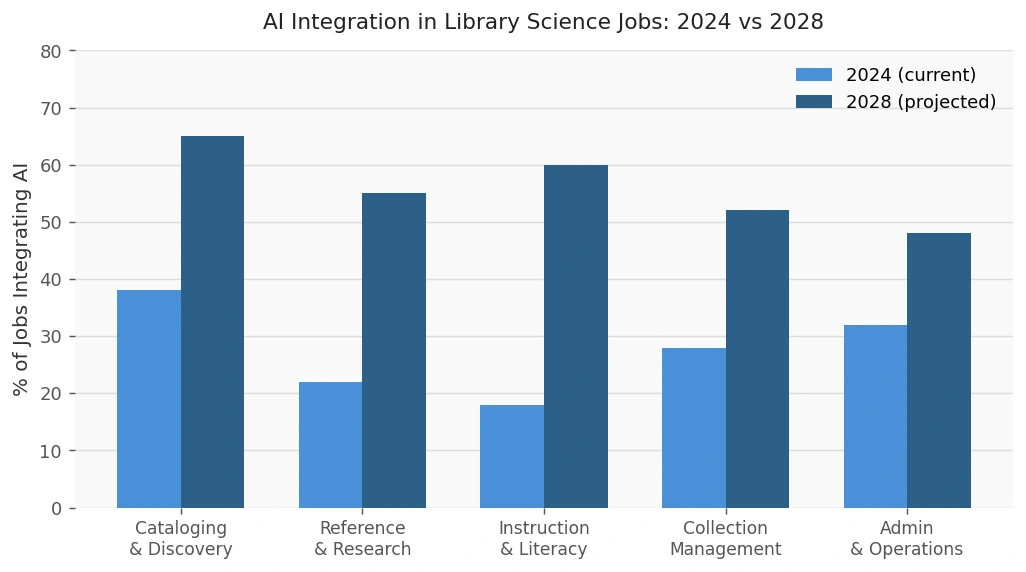
The steepest automation curves run through discovery and instruction. AI-powered discovery layers are already changing how students find sources, often returning generated summaries rather than raw database results. Instruction and research support roles follow closely, precisely because AI tools are being embedded directly into the research workflows those librarians are supposed to teach. These are the areas where the AI librarian role pays for itself fastest.
How Libraries Lead on AI Literacy
AI literacy is not a nice-to-have anymore. It is becoming a core competency your students need before they graduate, and your faculty need to teach well.
The library is the right home for it. Librarians already own information literacy instruction. AI literacy is the same skill set, updated for a new information environment.
Think about a student who signs up for a research methods course and has no idea that the AI tool built into the library database sometimes fabricates citations. Without instruction, they find out the hard way, usually right before a major assignment is due. A well-run AI literacy program catches that early.
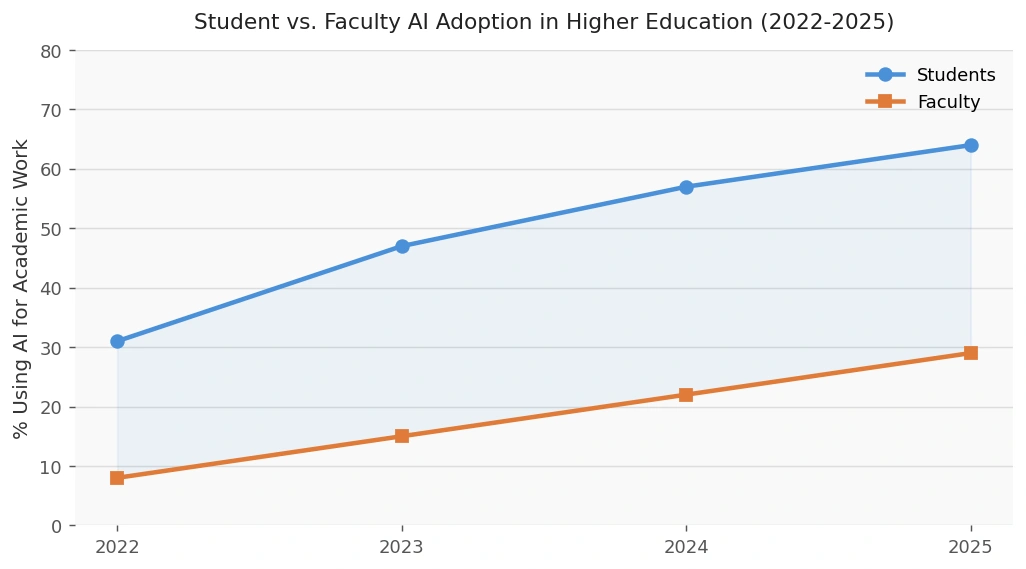
A fall 2023 Tyton Partners industry report found that almost half of higher education students were already using AI for academic work, while only about 22% of faculty were. That gap has only widened since. Students are running ahead of the curriculum, and someone on campus needs to be guiding that.
As Information Matters reported in January 2026, librarians are increasingly expected to explain how AI systems work, guide ethical and effective use, help develop institutional policy, and support faculty who are trying to integrate AI responsibly into their courses.
The adoption curves below make the scale of that divide concrete. Students have been experimenting with AI tools at nearly double the rate of faculty for two years running. The gap does not close on its own.
Where This Role Fits Institutionally
The AI librarian does not operate in isolation. In practice, the role sits at the intersection of three teams that rarely talk to each other as much as they should: the library, the IT department, and the Center for Teaching and Learning.
IT owns vendor contracts and security reviews for AI-integrated platforms. The CTL owns pedagogy and faculty development programming. Neither team typically has deep information science expertise. The AI librarian fills that gap, sitting between all three to advise on data privacy risks in AI tool adoption, flag algorithmic bias in library discovery systems, and build AI literacy programming that slots into existing faculty development workflows rather than duplicating them.
For provosts and deans, this is the key institutional argument. You are not just adding a librarian with new skills. You are creating a bridge role that makes your IT investments smarter, your CTL programming more current, and your academic departments better equipped to handle the AI tools their students are already using.
Institutions that treat this as a library-only hire tend to underutilize the role. The ones getting the most from it are embedding the AI librarian into broader campus AI governance conversations from day one.
Will College Still Matter With AI Around?
This is the question sitting underneath a lot of the anxiety about AI in higher education. If a student can generate a passable essay in 30 seconds, what exactly is a degree proving?
The honest answer is that AI raises the floor for information access, which means it raises the ceiling for what a college education has to deliver. Anyone can generate content. Fewer people can evaluate it, contextualize it, and use it to make sound decisions. That is what a degree should be training.
Your library, and by extension your AI librarian, is a visible signal to students and accreditors that your institution is taking that seriously. It is not just about checking a box. It is about positioning your campus as a place that teaches people how to think alongside AI, not just with it.
Should You Hire One?
A recent Ithaka S+R survey found that about a third of academic library deans and directors already plan to hire for AI and machine-learning roles. That number will grow.
Before opening a new line item in your budget, use this as a quick audit of your current exposure:
Coursework integration: Are departments already embedding AI tools into research methods courses?
Instructional gap: Does your current library staff have the capacity to design and run an AI literacy curriculum?
Academic integrity: Does your institution have clear policy covering generative AI use in assignments?
Faculty support: Are professors actively requesting guidance on restructuring assignments around AI?
Staffing opportunity: Has a recent retirement or restructure created an opening to shift a role toward AI work?
If you checked two or more of those, you already have a case for the role. One liberal arts college hired its first AI librarian after a long-serving reference librarian retired, and the dean noticed that every major research platform had started integrating AI features. The retirement created the budget. The timing made the decision clear.
If a new FTE is not in the budget, that is not the end of the conversation. Upskilling existing staff using the ACRL competency framework is a proven lower-cost alternative. The framework is free, built specifically for this transition, and flexible enough to apply across different library sizes and structures. Several institutions have used it to reskill two or three existing librarians rather than creating a new position, and the results are comparable for all but the largest research libraries.
What This Means for Your Institution
You do not have to hire a dedicated AI librarian tomorrow. You do need a plan, though. The institutions building that infrastructure now will be better positioned when accreditors, students, and faculty start expecting it everywhere.
 The Real Economics Behind Entry-Level Gigs
 Can 3-Year Degrees Solve the Teacher Shortage?
 Does College Public Speaking Really Matter in Today’s Job Market?
 Strategies for Communicating Tuition and Outcomes to Prospective Students
 How Politics Is Shaping College Enrollment