
Fraud is draining millions from higher education. AI-generated essays are flooding application portals, while “ghost students” collect financial aid they never earned. These are no longer edge cases; they are the daily reality for admissions teams across the country. Ironically, AI in college admissions has become both the catalyst for this crisis and the most effective tool to fix it.
Admissions officers and higher education leaders can strategically deploy AI to protect institutional integrity while avoiding the pitfalls of automated gatekeeping.
Challenge | What AI Does | Risk if Ignored |
|---|---|---|
Application fraud | Detects fake identities and bot submissions | Financial aid depletion, severe enrollment data distortion |
Essay authenticity | Flags AI-generated writing patterns | Admitting unqualified applicants, erosion of institutional reputation |
Bias in review | Audits for inconsistent human decisions | Civil rights litigation, Title IX/Title VI non-compliance |
Student data privacy | Controls access to sensitive records | FERPA violations, data breaches |
It’s Already in the Essays
The policy landscape is a mess. A 2025 Kaplan survey of over 200 admissions officers found that only 2% of colleges officially allowed generative AI for essay writing, 30% banned it outright, and 68% had no policy at all.
The Common App updated its Fraud Policy in 2024 to classify AI-generated essay content as fraud. But without consistent institutional policies, enforcement remained uneven. When the same AI-written essay got submitted to several schools, some flagged it and some didn’t. That inconsistency was exactly the problem the sector tried to solve.
Detection spread quickly. Surveys from 2023 showed about 28% of four-year colleges were using AI detection tools in early 2023, climbing to nearly 40% by mid-year, with another 35% actively considering implementation for the 2024–2025 cycle. By 2025, AI involvement in admissions review had become increasingly normalized, though transparency about exactly how it was used remained limited across the sector.
Stopping Application and Financial Aid Fraud
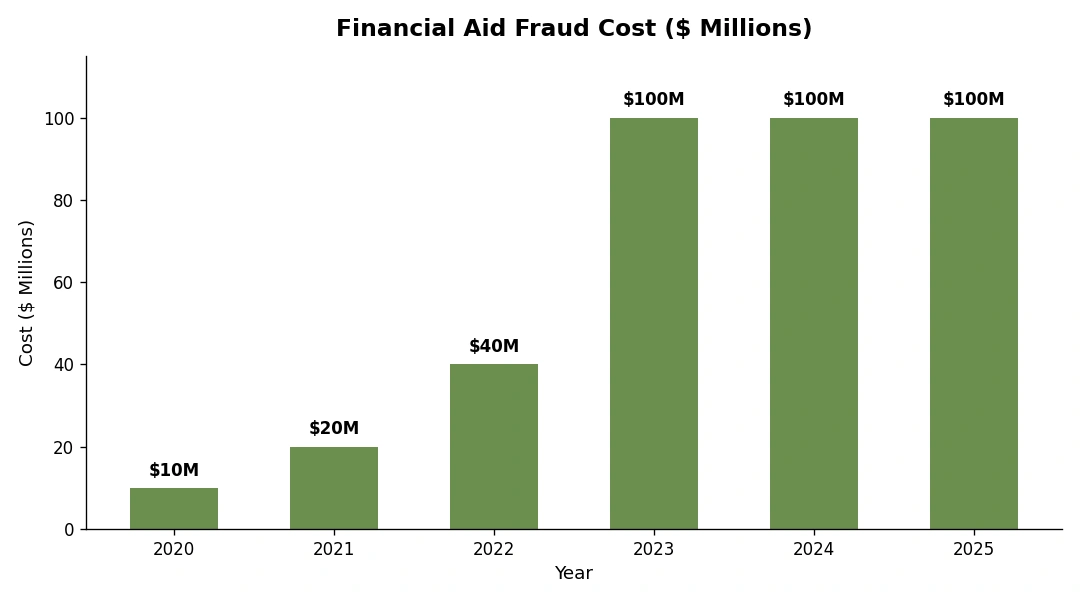
The U.S. Department of Education reported that nearly $90 million in federal aid was disbursed to ineligible recipients in 2025, including more than $30 million to deceased individuals over three years. LexisNexis Risk Solutions put the annual cost of financial aid fraud at $100 million by 2023, up from roughly $10 million before 2020. The chart below tracks how that cost grew.
Community colleges took the hardest hits. California community colleges reported that at least 31% of applicants statewide were fraudulent in 2024, costing institutions more than $11 million in financial aid that year alone.
AI tools fought this at scale by cross-referencing applicant data across databases in real time, detecting bot-submission patterns, running biometric identity checks, and flagging ghost students who enrolled to collect aid but never attended class. At institutions where bot submissions flooded course registrations and left legitimate applicants on waitlists, AI triage tools cut resolution time significantly.
Catching Altered Transcripts
Altered transcripts are a persistent fraud vector that identity checks alone won’t catch. AI-powered document integrity tools scan each submission for manipulation signals before a credential evaluation or admissions decision moves forward.
Common indicators include digital compositing, where an element has been placed over a scanned document to obscure or replace content; overlay elements with inconsistent texture or contrast; ink density variation across pages, particularly in stamp or signature areas; and photo elements that cover printed text with no physical attachment evidence such as tape marks or staple shadows.
No single signal is conclusive. Layered analysis surfaces combinations that reviewers can act on. Scholaro’s Document Integrity Score uses this approach, assigning each transcript a score from 0 to 100 across Low, Medium, and High risk tiers. When a file flags as high-risk, procedures should require secondary verification directly with the issuing institution or Ministry of Education before the application advances to review.
The False-Flag Problem
Research has consistently found that international students and certain racial and ethnic groups are significantly more likely to be falsely flagged by AI detection tools. For admissions offices, this is not an edge case. It is a documented equity failure built into the detection infrastructure itself.
A non-native English speaker who writes clean, precise prose is at measurable risk of having their essay flagged as machine-generated. Without a human review layer and a clear escalation process, that student may be penalized for writing well in a second language. Institutions that deployed AI detection without accounting for this bias made decisions with legal, ethical, and reputational consequences.
AI should support human judgment in essay review, not substitute for it. That means building a clear escalation path: when a tool flags a submission, a human reviewer makes the final call, not the algorithm.
Reducing Bias in the Review Process
One of AI’s genuine strengths is consistency. Human reviewers have good days and bad days. They carry blind spots. AI doesn’t get tired.
Data-driven platforms evaluate applicants across academic records, extracurricular involvement, leadership roles, and community activities, reducing the weight of any single factor. AI can also flag patterns in which applicant groups are being advanced or screened out, giving institutions a systematic check that’s hard to replicate manually at scale.
No AI system is bias-free out of the box. The data it’s trained on reflects past decisions, and past decisions often carry the biases institutions are trying to move away from. Ongoing auditing isn’t optional. It’s the mechanism that makes the rest of this work.
Protecting Student Data
A common and costly mistake is using consumer-grade AI tools to process student information. As generative AI spreads, the risk of improper disclosure of FERPA-protected data grows. Public AI tools can share restricted student records with outside users and potentially use them to train their own models.
Check Point Research found that in Q2 2025, educational institutions faced an average of over 4,300 cyberattacks per organization every week, more than double the global average across all industries. Sound data practice means using only institution-approved platforms, never entering student records into open AI systems, assigning data access by role, and documenting every AI touchpoint in the admissions workflow.
Making AI Work Responsibly
Buying an AI tool is the easy part. Making it work without creating new problems takes deliberate effort. Successful integration requires transparency about what AI is doing and where humans stay in the loop, staff training so reviewers can interpret outputs critically, regular bias auditing, and clear policies for applicants about what AI use is and isn’t permitted.
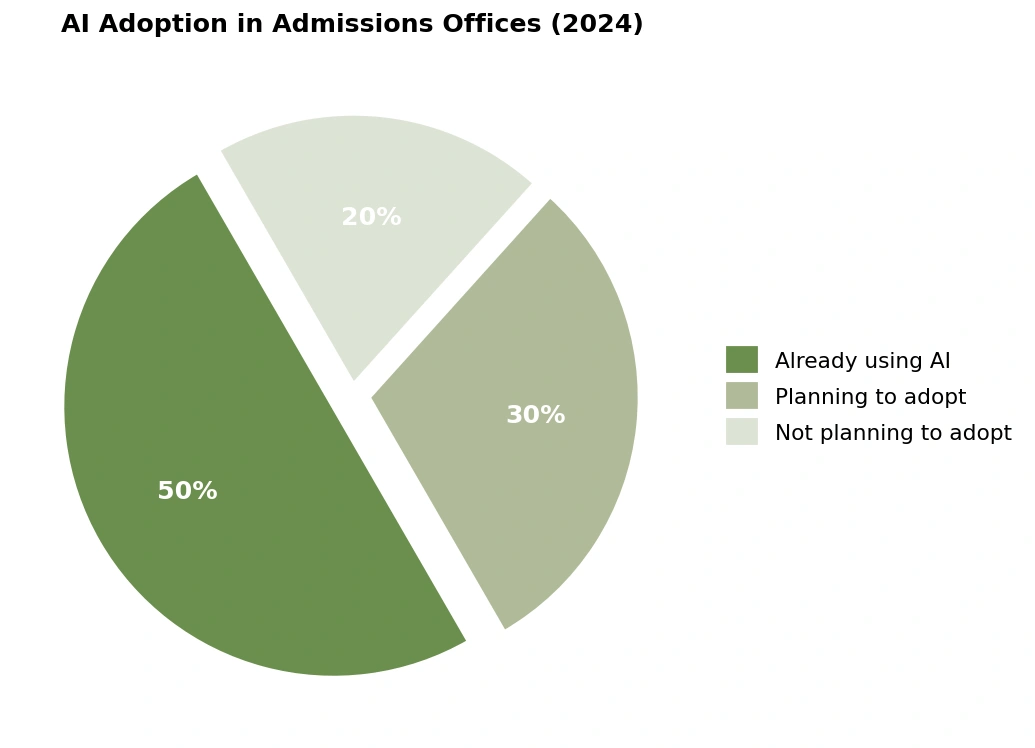
Around 50% of admissions offices were already integrating AI into their review processes by 2024, with another 30% planning to follow. Adoption without accountability creates a new category of risk. The institutions getting this right treated AI as a tool that informed human decisions, not one that made them.
Fast Facts
The U.S. Department of Education disbursed nearly $90 million in aid to ineligible recipients in 2025
California colleges identified over 31% of 2024 applications as fraudulent using AI detection
Only 30% of colleges had a formal policy banning AI-written admissions essays as of 2025
AI document integrity tools score transcripts for signs of manipulation, fabrication, and fraud
AI detection tools carry documented bias risks, particularly for international applicants
Entering student data into public AI tools risks FERPA violations and data exposure
AI is neither the problem nor the solution in higher education admissions; it is a reflection of how institutions choose to use it. By pairing automated detection with rigorous human oversight, clear data boundaries, and continuous bias auditing, admissions leaders can protect their institutions against modern fraud while keeping the process fair for the students it is meant to serve.
 The Real Economics Behind Entry-Level Gigs
 Can 3-Year Degrees Solve the Teacher Shortage?
 Does College Public Speaking Really Matter in Today’s Job Market?
 Strategies for Communicating Tuition and Outcomes to Prospective Students
 How Politics Is Shaping College Enrollment