Indicator | Pre-pandemic | 2024 Status |
|---|---|---|
Grade-level achievement gap (math & reading) | Baseline | Nearly half a grade level behind |
Chronic absenteeism rate | ~15% | ~21% (down from 29% peak) |
High-dosage tutoring learning gain | Baseline | +0.33 grade levels per year |
Academic probation outcomes (structured programs) | - | 7% drop in suspensions; 3% rise in good standing |
Student academic recovery is one of the defining challenges in higher education right now. If you work in admissions, advising, or institutional leadership, you are seeing it up close: students arriving underprepared, more first-year probation cases, and support services under strain. According to the Education Recovery Scorecard, a collaboration between Harvard, Stanford, and Dartmouth, the average U.S. student in 2024 remained nearly half a grade level behind 2019 achievement levels in both math and reading.
Think of a student who missed a full year of foundational math during COVID. They are now in a college classroom trying to keep up with peers who did not have the same gaps. That gap did not close on its own. It followed them here.
This article covers what the evidence says actually works, and what institutions can do right now.
What the Pandemic Left Behind
No state scored above 2019 levels on the National Assessment of Educational Progress in both math and reading in 2024, according to the Education Recovery Scorecard. The gap is even worse for students in low-income districts, where high-income districts are nearly four times more likely to have recovered in both subjects.
This is not a K-12 problem that resolves itself at the college gate. The students in your classrooms today were in middle school when schools shut down. Their foundational gaps are real, and traditional academic support was not built for recovery at this scale.
3 High-Impact Strategies for Recovery
1. High-Dosage Tutoring
High-dosage tutoring (HDT) is the most consistently supported intervention in the research. According to the Harvard Strategic Data Project, students who receive tutoring gain about a third of a grade level per year. Over three years, that adds up to a full extra year of learning.
HDT works best when it is built into the schedule, delivered in small groups, targeted at students with the largest skill gaps, and tracked with regular data. NWEA's 2024 review identified program fidelity and tutor training quality as non-negotiable factors, especially for at-risk students.
2. Double-Dose Classes
Double-dose instruction pairs a core course with a supplemental session covering the same content in more depth. A student struggling in college-level math attends both the regular class and a co-requisite support session. The catch-up happens alongside the main course, not instead of it. Students do not lose time, and they do not fall further behind on credits.
3. Mastery-Based Remediation
Mastery-based modules let students target specific gaps rather than repeat entire courses. Often self-paced and online, they suit students balancing work or family commitments. A student who failed a writing course because of citation skills does not need to redo grammar they already know. They need a focused path to the one thing holding them back.
The chart below shows estimated annual learning gains across the main intervention types: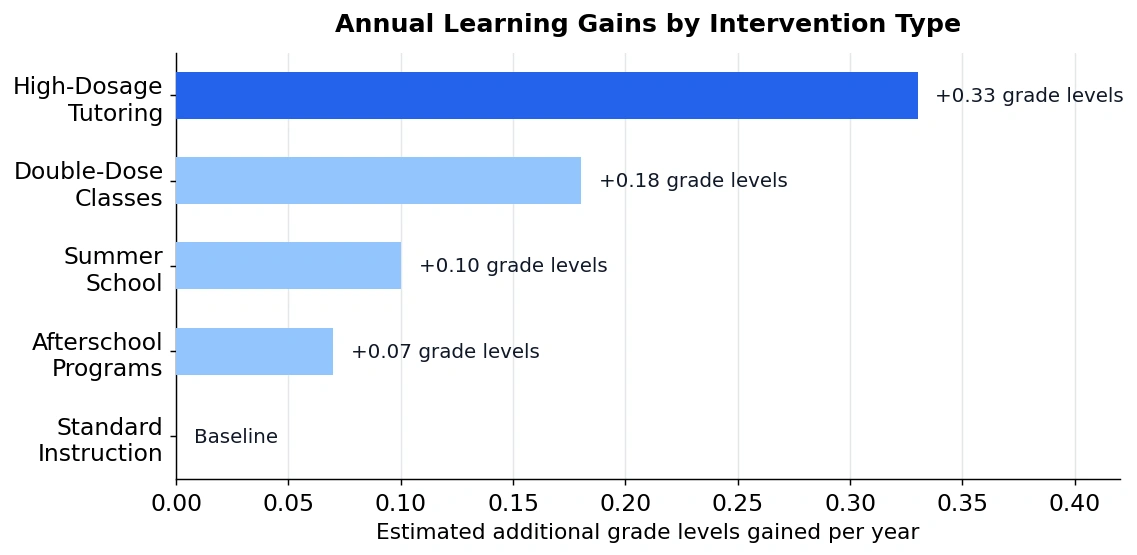
Build Systems That Catch Students Early
Individual interventions only work if your institution connects students to them at the right moment. Most campuses find out a student is struggling at midterms, when the damage is already done.
Effective recovery frameworks share these features:
Early alert systems that flag attendance drops or missed work in the first three weeks
Curriculum dashboards mapping student progress against benchmarks so advisors spot gaps before they become failing grades
Structured probation programs that require engagement, not just awareness
Advisor check-ins tied to specific action steps
One structured probation program reported a 7% decrease in academic suspensions and a 3% increase in students regaining good standing in its first year, according to Inside Higher Ed. The key was requiring students to actively engage with support resources rather than leaving participation optional.
Addressing Chronic Absenteeism
You cannot recover academically if you are not showing up. Absenteeism is quietly undermining recovery efforts nationwide.
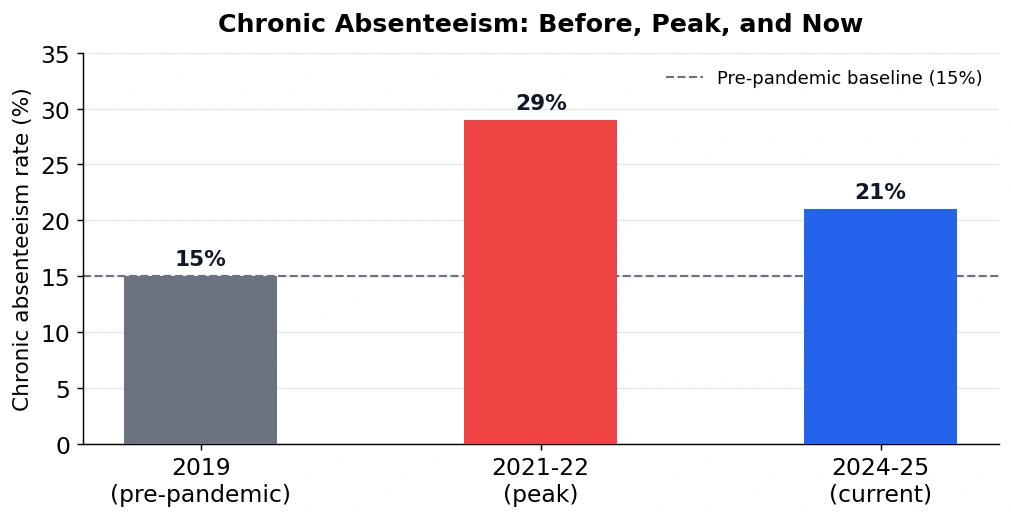
According to research from Attendance Works and the Everyone Graduates Center at Johns Hopkins University, 1 in 5 students remained chronically absent in 2024-25. That is an improvement from the 2021-22 peak of 29%, but still well above the pre-pandemic baseline of 15%. Research tracking NC student data found that each additional absent day correlates with a measurable drop in math achievement.
Common drivers include financial pressure, mental health challenges, transportation barriers, and disconnection from campus. A generic automated reminder does not do what a direct message from an advisor or faculty member does. Data from Frontline Education shows that districts using early warning indicators report chronic absenteeism rates of 14%, compared with 21% in districts not tracking them at all.
The chart below shows chronic absenteeism trends before, during, and after the pandemic peak:
Imagine a student who misses three weeks during a family crisis. Without a proactive outreach from an advisor, they stop logging in and quietly disenroll. That one contact before the absence compounds is often the difference between staying and leaving.
Summer and Afterschool Programs
More structured learning time is one of the most practical recovery tools available. The RAND Corporation's October 2025 report, sponsored by The Wallace Foundation, found strong evidence for structured summer programming, particularly for low-income students where the summer slide hits hardest.
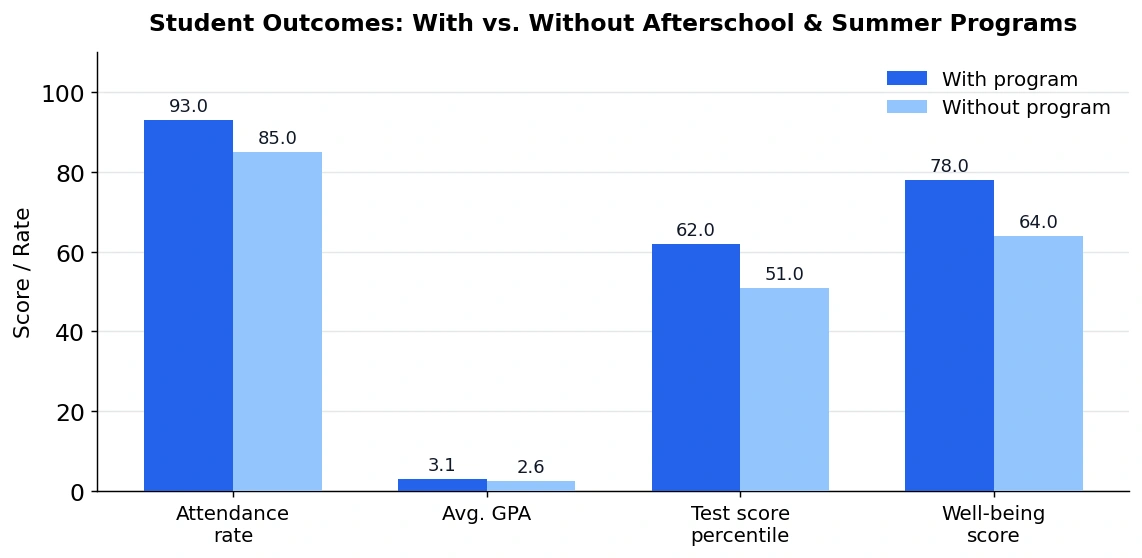
A 2024 study presented at the Mott Afterschool State Networks found that sustained participation in quality afterschool and summer programs is linked to better attendance, grades, test scores, and well-being. One summer does not do it. Programs students return to year after year produce the clearest outcomes.
For universities, the practical moves are:
Build credit-bearing summer bridge programs for incoming students showing academic risk
Recognize summer program participation in admissions review as evidence of engagement and effort
Use What Already Exists
Institutions do not have to fund everything from scratch. Two resources worth knowing:
21st Century Community Learning Centers: A federal program distributing roughly 1.3 billion dollars annually to afterschool and summer programs, serving around 1.4 million students each year via state education grants, according to the American Institutes for Research.
HDT Data Toolkit: Released in October 2025 by the Harvard Strategic Data Project and Accelerate, this is a free HDT toolkit for assessing and scaling tutoring programs across different campus contexts.
A Note for Employers
A candidate whose transcript shows a rough period followed by a clear upward trend is not a red flag. Evaluating the last 60 credits rather than the four-year cumulative GPA gives you a more accurate picture of who will actually show up and perform. The academic recovery story is a talent pipeline story too.
Wrapping Up
Student academic recovery is not one program. It is a system: early alerts, targeted tutoring, attendance support, and extended learning time working together. The evidence for what works is solid. Start with the highest-impact moves, use available federal resources, and treat struggle as recoverable rather than final.
High-dosage tutoring produces roughly one extra year of learning over three years, making it the strongest single recovery intervention available to institutions today.
Chronic absenteeism peaked at 29% in 2021-22 and remains above pre-pandemic levels at 21%, with each additional absence measurably reducing academic achievement.
Early alert systems and structured probation programs reduce suspensions and increase the share of students who regain good standing before withdrawal.
Sustained participation in afterschool and summer programs improves attendance, grades, test scores, and student well-being across multiple years of engagement.
Admissions teams and employers who assess academic recovery trajectories rather than cumulative GPA alone make more accurate and equitable decisions.
 The Real Economics Behind Entry-Level Gigs
 Can 3-Year Degrees Solve the Teacher Shortage?
 Does College Public Speaking Really Matter in Today’s Job Market?
 Strategies for Communicating Tuition and Outcomes to Prospective Students
 How Politics Is Shaping College Enrollment