
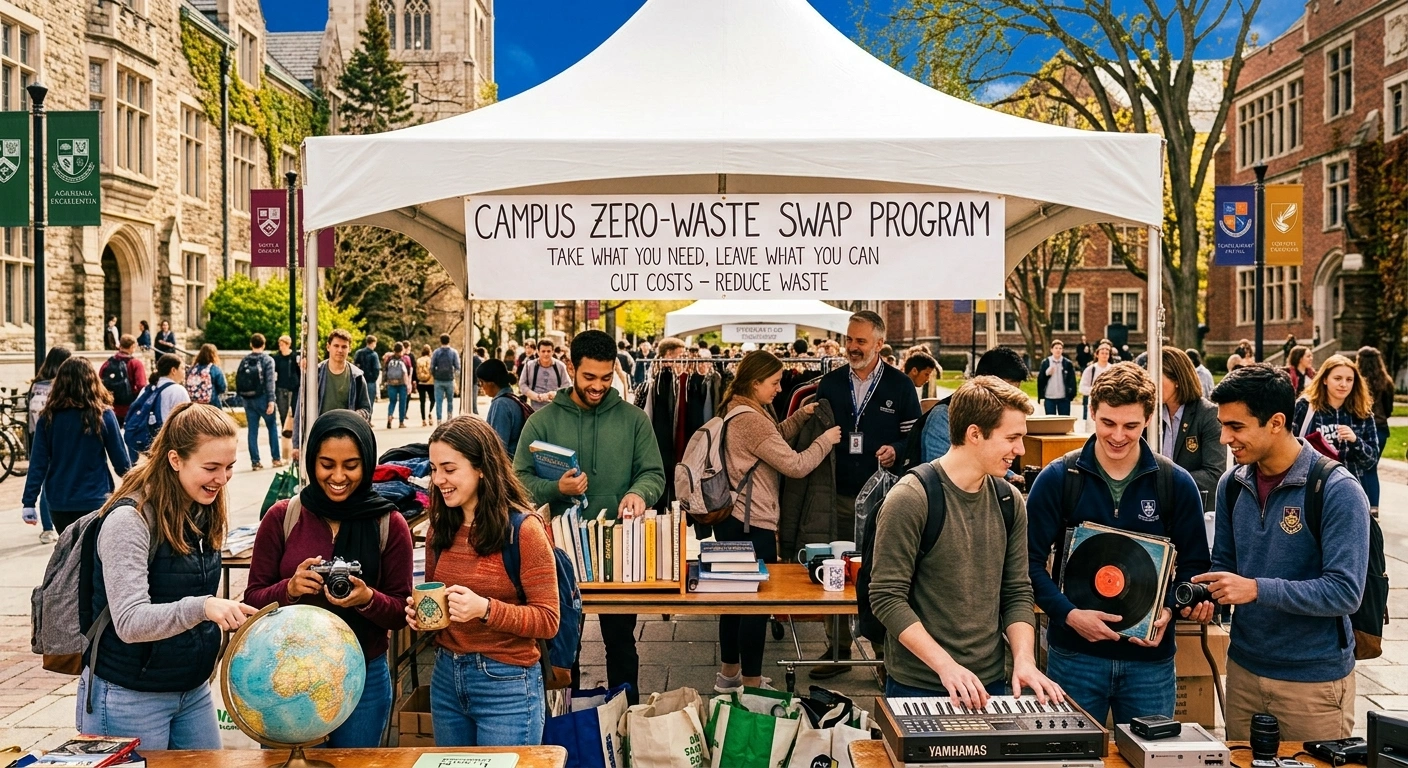
Swap shops are gaining ground on college campuses across the country. The concept is straightforward: students donate items they no longer need, and other students take what they can use. No purchase required. The result is less waste, lower costs for students, and a practical addition to existing campus sustainability efforts.
A swap shop can take several forms, from a dedicated room to a set of collection bins during move-out week. Students drop off items such as clothing, small appliances, and furniture, and pick up what they need at no cost. The concept is simple, but the reported impact on waste diversion is substantial.
Program Type | Typical Scale | Reported Diversion |
|---|---|---|
Move-out donation drives | Semester-end residence hall collection | About 20,000 pounds of goods collected annually at one large campus |
Standing swap shops | Year-round walk-in space | About 560 pounds diverted in one semester at one campus |
Textile-specific exchanges | Ongoing collection, clothing only | Over 220 tons diverted over five years at one campus |
Food waste diversion | Dining hall composting or digestion | 137 tons diverted in one year at one campus |
National aggregate (all methods) | ~1,100 participating campuses | 29.4 million pounds diverted in 2023, per Campus Race to Zero Waste |
Figures reflect individual program reporting cited in campus sustainability case studies and the National Wildlife Federation's Campus Race to Zero Waste program. The national aggregate spans recycling, composting, and donation combined, not swap programs alone.
These figures reflect four distinct program models, each with a different operational footprint.
Four Models for Reducing Campus Waste
Most swap initiatives fall into one of the following categories:
Move-out collections. Campuses set up donation stations in residence halls at the end of each semester so students can donate items instead of discarding them.
Standing swap shops. A dedicated, year-round space functioning as a free exchange point for donated goods.
Redistribution partnerships. Unclaimed items are routed to local charities or food banks rather than sent to a landfill.
Niche exchanges. Some institutions run category-specific swaps, such as textiles or laboratory equipment, where volume is highest.
A student, for example, might donate a mini fridge they no longer need along with clothing that no longer fits, and leave with a working fan and a winter coat. The exchange requires no payment and keeps usable items out of the waste stream.
The Financial and Environmental Case for Swap Shops
These programs deliver value on two fronts.
Direct cost savings. Furniture, appliances, and clothing that would otherwise cost students hundreds of dollars are available at no charge, a pattern Inside Higher Ed reporting has documented at campus thrift stores nationwide.
Reduced landfill waste. According to Campus Race to Zero Waste, participating campuses diverted more than 29 million pounds of waste through donation, composting, and recycling combined in 2023 alone.
A visible model of reuse. Access to a functioning exchange system gives students a tangible alternative to purchasing new items.
Most Programs Begin With Student Initiative
Many swap programs originate with students rather than administrators. A recurring pattern across campuses is a small group of students responding to visible waste during move-out season by organizing an informal collection point.
A student, for example, might notice the volume of discarded items during move-out week and organize a collection table in a residence hall lobby. Programs that begin this way often gain institutional support once their impact becomes measurable.
Over time, many institutions formalize these student-led efforts with dedicated space, staffing, or budget. The typical progression is student initiative first, followed by institutional backing. The Earth & I has covered several such programs as part of the broader growth in campus swap shops.
How Access to Free Items Shifts Student Behavior
Participation in a swap program tends to change how students approach acquiring goods. Once a student has furnished a room through donated items, purchasing new becomes a less automatic choice.
Reporting from local news coverage of one campus swap event found that more than 1,800 students attended over a few days, with donated items including approximately 155 microwaves. Turnout at this scale indicates meaningful student demand rather than a niche interest.
Relevance for International Education
Swap programs carry particular relevance within international education. Students arriving from abroad often face higher setup costs than domestic peers, since they typically cannot bring furniture, appliances, or seasonal clothing with them and must acquire these items locally in a short window after arrival.
A student, for example, arriving from overseas for the first time might rely entirely on a campus swap shop to furnish a dorm room, avoiding a significant upfront expense during an already costly transition. International student services offices are increasingly positioned to point new arrivals toward these programs as part of standard orientation guidance.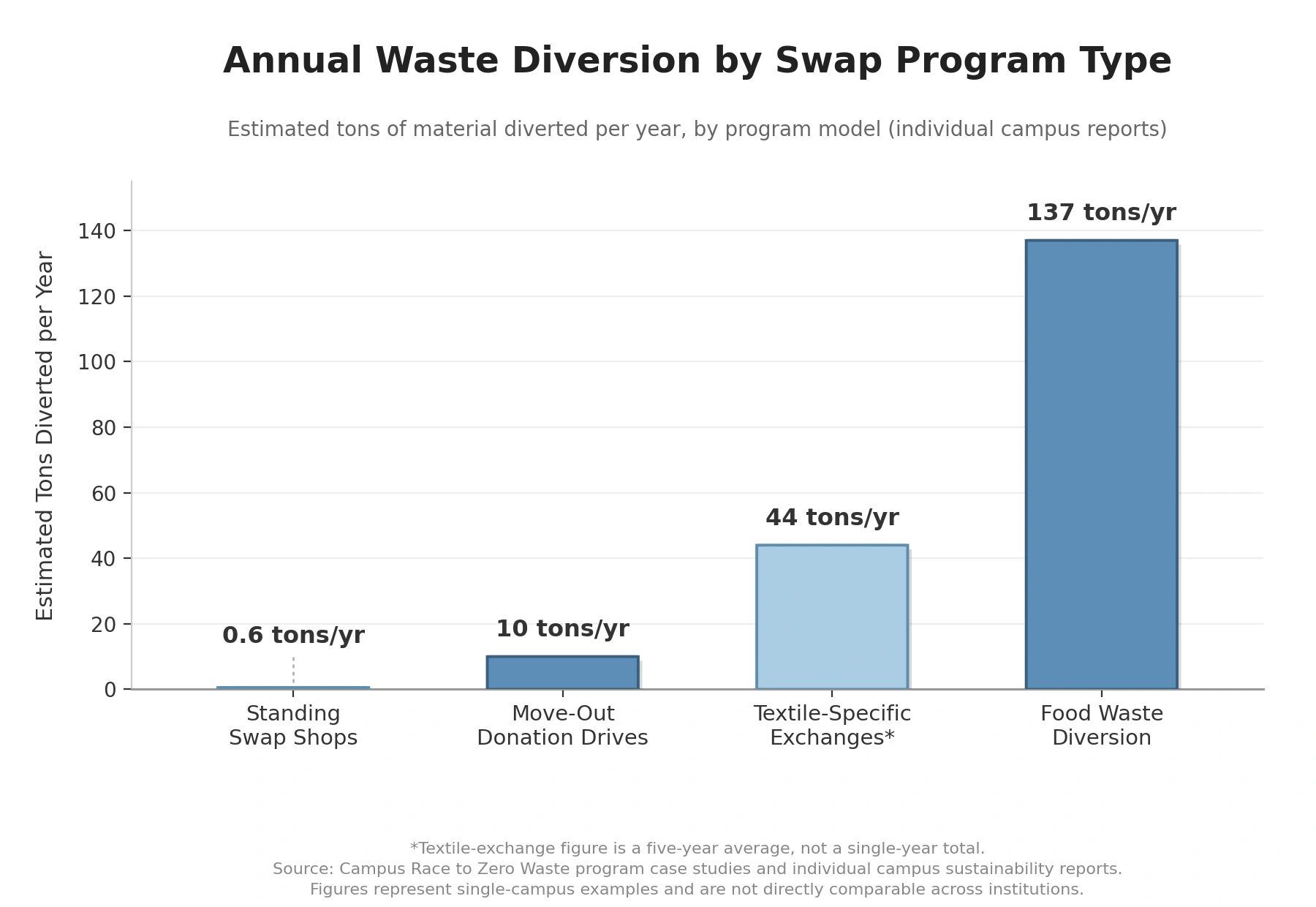
These programs also align with sustainability priorities that many international education offices already track, since diverting waste and reducing new consumption are goals shared across institutions working with global student populations.
Integrating Swap Programs Into Existing Sustainability Efforts
A swap program does not need to operate as a standalone initiative. It complements infrastructure most campuses already have in place, including recycling programs, composting systems, and seasonal recycling events.
Campuses with the following in place are well positioned to add a swap program with minimal additional infrastructure:
Recycling collection in common areas
Composting in dining facilities
Seasonal recycling or donation events
Adding a swap component extends existing sustainability efforts rather than requiring a new operational framework.
Steps to Establish a Swap Program
Institutions looking to launch or expand a program can follow a straightforward sequence:
Start with a single collection point. Launch in one residence hall or high-traffic location before expanding.
Establish a charity partnership. Items that go unclaimed should be routed to a local nonprofit rather than disposed of.
Track diversion data. Weighing and logging donated items supports sustainability reporting and future budget requests.
Maintain student leadership. Programs tend to perform best when students manage day-to-day operations, with administrative support rather than oversight.
It's worth noting that some programs cost more to operate than standard disposal would. Staffing, storage, and logistics account for part of that cost, and a significant portion comes from sorting. Not every donated item is usable, and volunteers or staff must inspect, clean, and dispose of unusable items separately, which adds labor beyond running the exchange itself. Institutions that have implemented these programs generally report that the cost is offset by reduced waste and improved student outcomes.
A Practical Model for Reducing Campus Waste
Swap programs require modest startup investment, scale with demonstrated demand, and reduce both costs for students and material sent to landfills. A single collection point can grow into an established program with measurable waste diversion and cost savings for the student body.
 5 ways colleges can make career prep 'unavoidable' for students
 The Real Economics Behind Entry-Level Gigs
 Can 3-Year Degrees Solve the Teacher Shortage?
 Does College Public Speaking Really Matter in Today’s Job Market?
 Strategies for Communicating Tuition and Outcomes to Prospective Students