In late August, many district HR offices are still scrambling to staff classrooms. School starts in a week. Some rooms still have no teacher.

That pressure explains why 3-year teaching degrees are getting serious attention from college leaders. The model trims a 120-credit degree to 90 credits. Students save a year of tuition. New teachers reach classrooms a year sooner.
The benefits are real, and so are the limits. If you're weighing a 3-year program, you'll want a clear view of both before committing faculty time and accreditation resources.
The Scale of the 2026 Teacher Shortage
The deficit is large, and preparation programs are struggling to keep pace.
The Learning Policy Institute's latest shortage update counts at least 425,412 affected teaching positions. That's roughly 1 in 8 teaching jobs nationwide. Each one was either vacant or filled by a teacher not fully certified for the assignment.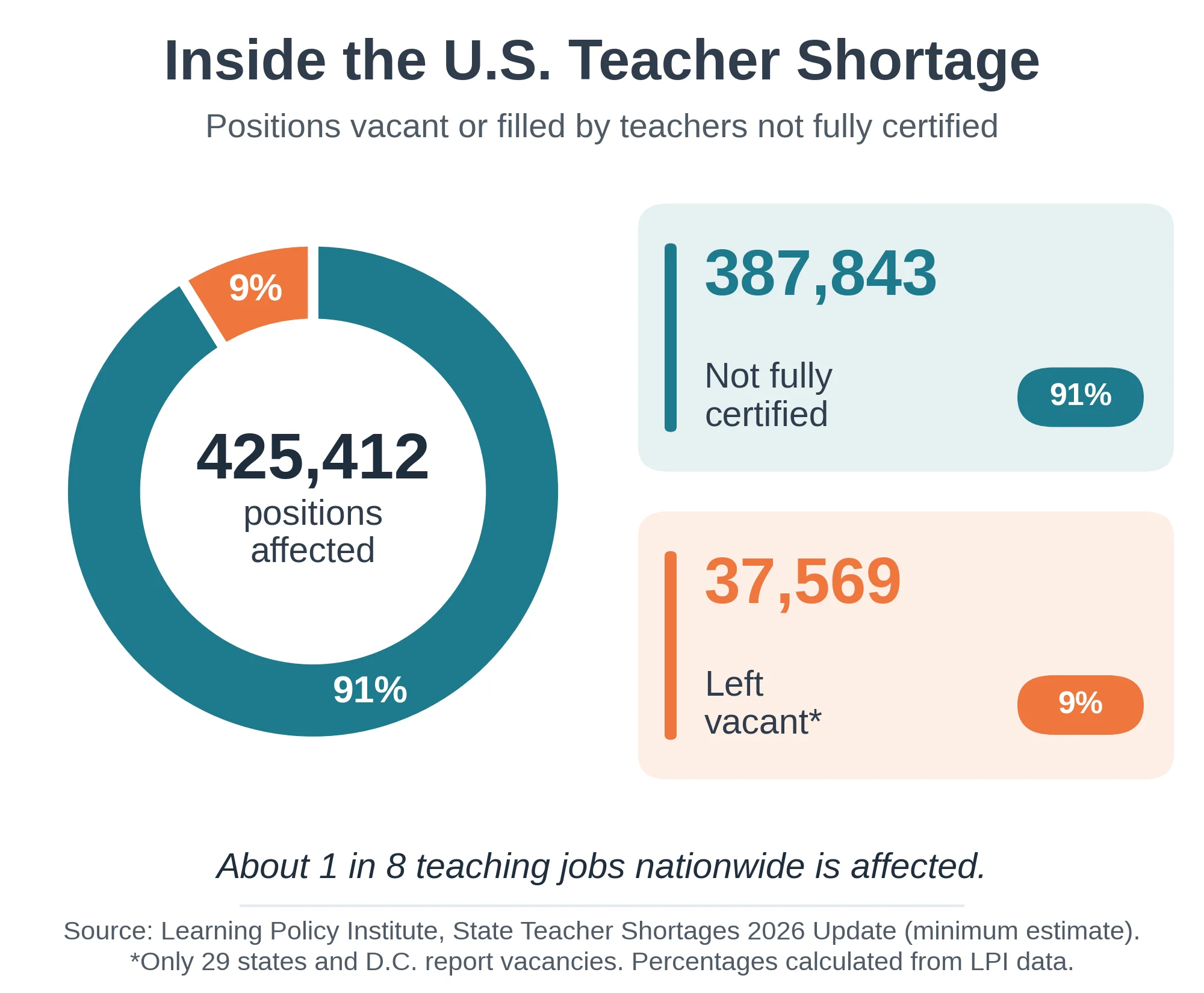
Most of those positions weren't empty. About 387,843 were filled by teachers without full certification. Another 37,569 sat vacant, though only 29 states and D.C. report vacancy data. State rules typically allow uncertified hires only when no fully certified teacher is available, so the large uncertified count signals a hidden shortage.
The gaps cluster in tough-to-staff subjects. The institute's shortage fact sheet shows 45 states reporting shortages in special education. Science shortages appear in 41 states, and math shortages in 40.
Fewer people are training to fill those roles, too. The American Association of Colleges for Teacher Education found teacher prep enrollment fell 33% over a decade. By 2022-23, it was down to 407,556 students, according to coverage of the education degree decline.
Comparing 3-Year and 4-Year Teaching Degrees
The table below reflects programs announced so far.
Factor | 3-Year Degree | 4-Year Degree |
|---|---|---|
Credits required | 90 | 120 |
Time to the classroom | One year sooner | Standard timeline |
Tuition saved | About $11,000 (public) to $26,000 (private) | None |
State certification | Met, per programs announced so far | Met |
What gets cut | Electives, general education, redundant coursework | Nothing |
States With the Deepest Gaps
No single state holds the "worst shortage" title. Rankings shift depending on what you count: raw vacancies, vacancies per student, or uncertified hires.
Arizona offers one of the clearest pictures. Its Department of Education counted more than 4,200 vacant teaching positions in fall 2025, according to a report on the statewide vacancy count.
Rural districts are hit especially hard, according to the Learning Policy Institute. It also found turnover runs 35% to 37% higher in schools serving the most low-income students and students of color.
Race, Ethnicity, and Who Can Afford to Teach
Teacher supply also depends on who can afford to enter the profession.
TNTP, an education research nonprofit, analyzed district data from every state, mostly from 2022-23. Its teacher diversity data shows 55% of students are people of color. Only 22% of teachers are.
The imbalance varies by group. There are about 8.5 White students for every White teacher. For Black students, the ratio is roughly 25 to 1. For Hispanic students, it's about 44 to 1. And in nearly 23% of schools, students have no teacher of color at all.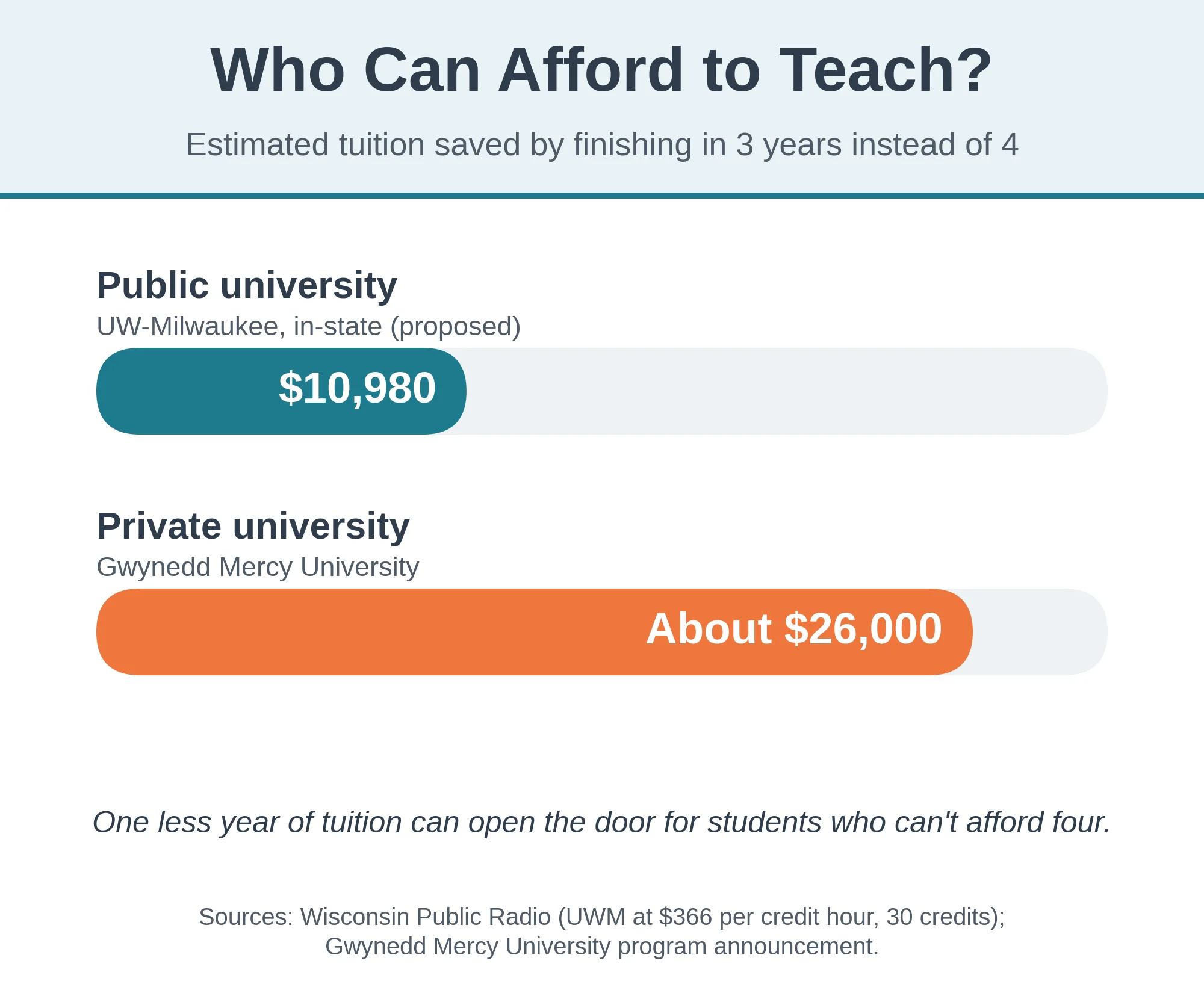
TNTP calls educator diversity "a proven catalyst for stronger connections, richer learning experiences, and improved outcomes for all students."
Pay gaps continue after hiring. A RAND analysis found Black teachers earned an average of $65,013 in 2023-24. White teachers averaged $70,695.
Cost can weigh heavily on first-generation college students. Four years of tuition for a field with modest pay is a hard sell. A shorter degree lowers that total cost. Supporters see this as one way 3-year teaching degrees could help diversify the workforce.
ASU and UW-Milwaukee Test the Model
Arizona State University launched a 90-credit education degree in fall 2026. It covers elementary and special education. ASU calls it the first three-year education degree at a U.S. public university.
Interest came quickly. The program drew about 130 applications within a few weeks, according to coverage of the three-year teaching pathway. It keeps clinical experience and state certification requirements in place.
The University of Wisconsin-Milwaukee is considering a different structure. Students would spend a fourth year working inside Milwaukee Public Schools. The district opened fall 2026 with 60 teacher vacancies. Its superintendent wants every classroom to have "a certified, qualified teacher, caring and competent." The UWM district partnership has no set timeline yet.
Lower Tuition for Future Teachers
College has gotten expensive. A February 2025 Learning Policy Institute analysis of federal data found costs rose nearly 50% over the past two decades.
Teacher pay hasn't kept up. The National Education Association reports average teacher salaries reached $74,495 in 2024-25. After inflation, though, pay fell 5% over the past decade.
Cutting a year makes a real dent. At UWM's in-state rate of $366 per credit hour, dropping 30 credits saves $10,980. Gwynedd Mercy University in Pennsylvania estimates its three-year education degree saves about $26,000. Recent student loan changes also shape how much future teachers can borrow and repay.
School aides may benefit most. Someone working 35 hours a week as a paraprofessional usually can't step away for four years of unpaid study. A shorter, cheaper degree can open a route into teaching that used to be out of reach.
Policy Changes Opening the Door
About 60 colleges have launched reduced-credit bachelor's programs, according to the College-in-3 Exchange's list of reduced-credit degree members.
States are making room for them. The Universities of Wisconsin Board of Regents approved 90-credit degrees in March 2026. In Massachusetts, the Board of Higher Education approved three-year pilots at Merrimack College and Suffolk University. Those launch in fall 2027, in fields outside education.
Plan for extra time. Converting an existing program usually requires accreditor approval. Compressed degrees can also force changes to term structures and course sequencing, part of a broader move toward academic calendar redesign.
Recruitment Gains, Retention Gaps
Faster graduation solves only part of the problem. The Learning Policy Institute links shortages to two forces: fewer people entering teaching, and too many leaving it. A 3-year degree mainly helps with the first.
High turnover means some schools rehire for the same positions year after year. ASU's education dean has said retention strategies need to be in place to keep new graduates in classrooms.
Concerns About Compressed Coursework
Critics ask what students lose when 30 credits disappear. The American Federation of Teachers and the American Association of University Professors warned that shorter degrees can "create the illusion of reducing costs." In their view, the model skips over why tuition keeps rising. They also argue a compressed curriculum narrows what students learn.
The Massachusetts Teachers Association raised related concerns in the Massachusetts pilot pushback. It warned of a "two-tiered" system with fewer electives and general education courses.
Faculty at ASU were split, too. The University Senate approved the degree 82 to 27 after some members objected, according to student coverage of the faculty senate vote.
Turnover Hits New Teachers Hardest
No current national figure tracks how many teachers leave within three years. Recent state data still points in one direction.
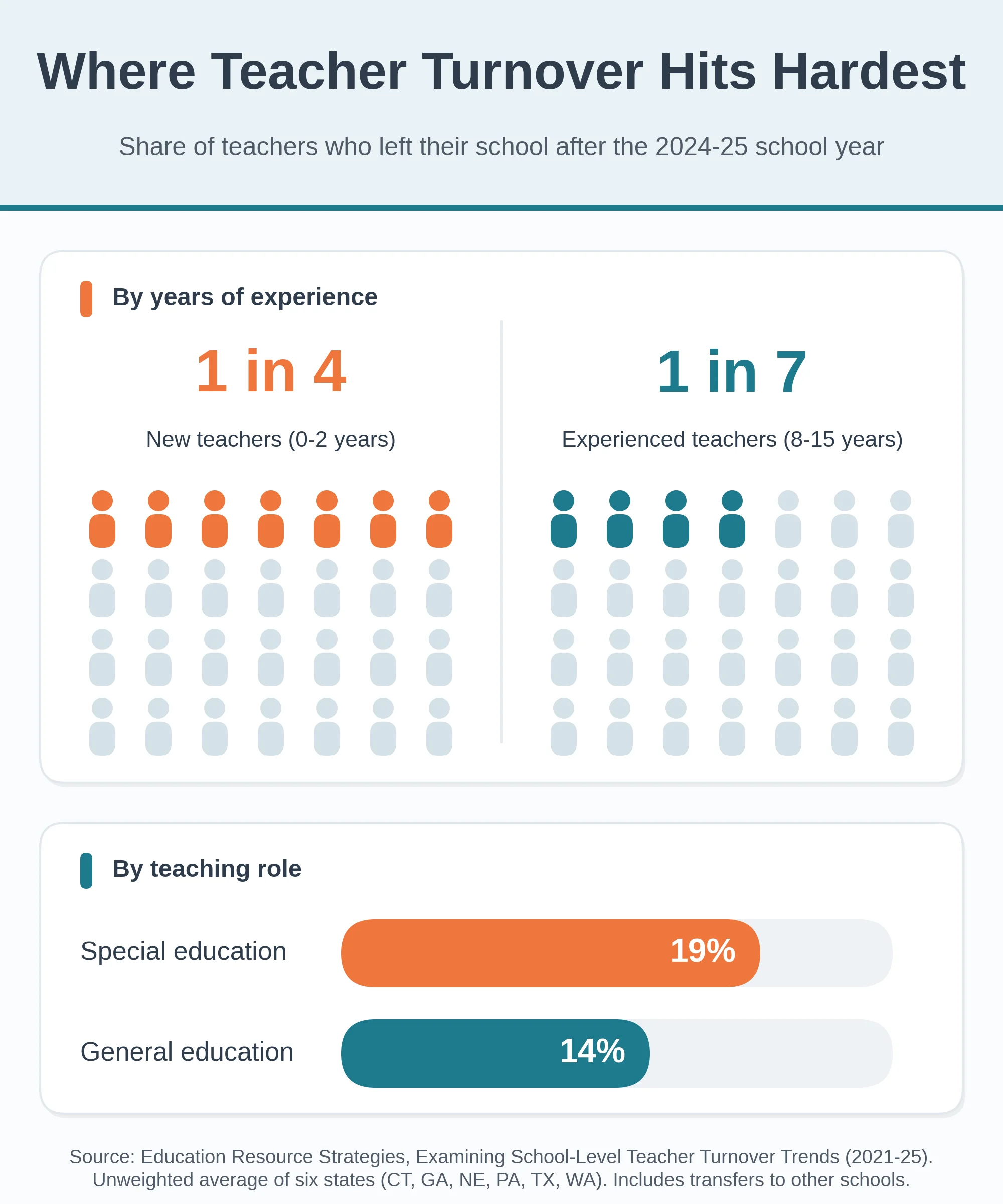
Education Resource Strategies examined six states in its school turnover analysis. After the 2024-25 school year, 1 in 4 teachers with two years of experience or less left their school. Among teachers with 8 to 15 years, the rate was 1 in 7. Special education teachers left at 19%, compared with 14% for general education teachers.
Survey data helps explain why. A spring 2025 Center for American Progress early career survey of 309 teachers in their first five years found nearly 70% had left or considered leaving. Most cited working conditions, lack of support, and low pay. One in 3 hadn't taken part in a formal induction program.
A teacher who graduates in three years still faces the same pressures as any new hire. Starting at an understaffed school without a mentor is hard regardless of degree length. What happens after graduation matters most.
Supports That Keep Teachers in Classrooms
The stronger 3-year programs pair a shorter degree with real support. Paid clinical work, like apprenticeships and paid student teaching, lets candidates earn while they train. District residencies, like the one UWM is exploring, connect graduates to a school before their first contract.
Mentoring and induction close the gap the Center for American Progress found. Grow-your-own pipelines give paraprofessionals, who already know their school community, a direct path into teaching.
Staffing design helps as well. ASU's Next Education Workforce model puts teachers in teams across shared learning spaces. It partnered with 128 schools in 2025-26. ASU reports higher teacher satisfaction and retention under the model, though the research is still early.
Planning Questions for University Leaders
Before approving a 3-year teaching degree, your leadership team should be able to answer these questions:
Which shortage areas, such as special education, math, or science, do partner districts most need filled?
Does the redesigned program protect clinical hours while cutting electives and redundant coursework?
What do state licensure rules and accreditor review require, and how long will approval take?
How will you track graduates' placement and retention over time, beyond enrollment numbers?
Shared Responsibility for Keeping Teachers
3-year teaching degrees can lower costs and get new teachers into schools sooner. Keeping them there depends on what comes next. Universities that shorten the path owe graduates thorough preparation, and districts that hire them owe those teachers the mentoring and conditions that make staying possible.
 Does College Public Speaking Really Matter in Today’s Job Market?
 Strategies for Communicating Tuition and Outcomes to Prospective Students
 How Politics Is Shaping College Enrollment
 How Top Performers Land US Job Offers
 The College Majors Foreign Students Regret Choosing