Disclaimer: This article is for general informational purposes only and isn't financial, legal, or institutional advice. Data on closures, enrollment, tuition discounting, loan defaults, and federal funding reflects sources available at time of writing. Higher education policy and visa rules can change fast. Any single school's finances may look very different from the sector trends below. Talk to the college, an accrediting body, the U.S. Department of Education, or another official source before you make enrollment, investment, or strategy decisions.
College risk isn't a someday problem anymore. It's happening right now. Shrinking pipelines, shaky finances, federal funding cuts, and a real public debate about whether a degree is worth the price tag are all colliding at once. Here's what's actually going on, in plain terms, and what it means for you or your student.
Risk Area | What the Data Shows | Source |
|---|---|---|
College closures | 80+ private nonprofits closed or merged since 2020; 16 closed in 2025 alone | BestColleges.com |
Shrinking pipeline | High school graduates projected to drop about 10% by 2041 | WICHE |
International students | Projected $3.4B economic hit for 2026-27 as enrollment keeps falling | NAFSA |
Student loan defaults | Over 9 million borrowers now in default, about 1 in 5 | U.S. Dept. of Education |
Tuition discounting | 56.3% average discount rate for first-year students, a record high | NACUBO |
Credit outlook | Downgrades outpacing upgrades more than 2 to 1 | S&P Global Ratings |
Money Is Running Out
Not every school is in trouble. Big-name schools with fat endowments and long waitlists are mostly fine. It's the smaller, tuition-dependent schools that are getting squeezed from every direction.
Federal research money is drying up. The White House's proposed fiscal 2026 budget called for roughly an $18 billion cut to the National Institutes of Health and a $5.1 billion cut to the National Science Foundation, according to the Pew Charitable Trusts. That's a huge chunk of the $60 billion in federal research funding schools got in fiscal 2023.
States aren't helping much either. At least 15 states proposed or made cuts to public funding in their 2025 sessions. Even flat funding is a cut once you factor in inflation.
Then there's the discount trap. Schools are handing out bigger scholarships just to fill seats. NACUBO's 2025 study found the average discount rate for first-year students at private nonprofits hit 56.3% in 2024-25, another record. Net tuition revenue only grew 1.4% after inflation. Do that math on repeat for a few years and you get a school with less real money every single year, even while sticker price keeps climbing.
If a student gets offered a scholarship worth 60% off the sticker price, for example, that's not the school being generous. That's the school admitting the sticker price was never real in the first place.
Three major credit agencies, S&P, Moody's, and Fitch, all issued negative outlooks for 2026, citing enrollment declines, federal policy shifts, and rising costs. Forbes' 2026 College Financial Grades backs that up: more than 25% of the 928 private nonprofits it graded got a D, the worst showing since Forbes started grading in 2013. Colleges also can't file for Chapter 11 bankruptcy and keep taking federal student aid, which is usually their biggest source of income. So instead of restructuring, most just sell off buildings, cut staff, or close.
Fewer Students Are Coming
Birth rates dropped hard during the 2008-09 recession. Those kids are college-age now, and there simply aren't as many of them.
WICHE projects the pool of high school graduates will peak in 2025 near 3.9 million, then slide about 10% by 2041. Meanwhile the share of high schoolers going straight to college has slid from 70% to 62% over the past decade, as more students weigh apprenticeships, certificates, or jumping straight into work.
The Philly Fed projects overall enrollment could fall as much as 15% from 2025 to 2029, hitting the Northeast and Midwest hardest.
If a student comes from a small town where the graduating class keeps shrinking every year, for example, that student actually has more leverage than they realize. Schools are competing harder than ever for fewer applicants, which means more scholarship money and more room to negotiate.
International Students Are Staying Home
International tuition used to be one of the most dependable revenue lines a school had. That changed fast.
NAFSA's Fall 2025 snapshot found new international enrollment fell 17%, pulling total international enrollment down 7% and costing colleges an estimated $1.1 billion and 23,000 jobs that season. Looking ahead, newer NAFSA projections put total international enrollment at roughly 1,057,000 for 2026-27, down from about 1,169,000 the year before, a hit of about $3.4 billion and 40,000 fewer jobs nationwide.
International students usually pay full price. At a lot of regional schools, that full-price tuition quietly helps cover financial aid for everyone else. Lose those students and that support disappears too.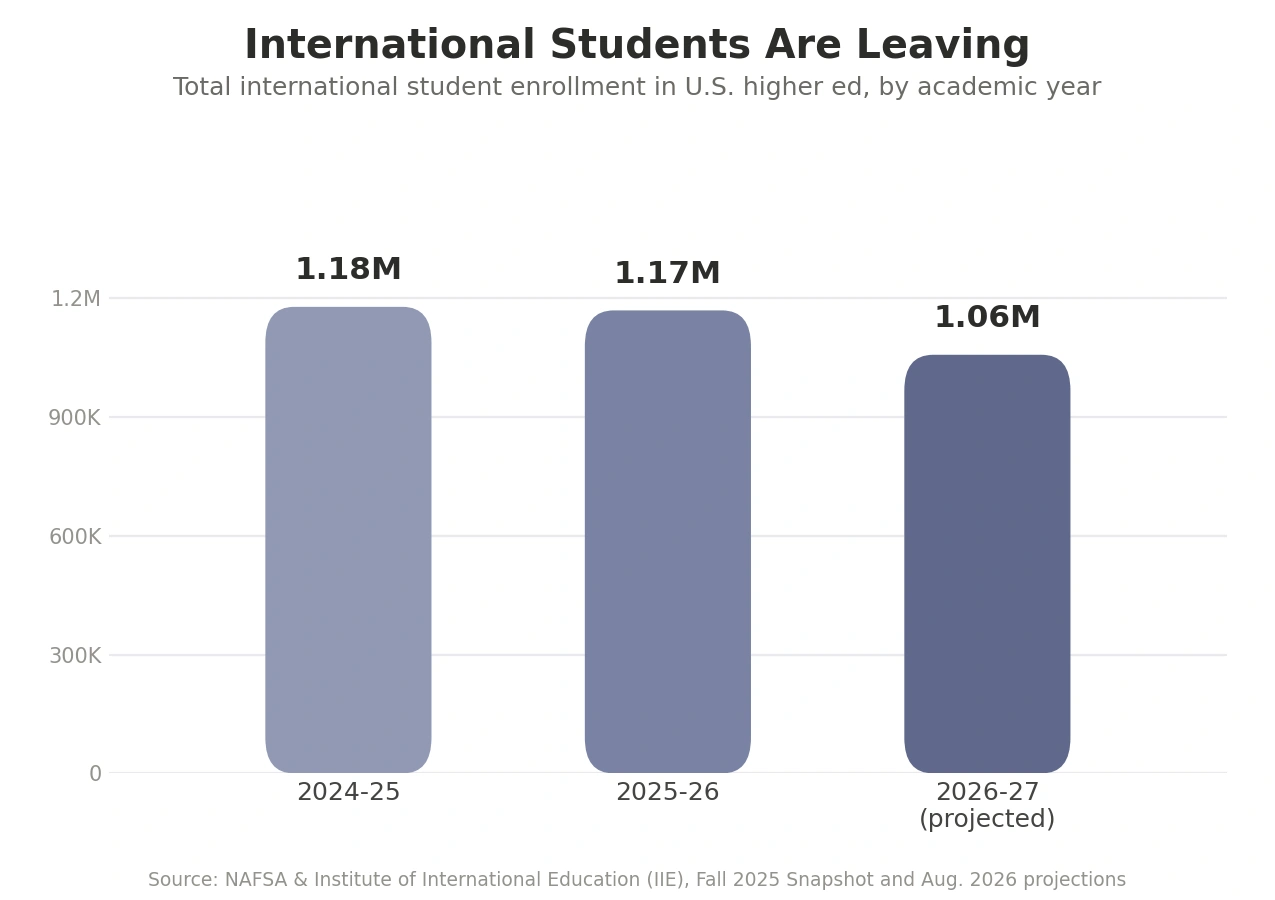
If an admitted student abroad, for example, waits months for a visa interview slot and misses the semester entirely, that's one student's plan derailed and one seat's worth of tuition gone for the school. Multiply that by thousands and you see the scale of the problem.
This is exactly where getting credentials evaluated correctly and fast matters more than ever. A service like Scholaro exists so international applicants aren't stuck waiting on paperwork on top of everything else working against them.
Debt Is Crushing Borrowers
The cost of college has climbed way faster than paychecks for decades, and the debt fallout shows it.
Over 9 million student loan borrowers are now in default, roughly 1 in 5, according to Department of Education data reported in mid-2026. That's up sharply from around 5 million just a year earlier. Millions more are behind on payments and at risk of tipping into default next.
Loans also got more expensive. The Bipartisan Policy Center found a student who borrowed the average amount for undergrad in 2024-25 will pay about $6,430 more in interest over the life of the loan than someone who borrowed the same amount in 2020-21.
The One Big Beautiful Bill Act, signed in July 2025, caps Parent PLUS loans at $20,000 a year ($65,000 total per student), gets rid of the Grad PLUS loan program altogether, and puts new yearly caps on loans for law, medical, and other professional programs. All of it kicks in for the 2026-27 school year. Hit one of those caps and you're looking at private loans, worse terms, and no guarantee of approval.
Even landing a job after graduation isn't the finish line people think it is. A Strada and Burning Glass study found 52% of grads were underemployed a year out, meaning their job didn't need a degree at all.
If a student picks a degree with a $160,000 median ROI, for example, they're picking the median outcome, not the guaranteed one. Engineering, nursing, computer science, and economics grads often clear $500,000 or more over a lifetime. Plenty of arts and humanities programs land nowhere close. The real question isn't "is college worth it." It's "is this specific program, at this specific cost, worth it for me."
Closures Are Already Here
This isn't a future risk. It's a current event.
Sixteen nonprofit colleges closed in 2025, including Siena Heights University in Michigan, Limestone University in South Carolina, St. Andrews University in North Carolina, Northland College in Wisconsin, and Eastern Nazarene College near Boston. By mid-2026, at least eight more had shut their doors, including Anna Maria College and Hampshire College, both in Massachusetts, and University of Valley Forge in Pennsylvania.
The pattern repeats every time:
Enrollment has been sliding for years, not months
Tuition covers most of the budget, with little else to fall back on
The endowment is small or already spent down
Debt keeps piling up with no clear way to pay it off
Credit markets see it coming before anyone announces anything. Colleges took on more than $34 billion in state and local government debt in 2025, up 28% from 2024, per Bloomberg-reported data. Elite schools with top-tier ratings borrow easily to build and expand. Lower-rated schools get shut out of cheap borrowing and end up competing with corporate bond issuers for financing, which costs a lot more.
If a student's college shuts down mid-degree, for example, they don't just lose a campus. They often lose transfer credits, lose time toward graduation, and end up back at square one somewhere else, sometimes with debt from a degree they never finished. Research on college closures backs this up: students who go through one are less likely to ever finish a credential at all. Mergers are the better outcome when they happen, since they give students a path to keep their credits and finish somewhere else. But a merger needs a willing partner, and that's not always on the table.
Read the Warning Signs Early
The schools most at risk share a profile: small, tuition-dependent, thin endowment, shrinking local applicant pool. That model doesn't work anymore.
If you're choosing a school, check its financial health the same way you'd check a company before investing in it. If you're already enrolled somewhere shaky, ask about teach-out agreements now, before you need one.
 Strategies for Communicating Tuition and Outcomes to Prospective Students
 How Politics Is Shaping College Enrollment
 How Top Performers Land US Job Offers
 The College Majors Foreign Students Regret Choosing
 The Tightest Job Market in Years for College Grads