
International candidates compete in two distinct arenas — the college admissions process and the job market — but the qualities that move the needle in both are more similar than most people expect. Grades, communication, authenticity, and demonstrated commitment show up on every evaluator's checklist, whether they're reading a Common App essay or a resume. Understanding both sets of criteria gives admissions teams, employers, and candidates a clearer picture of what actually drives decisions.
What Employers Look for in International Candidates
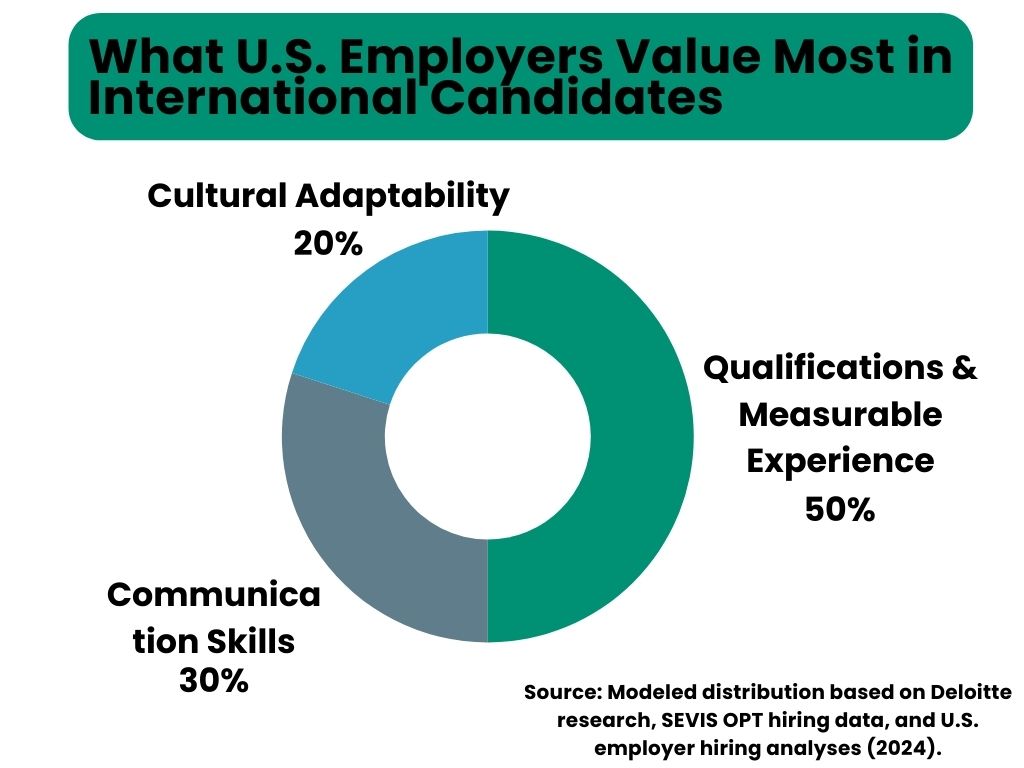
Employers consistently focus on three things when evaluating international candidates: qualifications, communication, and cultural adaptability.
Qualifications and relevant experience. Academic credentials are the starting point. Employers check that your degree level and field of study match the role, and that your credentials come from an accredited institution. But U.S. employers weight measurable experience more than certifications alone. Showing what you've built, solved, or delivered matters more than listing qualifications.
Communication. The most basic requirement for any international candidate is the ability to communicate clearly in the working language — written and verbal. Employers assess how you handle professional interactions: negotiating, presenting, building rapport. A common mistake international candidates make is writing cover letters that are too formal or verbose by U.S. standards. American employers prefer concise, direct, confident communication.
Cultural adaptability. Employers are not hiring international candidates simply for diversity optics. They look for candidates who bring a genuine global perspective — experience working across cultures, adapting to different work styles, and approaching problems from unfamiliar angles. Deloitte research shows that diverse thinking drives innovation by around 20%. Cultural adaptability and flexibility are the clearest signals an international candidate can offer beyond their resume.
Which Companies Hire the Most International Candidates
The largest employers of international students in the U.S. are concentrated in tech and STEM. According to the Student and Exchange Visitor Information System (SEVIS), managed by U.S. Immigration and Customs Enforcement, Amazon led all employers in 2024 with 6,679 new OPT hires. Google followed with 1,778, Microsoft with 1,496, and Meta with 1,302. The full top 10 from SEVIS also includes the University of California, Walmart, Intel, Apple, Goldman Sachs, and Tesla.
Outside tech, finance and consulting firms — Deloitte, McKinsey, EY, JP Morgan — are consistent OPT and H-1B sponsors. With H-1B processes tightening, companies are increasingly using OPT as an earlier talent pipeline entry point. For international candidates seeking long-term employment, Fortune 500 companies with established OPT hiring programs offer the clearest path to H-1B sponsorship and permanent U.S. employment.
STEM candidates have a structural advantage: the STEM OPT extension allows up to 36 months of work authorization, giving employers more runway to support a candidate through to H-1B sponsorship. Non-STEM candidates face more competition and a shorter OPT window, which makes targeting employers with active international hiring programs even more important.
What Admissions Officers Look for in International Applicants
What Gets Reviewed First
Admissions officers start with academic performance. Grades are the first and most heavily weighted factor in the review process — not test scores, as many applicants assume. Officers look at GPA, course rigor (AP, IB, honors), grade trends across all four years of secondary school, and whether the curriculum reflects genuine academic challenge relative to what the student's school offered.
For international candidates specifically, transcripts are read in the context of their home country's grading system. Officers at selective U.S. institutions are trained to evaluate international transcripts. Candidates do not need to convert grades to the U.S. GPA scale on the Common Application — report them as-is. However, transcripts not in English require certified translation or third-party evaluation; World Education Services (WES) is widely recognized.
English proficiency scores (TOEFL, IELTS, or Duolingo English Test) are reviewed alongside transcripts. As Interstride notes in its admissions evaluation overview, these tests are not about perfection — they confirm a candidate can study and communicate effectively in English.
The Three Things That Build a Compelling Application
IvyWise identifies three core criteria that run through every strong application:
Defined interests. Not a long list of unrelated activities, but sustained engagement in a focused area. Admissions offices are not building classes of well-rounded students — they are building well-rounded classes out of specialists. A student with deep involvement in two or three areas over several years signals more to an officer than one who lists ten superficial activities.
Strong grades in rigorous courses. A necessary baseline, but not sufficient on its own. Good grades in easy classes are not impressive. Officers look for students who challenged themselves relative to what was available at their school.
Context and authenticity. This is the job of the personal essay. It should show — not tell — who the candidate is through specific anecdotes and experiences. Columbia's admissions office describes reading essays to understand perspective and engagement with the world, not to hear a candidate list their achievements.
Do Admissions Officers Review All 10 Activities?
Yes. Every listed activity is read, but volume is not the goal. A student with 10 superficial activities across different areas is at a disadvantage compared to one who shows two or three years of committed leadership in a focused field. Activities should align with the candidate's stated major and reinforce the essay narrative. Officers are experienced at spotting padded lists, and a broad, unconnected activity list is a well-known red flag.
Demonstrated Interest
Showing genuine interest in a specific institution matters, particularly for international candidates who may be competing for a limited number of international spots. This means engaging with admissions offices, attending virtual information sessions, contacting international student services, and referencing specific programs or faculty in supplemental essays. Interstride notes that many U.S. colleges now track demonstrated interest as part of the review process.
Red Flags in College Applications
Admissions officers are pattern-recognition specialists. Common red flags include:
Grade inconsistency or unexplained drops. A sudden dip without context raises questions about academic readiness. If there is a legitimate reason — illness, family circumstances — address it in the additional information section.
Mismatch between stated major and actual profile. Applying as a computer science candidate with no STEM coursework or activities is immediately visible. The essay, activities, and intended major need to form a coherent narrative.
Essays not written in the candidate's own voice. Admissions counselors read thousands of essays and recognize when a student hasn't written their own. A polished essay paired with weak English proficiency scores is a fast route to skepticism. Authenticity matters more than perfect prose.
Exaggeration and boasting. Ivy Coach cautions that excessive self-aggrandizing in activity lists and essays tends to backfire. Inflated claims about the scale of a charity project or community impact are harder to believe than honest, specific descriptions of what a candidate actually did.
Generic or misdirected supplemental essays. Writing the wrong school's name, or describing a program the institution doesn't offer, signals low effort and weak research. Each supplemental essay should reference specific programs, faculty, or campus resources.
Problematic social media. Officers may check public profiles. Posts that contradict the character presented in an application — or that show poor judgment — can result in withdrawn offers.
What actually impresses: a consistent narrative across all components, intellectual curiosity with evidence behind it, focused leadership in a chosen area, an authentic essay that shows self-awareness, and letters of recommendation that add genuine context rather than repeating transcript data.
How to Impress During the Admissions Interview
The interview is a chance to add dimension — not to repeat the resume. Officers are assessing maturity, self-awareness, and genuine interest in the institution. International candidates should prepare specific answers about their academic goals, why they chose the U.S. for study, and what they will contribute to campus life.
What impresses: specific knowledge of the school's programs, honest reflection on past challenges, clear thinking about future goals, and thoughtful questions for the interviewer. What raises flags: rehearsed or vague answers, failure to research the institution, and an inability to hold a clear, focused conversation. After the interview, send a brief thank-you email — it is a small signal of professionalism that a meaningful number of candidates skip.
Organizational Red Flags That Push International Candidates Away
Hiring is a two-way assessment. Strong international candidates — who are often weighing multiple offers and managing visa timelines — are more sensitive to employer red flags than domestic candidates.
According to research from Harvard Business Review by Boris Groysberg and Robin Abrahams, the four organizational red flags that deter job candidates are: lack of clarity about the job or organization, poor recruitment practices, disengaged or unpleasant interviewers, and a poor corporate reputation.
Additional warning signs that international candidates specifically watch for:
Vague job descriptions. Signals unclear internal alignment and makes it impossible to assess OPT eligibility or role fit.
No visible sponsorship history. Candidates can check employer visa history through USCIS databases and tools like MyVisaJobs. An employer with no track record of sponsoring international workers is a practical barrier, not just a cultural one.
High staff turnover. People Managing People data shows that candidates view frequent job re-postings as a major red flag. It signals a culture problem the employer may not be acknowledging.
Slow or absent communication. Particularly damaging for international candidates managing hard visa authorization deadlines.
Pressure tactics. Exploding offers or demands for unrealistically quick decisions are disproportionately harmful to international candidates who need time to verify authorization status and navigate immigration requirements.
Employers who want to attract and retain international candidates need to be transparent about work authorization processes from the start, communicate clearly through the hiring process, and demonstrate an existing culture of inclusion — not just describe one.
What Both Processes Have in Common
The overlap between admissions and employer selection criteria is not coincidental. Both processes reward the same qualities: consistency between what a candidate claims and what they demonstrate, communication that is clear and direct, evidence of genuine commitment in a focused area, and the maturity to present themselves honestly rather than strategically. For international candidates, success in both arenas starts with understanding what evaluators actually read — and building a profile that holds up under scrutiny at every layer.
 The College Majors Foreign Students Regret Choosing
 The Tightest Job Market in Years for College Grads
 How Universities Are Adapting Health Programs to a Moderating Job Market
 How Flexible Are PhDs in a Changing Job Market
 Understanding the Decline of International Enrollment in American Universities