
Picking the right school for a language major isn't just about prestige. Where you study determines which languages you can actually major in, how much immersion you get, and what career path opens up after graduation. This guide breaks down the best colleges for language majors by institution type, what each does well, and what to look for before you apply.
Institution | Type | Languages Offered | Strength |
|---|---|---|---|
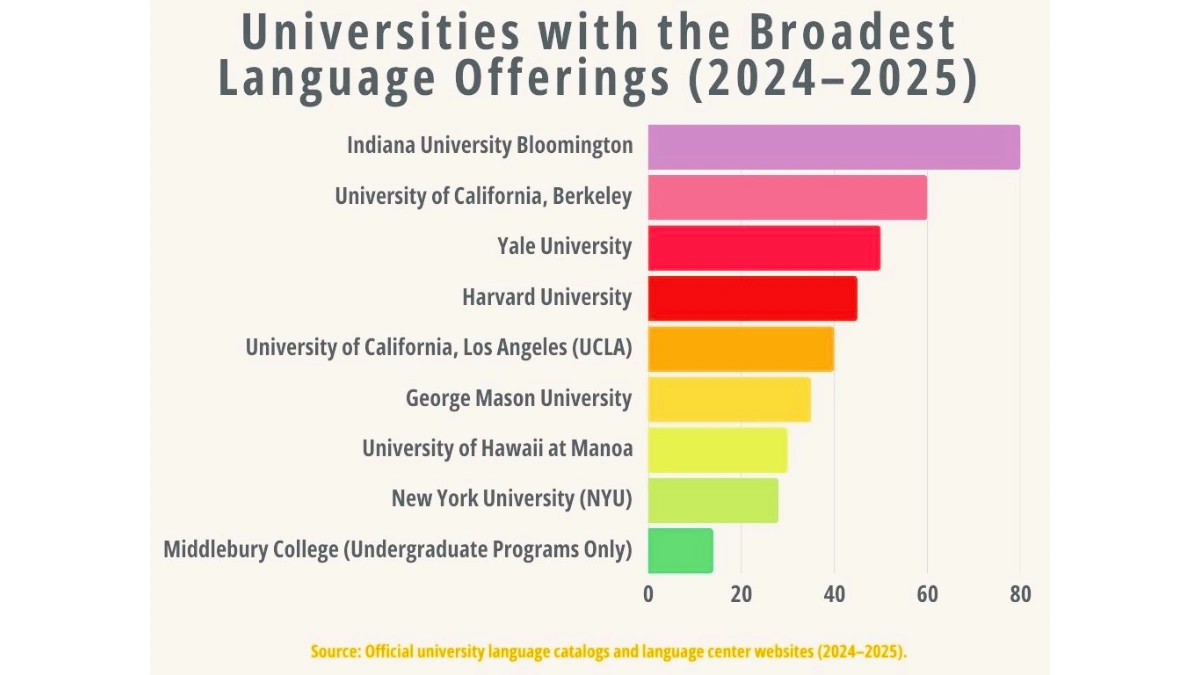
Middlebury College (VT) | Private LAC | 12+ | Immersion pledge, Language Schools |
UCLA (CA) | Public research university | 40+ | Heritage language programs, Center for World Languages |
UC Berkeley (CA) | Public research university | 50+ | Indigenous and rare languages, applied linguistics |
UW-Madison (WI) | Public research university | 40+ | DoD Language Flagship Program |
Georgetown (DC) | Private research university | 40+ | Diplomacy and international relations |
Swarthmore (PA) | Private LAC | Varied | Tri-College Consortium, high study abroad rate |
UT Austin (TX) | Public research university | 40+ | Latin American and Middle Eastern language institutes |
What Makes a Program Worth Your Time
Take Sofia, a Spanish heritage speaker from San Antonio who assumed any major university would serve her well. She enrolled at a school with a highly ranked overall program, only to find the Spanish department treated all students as beginners and offered no heritage speaker track. She transferred to UT Austin a year later.
That's a common pitfall. Before you commit, check these:
Does the school offer a declared major in your specific language, not just a handful of electives or a summer immersion program?
Is there a heritage learner track? Students who grew up speaking a language at home need different instruction than complete beginners.
How strong is the study abroad program? The best schools build credit-bearing, structured study abroad into the degree, not as an optional add-on.
What are the career outcomes? A school's language department strength should align with your goal: translation, government, healthcare, or academia all reward different institutional strengths.
It's also worth knowing that the share of U.S. colleges requiring a foreign language for a bachelor's degree has dropped from over two-thirds to around 50%. That means dedicated language departments matter more, not less, since institutional support for language programs varies widely.
Top Liberal Arts Colleges (LACs) for Language Majors
LACs suit language study for a specific reason: small classes mean more speaking time, faster feedback, and tighter faculty relationships. That's hard to replicate in a 200-person lecture.
Middlebury College (Vermont) is the name that comes up first in almost every serious conversation about language study. It is widely regarded as the top institution for immersive language education in the U.S., built around a Language Pledge that requires students to speak only their target language for the duration of the program. Middlebury also maintains 16 language-immersive campuses globally and runs summer Language Schools open to students from other universities.
Swarthmore College (Pennsylvania) offers access to Bryn Mawr and Haverford through the Tri-College Consortium, which significantly expands language course options beyond what one small campus alone could offer. Study abroad participation sits at 49%, with students choosing from 70+ programs across 30+ countries.
Barnard College (New York) has been a top producer of Fulbright scholars for seven consecutive years, with 16 recipients in 2024 alone. For language majors aiming at international careers, that track record carries real weight.
Bryn Mawr College (Pennsylvania) holds a U.S. Department of Defense Language Flagship grant for Russian, administered as part of a consortium. That's federal-level recognition of program quality in a critical language.
"I went to Middlebury thinking I'd get better at French. I left thinking differently in French. The pledge feels extreme at first, but it rewires how you process the language." — Middlebury alumna, now working at the U.S. State Department
Top Public Universities for Language Majors
Public universities offer breadth. If you want to major in Swahili, Kazakh, or Wolof, your options narrow quickly to large research institutions with the faculty and funding to support low-enrollment programs.
UCLA (California) offers instruction in more than 40 languages and is particularly strong in heritage language programs for students who grew up speaking a language at home. The UCLA Center for World Languages leads national research on language pedagogy. Los Angeles itself functions as a living classroom, with large communities speaking dozens of languages in everyday settings.
UC Berkeley (California) offers majors and minors in over 50 languages, including rare options like Biblical Hebrew and a minor in Applied Language Studies. It has a strong tradition of fieldwork on indigenous and under-documented languages.
University of Wisconsin-Madison is a national leader for critical languages tied to government and national security. It participates in the U.S. Department of Defense's Language Flagship Program, which trains students to reach near-native proficiency in Arabic, Chinese, Korean, Persian, Russian, and Turkish through domestic study followed by a full year overseas.
Georgetown University (Washington, D.C.) holds DoD Language Flagship grants for Arabic and Persian and sits minutes from federal agencies, think tanks, and embassies. It's the strongest option if you're aiming at diplomacy, policy, or intelligence careers.
University of Texas at Austin is underrated outside of Texas. It has world-class Middle Eastern and Latin American language institutes and a student body that is roughly 25% Hispanic, which creates a natural environment for Spanish heritage learners and applied language research.
AI Is Changing What Language Programs Teach
This matters for your school choice in 2026. Machine translation has gotten good enough that basic fluency is no longer the competitive skill it once was. Per Urlaub, Director of Global Languages at MIT, put it directly: the goal in humanities education is "to make young people critical thinkers" and "effective, critical, and ethical collaborators with current technology."
The programs that will serve you best are the ones pivoting from rote translation toward cultural intelligence: understanding how language shapes power, identity, and communication across contexts. Look for departments that integrate media, literature, and community engagement alongside grammar and vocabulary.
Matching Your Career Goal to the Right School
This is where most students get it wrong. They pick the most famous name on the list rather than the best fit for where they want to go.
Translation and localization: Middlebury, UW-Madison
Diplomacy and government: Georgetown, Barnard (Fulbright pipeline)
Healthcare and applied language use: UCLA, University of Pennsylvania
International business: Cornell, Stanford
Linguistics research and academia: Harvard, Indiana University Bloomington, UC Berkeley
If you're considering government or national security work, look specifically for schools that hold active Language Flagship grants — these change, so verify directly. Flagship institutions provide structured pathways to high-level proficiency with federal funding and a built-in overseas component.
One practical step most students skip: use a GPA conversion tool early. If you're transferring or applying to graduate programs later, having your credentials properly evaluated from the start saves real headaches.
"A Language Degree Is Useless" — Let's Kill That Myth
You've heard it. Maybe your parents said it. Maybe an advisor hinted at it. It's wrong, and the data says so.
Columbia language and linguistics graduates earn on average $20,701 above the median salary for their field. Notre Dame language graduates come out $12,833 ahead of the average college grad in the same field. These aren't outliers — they reflect what happens when strong language training gets paired with the right career track.
The "useless degree" myth usually targets people who study a language without a plan. The degree itself isn't the problem. Studying French at a school with no study abroad program, no career advising, and no declared major pathway — that's the problem. A language degree from Georgetown, Middlebury, or UCLA, paired with a clear career direction, is a competitive asset in government, healthcare, international business, and tech.
In 2026, with AI handling basic translation, the skill employers actually pay for is cultural fluency — knowing not just what words mean, but how communication works across cultures and contexts. That's something no app does well. And it's exactly what the best language programs teach.
 Choosing a U.S. Graduate School That Matches Your Goals
 5 ESL Teaching Trends Colleges Are Watching in 2026
 How to Turn Apprenticeship Experience Into College Credit
 The Rise of Digital Diplomas
 U.S. Universities Are Opening Campuses Abroad to Survive. Will It Work?