

Managing a double major in college requires planning, organization, and strong time management skills. While students earn a single degree with concentrations in two fields, meeting the requirements for both programs within four years demands strategic course selection and dedicated effort. This guide breaks down everything you need to know about successfully completing two majors.
Understanding Double Majors
What defines a double major
A double major means completing all requirements for two different fields of study while earning a single bachelor's degree. Both majors appear on your diploma, but you receive one diploma rather than two. Most universities require students to complete a minimum of 120 credit hours, the same as single-major students.
The catch? You need to fulfill requirements for both programs within those credits. This means less room for random electives and more focus on strategic course selection. Some schools have specific rules about overlapping courses. Stanford University limits how many courses can count toward both majors, typically capping overlap at the lower-division level.
How double majors differ from dual degrees
The terms sound similar but represent different paths. Double majors earn one diploma listing both fields. Dual degree students earn two separate degrees requiring additional credit hours, often around 225 units instead of the standard 180.
Dual degrees typically involve combining different degree types, like a Bachelor of Arts and a Bachelor of Science. This path requires significantly more time and money. Double majors offer a middle ground, letting you study two fields without the extended timeline or extra tuition costs.
A secondary major offers another option. You complete requirements for two majors but only your primary major appears on your degree. Your transcript notes the secondary major, and you can share course requirements between programs, which often means fewer total courses than a traditional double major.
Comparing double majors to minors
A double major requires completing full degree requirements for both fields. A minor typically needs 18-24 credit hours versus 30-40 for a major. Minors don't appear on your degree, only your transcript.
The choice between a double major and a major plus minor depends on your goals. Minors provide exposure to another field without the full commitment. Double majors offer deeper knowledge but less flexibility for extracurriculars and electives. Consider whether you need comprehensive expertise in both areas or if supplementary knowledge through a minor serves your purposes.
Expected time commitment
Most students complete a double major in four years with proper planning. Success depends on several factors: credit requirements for each major, course availability, and how early you declare.
Students who choose related fields typically finish on schedule because majors share prerequisites. Combining unrelated fields like art and engineering may require extra semesters. Some combinations naturally take longer due to sequential prerequisites or limited course offerings.
Transfer students and those who declare late face tighter timelines. If you don't declare until junior year, fitting in all requirements becomes challenging.
Strategic Planning
Begin planning in your first year
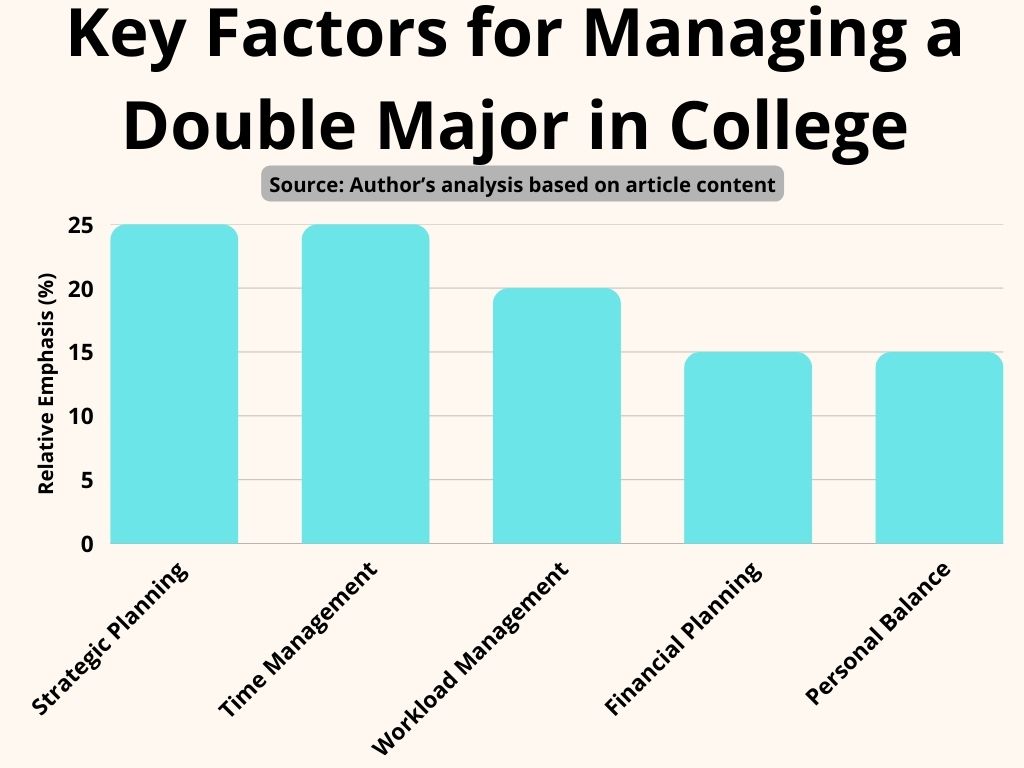
Early planning prevents problems later. Review requirements for both majors immediately, even if you haven't officially declared. Create a four-year course plan showing when you'll take each required class.
Pay attention to prerequisites. Some courses require specific classes beforehand, creating chains you must complete in order. Missing one prerequisite can delay graduation by a full year if that course isn't offered every semester.
Check course offerings for both majors. Some classes only run in Fall or Spring, not both. Foreign language courses often follow this pattern. If you need three semesters of a language only offered in Spring, you must start by sophomore year at the latest.
Work closely with academic advisers
Connect with advisers from both departments regularly. They help you navigate requirements, approve course substitutions, and ensure you meet graduation deadlines. UC Berkeley requires students to obtain approval from both departments before declaring a double major.
Schedule meetings each semester before registration. Advisers catch conflicts you might miss and suggest courses that work for both majors. They also know about policy changes, new course offerings, and exceptions to standard rules.
If your majors sit in different colleges within the university, you may have two sets of general education requirements. Advisers help you understand which requirements you must complete and where overlap exists.
Choose complementary fields
Select majors from related areas when possible. Related fields share prerequisites, reducing your total course load. Business and computer science majors both require statistics and math. Biology and chemistry overlap in fundamental science courses.
Overlapping requirements save time and money. Instead of taking separate statistics courses for each major, one class satisfies both requirements. This frees credits for other required courses.
Even unrelated majors can work if you plan carefully. English and biology don't share prerequisites, but both fulfill liberal arts breadth requirements. The key is understanding where efficiencies exist.
Find courses that satisfy multiple requirements
Look for classes that count toward both majors. A political science major and sociology major might both require statistics. An American literature course could satisfy English major requirements and American studies requirements simultaneously.
Universities have different policies about double-counting courses. Some limit how many classes can satisfy requirements for both majors. Most allow lower-division overlap more freely than upper-division requirements.
Check if courses meet general education requirements while satisfying major prerequisites. A philosophy course might fulfill a humanities requirement and serve as a prerequisite for ethics courses in your business major.
Managing the Workload
Develop effective study habits
Double majors face twice the coursework of single-major students. You need efficient study methods, not just more hours.
Create a dedicated study space free from distractions. Your brain associates locations with activities. A consistent study spot trains your mind to focus when you sit down.
Break large assignments into smaller tasks instead of facing huge projects all at once. A 20-page research paper becomes less overwhelming when divided into research phase, outline, draft, and revision stages.
Use active learning techniques. Don't just reread notes. Test yourself, explain concepts aloud, and create practice problems. Active engagement cements information better than passive review.
Study smarter, not just longer. Two focused hours beat four distracted hours every time. When your concentration fades, take a break rather than pushing through ineffectively.
Master time management techniques
Use planners, digital calendars, or apps to track assignments and deadlines. Write everything down. With double the courses, you can't rely on memory.
The Pomodoro technique works well for maintaining focus. Study for 25 minutes, take a 5-minute break, then repeat. This prevents burnout and keeps your mind fresh.
Time blocking dedicates specific hours to specific tasks. Schedule class time, study sessions, meals, exercise, and leisure. Treat study blocks like appointments you can't skip.
Prioritize tasks by urgency and importance. Handle assignments due tomorrow before those due next week. Avoid multitasking, which reduces efficiency. Focus on one task at a time.
Set realistic deadlines earlier than actual due dates. If a paper is due Friday, aim to finish Wednesday. This buffer protects against unexpected problems.
Set clear priorities
Determine what matters most beyond academics. If joining clubs is important, factor that into your schedule. Double majoring limits time for extracurriculars, so choose activities carefully.
You can't do everything. Some students prioritize research opportunities. Others value leadership positions in organizations. Still others focus purely on academics.
Be honest about your capacity. If maintaining a social life matters to you, acknowledge that and plan accordingly. Don't commit to activities you can't sustain.
Your priorities might shift over four years. Freshman year you might explore clubs. Junior year might emphasize internships. Senior year could focus on graduate school applications or job searches.
Balance your course load each semester
Don't overload one semester with all upper-division courses. Mix challenging classes with lighter ones. A semester with organic chemistry, physics, and calculus will crush you. Add some less intensive courses to maintain balance.
Check the workload requirements for each class. Lab courses demand hours beyond lecture time. Courses with multiple exams and papers require more effort than discussion-based seminars.
Take advantage of summer sessions or winter intersessions to spread requirements out. These condensed terms let you focus on one challenging course without juggling five others simultaneously.
Some students front-load requirements, taking heavier course loads early to ease senior year. Others prefer consistent loads across all semesters. Find the pattern that matches your energy and goals.
Financial Considerations
Calculate total costs
Additional courses may mean extra tuition, books, and supplies. If you need an extra year to complete both majors, costs increase significantly.
Create a budget before committing. Calculate tuition per credit hour at your school. Add textbook costs for additional courses. Factor in housing if extra time extends your on-campus living.
Some majors cost more than others. Engineering and science programs often charge differential tuition due to lab fees and equipment costs. Business programs sometimes carry premium pricing.
Don't forget opportunity costs. An extra year in school is a year not earning a full-time salary. For some students, this financial hit outweighs the benefits of a second major.
Explore financial aid options
Research scholarships specific to your majors. Some departments offer awards to declared majors. Professional organizations in your field may provide funding.
Meet with financial aid advisers to understand how double majoring affects your aid package. The University of Washington notes that exceeding credit limits can impact financial aid eligibility. Students planning to take more than 225 credits should consult their financial aid office early.
Apply for grants and scholarships continuously, not just freshman year. New opportunities arise each semester. Spending a few hours on applications can offset thousands in costs.
Consider whether taking summer courses affects your aid eligibility. Some financial aid packages only cover Fall and Spring semesters.
Consider part-time work implications
Working while double majoring requires exceptional time management. Factor work hours into your course planning. A 20-hour weekly job leaves less time for studying.
Some students delay graduation to balance work demands. Taking lighter course loads while working part-time can reduce stress but extends time to degree.
On-campus jobs often offer more flexibility than off-campus positions. Employers understand student schedules and exam periods. Library or departmental assistant positions might even provide quiet study time during slow periods.
Evaluate whether working is necessary. If loans can cover the gap, focusing fully on academics might serve you better long-term. Strong grades open doors to scholarships and opportunities that offset loan costs.
Evaluating if a Double Major is Right for You
Understand the difficulty level
Not all majors demand equal effort. Some require extensive lab work and problem sets. Combining two rigorous majors tests your capacity.
Chemistry majors average GPAs around 2.78, while architecture students spend 22 hours per week preparing for class outside lectures. Physics and mathematics demand high-level abstract thinking. Research from multiple universities shows that certain majors correlate with lower average GPAs due to difficulty.
Consider your strengths. Are you comfortable with heavy reading loads? Do you excel at quantitative reasoning? Choose combinations that play to your abilities rather than forcing you to constantly struggle in areas where you're weak.
Talk to current double majors in your intended fields. They'll give honest feedback about workload and whether the combination is feasible.
Assess career benefits
Research whether employers in your field value double majors. Some careers benefit from combined expertise. Computer science and business majors find opportunities in tech management roles. Psychology and marketing combinations suit consumer research positions.
The National Bureau of Economic Research published findings in 2024 showing that individuals who double majored are less likely to experience earnings shocks compared to single majors. The diversification provides career flexibility.
However, many employers prioritize skills and experience over additional credentials. A single major with strong internships may outperform a double major with no practical experience.
Consider your post-graduation plans. Graduate programs typically value depth over breadth. Medical schools care more about your GPA and research experience than whether you doubled majored. Law schools focus on LSAT scores and writing ability.
Weigh opportunity costs
Double majoring limits time for internships, research, study abroad, and networking. UC Berkeley's advising office notes that these experiential learning opportunities often matter more to employers and graduate programs than additional coursework.
A student with one major and three internships may have better job prospects than a double major with no work experience. Employers want candidates with proven skills, not just academic credentials.
Study abroad programs become harder to fit into double major schedules. These experiences provide cultural competency and independence that employers value.
Research opportunities, especially in STEM fields, build relationships with professors who write recommendation letters for graduate school. Double majoring might force you to skip these opportunities.
Consider whether depth in one field plus experiences serves you better than surface-level knowledge of two fields.
Maintaining Balance
Take general education requirements early
Complete gen ed courses in your first two years. This creates room for major-specific classes later and prevents scheduling conflicts in junior and senior years.
Many upper-division major courses have enrollment restrictions, giving priority to declared majors. If you're scrambling to finish gen eds senior year, you might not get into required major courses.
Gen ed courses also help you explore interests before declaring. That philosophy course might spark interest in a second major you hadn't considered.
Knocking out gen eds early reduces stress later. Senior year becomes about completing your majors, not juggling random requirements.
Establish interests outside academics
Find hobbies that relieve stress. Exercise, gaming, reading for pleasure, or creative pursuits all provide mental breaks from studying.
Dedicating time to non-academic activities prevents burnout. All work and no play makes you less effective at both.
Schedule leisure time like you schedule study sessions. If you don't protect this time, academics will consume everything.
Social connections matter. Friendships provide support during stressful periods. Make time for friends, even when busy.
Join one or two organizations you care about rather than spreading yourself thin across many activities. Deep involvement in one club beats surface participation in five.
Prioritize sleep and health
Don't sacrifice sleep to cram. Your brain consolidates learning during sleep. All-nighters might seem productive but actually harm retention and performance.
Listen to your body. If you're exhausted at midnight, go to bed. Waking up early to finish work beats staying up late producing low-quality results.
Regular exercise boosts energy and mental clarity. Even 20-minute walks between study sessions refresh your mind.
Eat properly. Your brain needs fuel to function. Skipping meals to study more backfires when your concentration crashes.
Sleep deprivation accumulates. One late night won't destroy you, but consistently getting insufficient sleep damages your health and academic performance.
Build a support network
Connect with other double majors who understand the challenges. They can share strategies, commiserate during tough weeks, and celebrate successes.
Form study groups in both majors. Collaborative learning helps you understand difficult concepts and makes studying less isolating.
Don't hesitate to use tutoring services when you struggle. Getting help early prevents small problems from becoming major obstacles.
Campus mental health resources exist for a reason. Stress, anxiety, and burnout are real concerns for double majors. Professional support helps you develop coping strategies.
Talk to professors during office hours. They want you to succeed and can provide guidance on managing coursework and career planning.
Putting Your Plan into Action
Successfully managing a double major comes down to preparation, discipline, and self-awareness. Start planning early, communicate regularly with advisers, and be realistic about your capacity.
Choose your combination strategically. Related fields offer more overlap and easier scheduling. Unrelated fields demand careful planning but can work with commitment.
Master time management. Use tools, create routines, and protect your schedule. Balance rigorous courses with lighter ones each semester.
Consider the financial implications honestly. Calculate costs, explore aid options, and determine whether the investment pays off for your goals.
Evaluate whether a double major truly serves your career objectives. Sometimes depth in one area plus practical experiences outweighs breadth across two fields.
Most importantly, maintain balance. Prioritize health, preserve time for interests outside academics, and build a support network. A double major shouldn't consume your entire college experience.
With strategic planning and disciplined execution, you can successfully complete two majors and graduate on time. The key is approaching it systematically rather than hoping things work out. Take control of your path, make informed decisions, and adjust as needed. Your college experience should challenge you without breaking you.
 Choosing Between Online and Classroom Learning? Here’s What Affects Your Future
 Rethinking Online Learning Strategy: What Today’s Students Demand
 Career Shock vs Culture Shock: What Shapes the First Job Abroad
 Best Platforms for Video-Based Learning on Mobile in 2026
 How Student Expectations Are Forcing U.S. Universities to Rethink Tech Strategy in 2026