
Static curricula are going extinct, and most departments haven't noticed yet. A course built five years ago and left alone is already teaching students for a job market that's moved on without it. Industry partnerships are the reason some programs are keeping pace and others are quietly falling behind.
Here's what's actually driving that shift, what it looks like on the ground, and what it means if you're the one signing off on curriculum changes.
Old School vs. New School Curricula
Before we go further, here's the short version of what's changing.
Traditional Curriculum | Modern Curriculum |
|---|---|
Content set once, revised every few years | Content updated alongside employer input |
Exams and papers | Live projects, case studies, portfolios |
Faculty design in isolation | Faculty and employers co-design courses |
Degree is the only credential | Degree plus stacked micro-credentials |
Why Students and Employers Don't Agree
There's a gap, and it's bigger than most people think. A 2026 report from the Lumina Foundation and Gallup found that only 54% of employers believe colleges are turning out graduates with the skills their businesses actually need.
Students see it differently. Separate survey data from the National Society of Leadership and Success found that 84% of students feel ready for the workforce. Only 37% of recruiters agree with them.
If a student spends four years acing every exam, for example, they can still walk into an interview and get asked about a tool or workflow nobody mentioned in class. That's the gap in one sentence.
The gap in three numbers:
54% of employers say grads have the skills their business needs
84% of students think they're ready for the workforce
37% of recruiters agree with them
Employers aren't rejecting degrees. They're rejecting degrees that stopped updating.
Internships help close it. The same research found that 94% of students who completed one said it prepared them for their career. Only about one in five students actually got that chance.
The Tightrope: Rigor Meets Real Skills
Here's the tension every curriculum committee is wrestling with: how do you bolt on job-ready skills without turning a degree into a bootcamp?
Most departments are handling it the same way. Keep the core theory locked in place, and add the industry-relevant tools as electives or modules around it. That way a student still gets the fundamentals, but also picks up the software or methods employers are actually asking for.
If a student is majoring in a technical field, for example, they might take the same core math and theory courses their professors took decades ago, then add on a module covering current industry software as a separate, swappable piece. Nobody has to gut the whole program to stay current.
Money from a company doesn't come with a vote on what counts as a passing grade, and good departments keep it that way on purpose. Here's what usually stays off-limits to a sponsor, no matter how much they've funded:
Faculty committees keep final say over course content and grading standards, sponsors don't get a seat at that table.
Companies can fund equipment, research, or a guest lecture, not exam questions or pass and fail thresholds.
Any donated curriculum material still runs through the same peer review as everything else the department teaches.
Industry money can pay for the lab. It can't sign off on the transcript.
That firewall is the thing that lets a department take a company's money without also taking its opinion on what a student deserves to graduate with.
When Companies Help Write the Syllabus
Direct employer involvement in course design is becoming normal, not rare. Research on university-industry partnerships shows companies now sit on curriculum committees, place staff as guest instructors, and fund joint research that feeds straight back into what gets taught.
You'll also see this at the graduate level. Pharmaceutical and biotech companies, for example, are putting real money into multi-year partnerships with research universities that combine funded coursework with hands-on lab time. It's not charity. Companies want graduates who can start contributing on day one instead of spending a year getting up to speed.
Live Projects Replace the Textbook
Two formats are doing most of the heavy lifting here.
Live case studies. Employers hand over a real, current business problem instead of a textbook scenario. Students work the actual data, not a sanitized version of it.
Co-op and integrated work terms. Students alternate between semesters of study and paid stints at a company, applying what they just learned before they forget it.
If a student is doing a co-op rotation, for example, they might spend a semester in class learning a method, then spend the next semester actually using it on a live project at a company. That back-and-forth sticks better than a semester of lectures ever could.
Who Foots the Bill for New Tech
Good curricula need good tools, and good tools cost money most departments don't have. That's where sponsorship comes in.
Sponsored labs. Companies fund equipment, facilities, and fellowship stipends so students train on gear the department could never afford alone. One research institute, for example, recently funded multiple cohorts of PhD students at an Ohio university specifically to prepare them for careers outside academia.
Software licensing. Firms provide free or discounted access to enterprise-grade tools, so students graduate already fluent in the software they'll actually use at work.
This matters most for programs that would otherwise be stuck teaching with outdated or watered-down versions of the real thing.
Turning Classes Into Job Offers
Some partnerships skip the middleman entirely and build a straight line from classroom to job offer.
Micro-credentials. Short, stackable certificates in specific skills get layered on top of a degree, so a transcript alone isn't the only proof of what a student can do.
Targeted recruitment. Some employers build ongoing, multi-year relationships with specific programs, showing up on campus year-round instead of just at job fair season.
For students, this can mean walking out with a job lined up before graduation even happens. For your career services team, it means these employer relationships need active management, not a once-a-year check-in.
Hackathons and Portfolios Take Over
Two newer formats are starting to replace the old proof-of-skill playbook.
Hackathons work as a low-stakes way for companies to see how students actually think and build under pressure, often doubling as informal recruiting events. Digital portfolios are doing something similar for individual proof of work: instead of a GPA on a transcript, a student can show an employer the actual project they built.
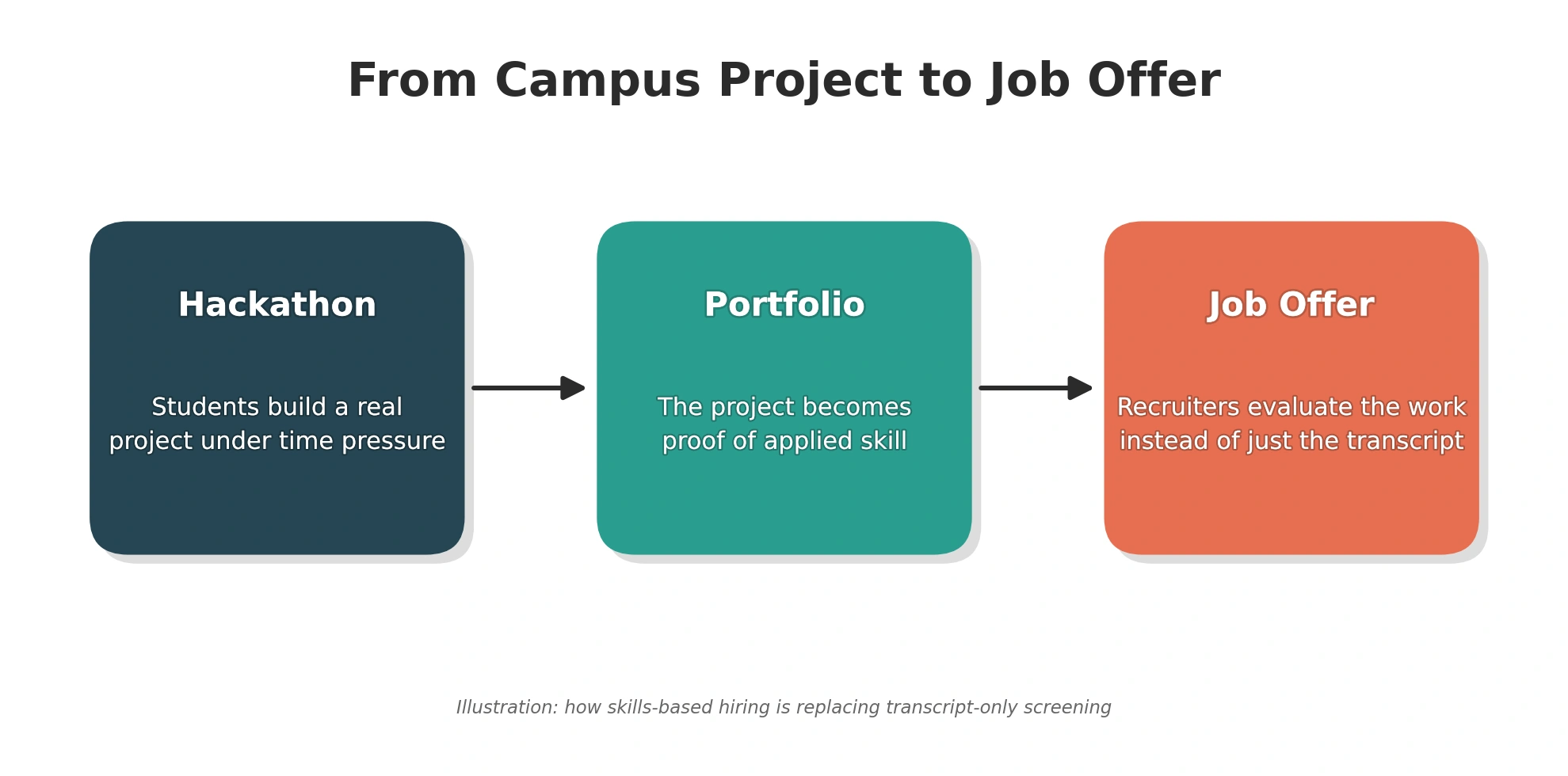
If a student builds a strong portfolio project during a hackathon, for example, that one weekend can end up carrying more weight with a recruiter than an entire semester's grade.
Build This Into Your Next Review
Industry partnerships aren't a side project anymore. They're becoming the default way curriculum gets built and kept current.
The practical move: build employer input into your regular course review cycle, treat portfolios and credentials as real outputs alongside the degree, and keep checking the skills gap data instead of reacting to whichever report lands on your desk this year.
 5 ways colleges can make career prep 'unavoidable' for students
 The Real Economics Behind Entry-Level Gigs
 Can 3-Year Degrees Solve the Teacher Shortage?
 Does College Public Speaking Really Matter in Today’s Job Market?
 Strategies for Communicating Tuition and Outcomes to Prospective Students