

Every frictionless shortcut has a hidden cost, it just doesn't show up right away. A student can produce a polished paper in ten minutes with AI. Weeks later, that same student can't explain the argument they supposedly made.
That gap is the real story. Every time a course lets students skip the struggle of thinking, it quietly erodes the exact skill the degree is supposed to certify. Cognitive science gives you a way to close that gap, and closing it needs to become part of how you design courses, not an afterthought.
The Hidden Cost of Frictionless Learning
AI tools are built to remove friction. That's the whole point. But friction is where learning happens. Skip the struggle and you skip the process that builds the skill.
Researcher Michael Gerlich studied 666 people and found a clear pattern: heavier AI use tracked with lower critical thinking scores, and the drop was steepest among younger users. His research points to a specific mechanism behind it, a habit of handing off mental effort instead of building it, and it shows up clearly in how AI shapes student thinking.
MIT researchers found the same pattern in the brain itself. Students who wrote essays with AI assistance showed weaker neural engagement and struggled to recall what they'd just written, compared to students who wrote without help.
A student, for example, might ask AI to summarize a reading instead of working through it themselves. The summary is accurate. But the student never builds the skill of pulling meaning out of dense material alone, and that skill doesn't show up when it matters, on an exam or in a job.
AI doesn't just skip memorization. It skips analysis, synthesis, and evaluation, the exact higher order thinking your programs exist to build.
Study | What They Found |
|---|---|
Gerlich, 2025 (666 participants) | Heavier AI use linked to lower critical thinking scores, strongest in younger users |
MIT brain imaging study, 2025 | Weaker recall and lower brain engagement when writing with AI assistance |
Roediger & Karpicke, 2006 | Students who tested themselves recalled 61% of material after a week, versus 40% for those who just reread it |
None of this is inevitable. The same body of research that exposes the cost also points to the fix, and it starts with how you structure coursework.
The Fix Lives in Course Design
Cognitive scientists have spent decades mapping what makes learning durable. Higher education just hasn't caught up to the research.
Three principles matter most:
Retrieval practice. Forcing your brain to pull up information, instead of just rereading it, builds retention. In the original study, students who tested themselves remembered 61% of a passage a week later. Students who just reread it four times remembered only 40%, even though they'd spent more time on the material.
Spaced repetition. A major meta-analysis covering 254 studies and over 14,000 people found that spreading practice out over time beats cramming it into one session, every single time. The gap isn't small either. It's large enough to change grades.
Scaffolding. Breaking a hard concept into smaller steps lets students build up to complex thinking instead of jumping straight to an AI generated answer they don't actually understand.
A student, for example, struggling with a statistics concept might get lost trying to solve the full problem at once. Break it into three smaller steps, have them explain each step out loud, and the concept clicks in a way it never would from a quick AI explanation.
The point isn't to ban AI. It's to design courses so students build the underlying skill first, then use AI as a tool on top of that skill, not a replacement for it.
Teach Students to Interrogate AI, Not Just Use It
Students trust AI answers because they sound confident and polished. Confidence isn't accuracy. AI tools get things wrong constantly, and a student who never learned to question a source won't catch the difference.
This is where your curriculum needs to do more work. Teaching students to evaluate sources, spot bias, and ask "how do you know that" isn't a nice extra anymore. It's basic literacy for a world full of fluent, confident, occasionally wrong AI output.
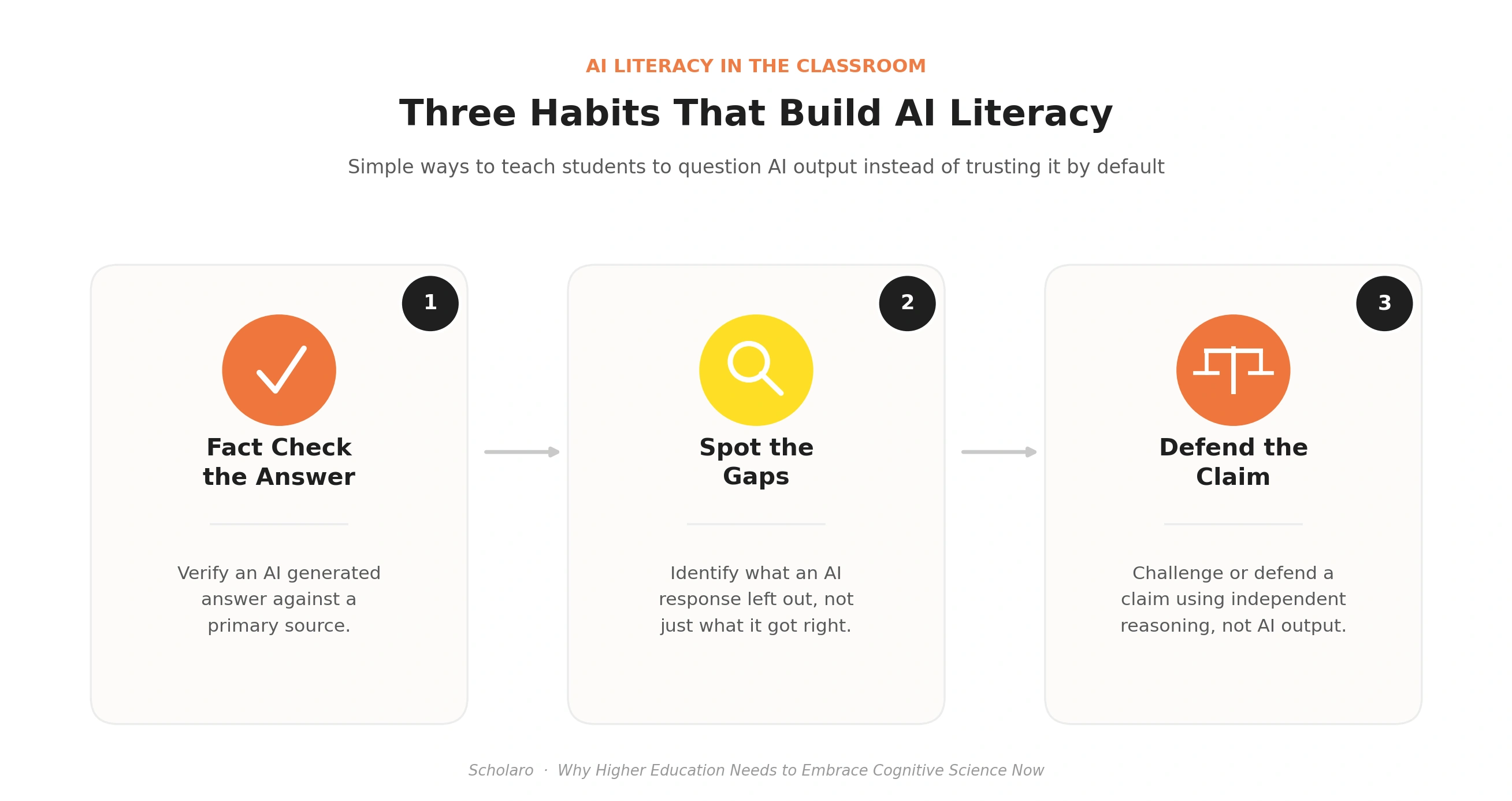
A few ways to build that habit into coursework:
Have students fact check an AI generated answer against a primary source
Ask students to identify what an AI response left out, not just what it got right
Build in assignments where students defend or challenge a claim with their own reasoning
None of this takes a full curriculum overhaul. It takes deliberate design, and a willingness to slow students down at the exact moments they'd rather speed up.
Critical Thinking Doesn't Just Happen, You Have to Teach It
Most course design assumes critical thinking develops naturally as a byproduct of content. Read enough material, write enough papers, and it'll just show up. That assumption was already shaky. AI makes it false.
If students can generate a polished paper without doing the underlying thinking, and nothing in the course structure forces retrieval, spacing, or scaffolded practice, the thinking skill simply doesn't develop. That's not a student problem. That's a design problem, and it sits with the people who build the curriculum.
This is also why it can't be left to individual instructors who happen to care about it. It needs to be a standard baked into course design across departments, the same way learning outcomes or accreditation requirements are.
Programs built around skills employers actually test for already lean this direction, since judgment and reasoning are exactly what AI can't replicate on a candidate's behalf.
Institutional Inertia Is the Real Risk
AI isn't the threat here. Inertia is. Every semester a curriculum leaves retrieval, spacing, and scaffolding to chance is a semester where AI does more of the thinking than the students do. The research already exists. What's missing is the institutional will to build it into how you teach, and that has to change now, not after the next accreditation cycle.
 5 ways colleges can make career prep 'unavoidable' for students
 The Real Economics Behind Entry-Level Gigs
 Can 3-Year Degrees Solve the Teacher Shortage?
 Does College Public Speaking Really Matter in Today’s Job Market?
 Strategies for Communicating Tuition and Outcomes to Prospective Students