
Picture this: you get the enrollment numbers Monday morning, a budget question Tuesday afternoon, and a staff resignation by Friday. That's not a bad week. That's the job now. If you're running a campus in 2026, the ground doesn't stop shifting long enough for you to plan around stability. The leaders who do well aren't the ones with every answer. They're the ones who know how to choose well without one.

Here's what that actually looks like.
Before we get into the how, look at the shape of what you're up against. These numbers aren't background noise, they're the structural shifts driving everything below:
What's happening | The number |
|---|---|
Average time a college president stays in the job | 5.9 years, down from 8.5 in 2006 |
Staff likely to job hunt this year | 1 in 4 |
Exempt staff turnover since the pandemic | Up from 7.9% to 14.3% |
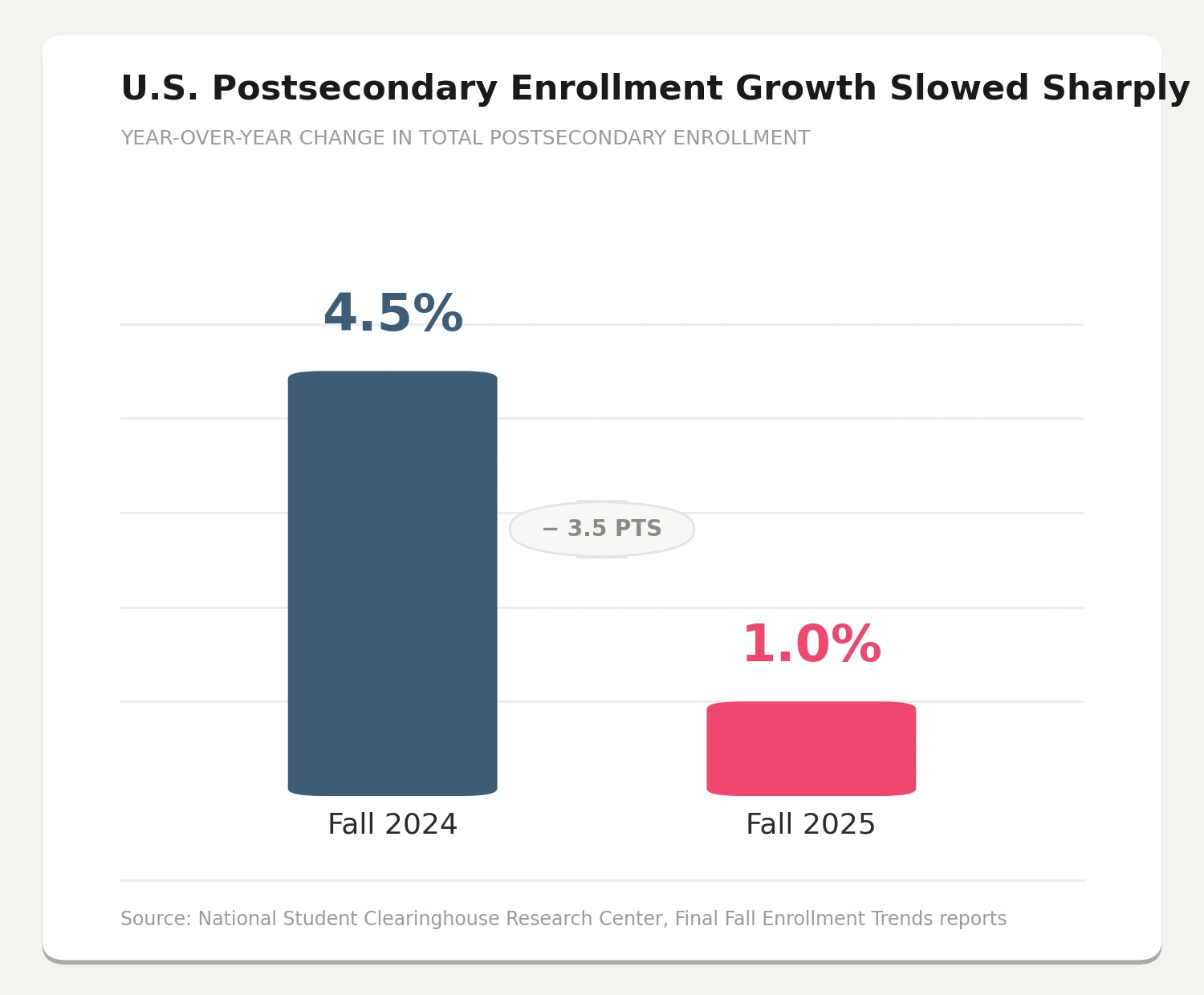
Enrollment growth, fall 2025 vs. the year before | 1%, down from 4% |
Every row here shows up again in the sections below. Let's break down what to actually do about them.
Stop Waiting for Things to Calm Down
A lot of leaders make decisions like a storm is passing through. Hunker down, wait it out, get back to normal once it clears.
That's not how this works anymore. The American Council on Education survey found presidents now stay in the job for 5.9 years on average, down from 8.5 back in 2006. Even the top office isn't stable. If you're planning around a return to normal, you're planning around something that isn't coming.
Say a provost holds off on adjusting the budget until enrollment numbers settle. They'll be waiting for years that never arrive. The better move is building a process that works without full information, not one that stalls until you get it.
Talk Now, Even Without All the Answers
Staff and faculty can handle bad news. What they can't handle is silence.
When leadership goes quiet, people fill in the blanks themselves. And they usually guess worse than reality. So say what you know. Say what you don't. Tell people when you'll know more.
Think about a chancellor who sends one campus wide update in March and then goes dark until fall. Staff spend those months assuming the worst. A short monthly note beats a polished quarterly one every time.
This isn't about sounding confident for the sake of it. It's about being honest in a way people can actually use.
Burnout Is Already Draining Your Team
Your staff are tired, and the data backs it up. CUPA-HR's 2025 survey found one in four higher ed employees are likely to look for a new job this year. Voluntary turnover for exempt staff jumped from 7.9% before the pandemic to 14.3% after it.
Here's the part that surprises people: pay isn't the biggest driver. Feeling valued and having a manageable workload matter more. A few things that actually move the needle:
Audit workloads honestly: not on paper, in practice
Train managers properly: give them real tools to support stretched teams
Offer flexible work: wherever the job actually allows it
Name the extra work: stop pretending overload is normal
Burned out staff can't support students well either. If a student can't get a timely answer from an advising office running on half its usual staff, for example, that gap traces straight back to a leadership decision that didn't account for burnout.
Spot Problems Before They Hit Your Enrollment
The enrollment cliff wasn't a surprise. Birth rates dropped after 2008, and anyone doing the math knew the high school graduate pipeline would shrink about 18 years later. That's exactly what's happening now. Some schools saw it coming and adjusted early. Others are scrambling.
Watching for what's ahead only works if you've got real data behind it, not a once a year planning retreat. That means:
Report regularly: get numbers to decision makers, not just committees
Track leading indicators: not just this year's enrollment count
Build in review points: don't wait for a crisis to force one
If a student picks a major and finds out mid year that the program is getting cut because nobody flagged the enrollment drop early, for example, that's the real cost of skipping this step. The stakes aren't abstract. They land on actual people.
Get Everyone Pulling in the Same Direction
Uncertainty gets worse when departments work in isolation. Take a recruitment push built around a program that finance already flagged for cuts. Both sides waste months before anyone notices.
Presidents and chancellors set the tone here. When they model open collaboration instead of top down mandates, other departments follow. Alignment isn't a meeting. It's a habit:
Share budget constraints: with the people actually planning around them
Loop in enrollment data: early, not after academic plans are locked
Make priorities visible: so teams aren't guessing what matters most
None of this requires a big restructure. It requires people actually talking to each other before decisions get made, not after.
Where You Start
You can't control the enrollment cliff or the next budget shortfall. You can control how clearly you communicate, how well you support your people, and how early you catch what's coming. Start with one of these five, and build from there.
 5 ways colleges can make career prep 'unavoidable' for students
 The Real Economics Behind Entry-Level Gigs
 Can 3-Year Degrees Solve the Teacher Shortage?
 Does College Public Speaking Really Matter in Today’s Job Market?
 Strategies for Communicating Tuition and Outcomes to Prospective Students