

College students are shaping the future of U.S. tech in 2026 by forcing institutions to move faster than they planned. Their expectations around AI, flexible learning, and career-ready credentials are rewriting how universities build infrastructure, design programs, and prove their value. For university leaders, this is not a slow evolution. It is a year of hard decisions driven by students who have already made theirs.
This article breaks down the five areas where student behavior is having the most direct impact on how American higher education intersects with technology, and what academic decision-makers should do about it.
From Pilot Programs to Full AI Infrastructure
Students no longer treat AI as a novelty. They expect it woven into advising, coursework, admissions, and daily campus operations. That expectation is the single biggest force pushing institutions past the experimentation phase and into enterprise-wide adoption.
The California State University system has partnered with Microsoft, OpenAI, and Google to give hundreds of thousands of students and staff access to AI tools. Ohio State University now requires AI fluency for every student, as Inside Higher Ed reported earlier this year. These are not peripheral programs. They represent a structural shift in what a university provides.
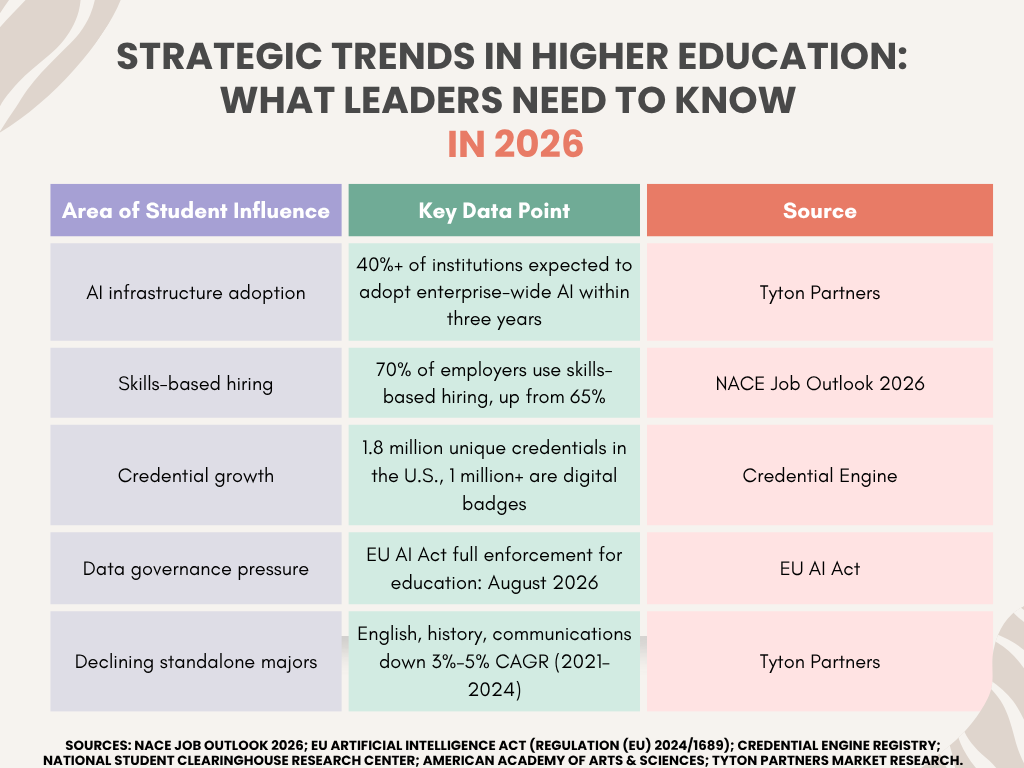
Campus Technology's 2026 predictions report captures the scale of this change: AI is expected to move from standalone tools to embedded campus infrastructure across admissions, advising, student services, learning, and administration. Tyton Partners projects that more than 40% of institutions will adopt AI at the enterprise level and implement institution-wide AI policies within the next three years.
Packback's research team predicts that by end of 2026, AI literacy will be embedded across programs at forward-thinking institutions. The definition of "authentic student work" is also changing. Assessment is shifting toward evaluating how students think with AI, not whether they avoided it.
For university leaders, the implication is straightforward. AI is no longer an IT project. It is institutional infrastructure. Budget it, govern it, and staff it accordingly.
Skills Over Degrees: The Microcredential Surge
Students are not waiting four years to prove they can do something useful. They want targeted credentials that employers recognize, in fields like AI, data science, and cybersecurity. This demand is accelerating the growth of microcredentials and digital badges at a pace that traditional degree programs cannot match.
Credential Engine's latest report puts the number of unique credentials in the U.S. at 1.8 million. Digital badges account for over one million of those offerings, according to Inside Higher Ed. That is a massive jump from the 1.07 million credentials counted in 2022.
Employer behavior is reinforcing the trend. The National Association of Colleges and Employers (NACE) reports in its Job Outlook 2026 survey that 70% of employers now use skills-based hiring for entry-level positions, up from 65% the prior year. GPA screening continues to decline: only 42% of employers use it, down from 73% in 2019.
Federal policy is also catching up. The passage of the 2025 H.R.1 legislation includes a Workforce Pell provision that will let low-income students use Pell grants for credential programs as short as eight weeks. Deloitte's 2026 higher education outlook identifies this as a driver of demand for non-degree credentials, though details are still being finalized before the July 2026 effective date.
Analysts project the digital badges market will grow at a rate above 17% annually through 2032. This is a structural shift, not a passing interest.
University leaders should treat microcredentials as a core product line. Build stackable pathways that connect short credentials to degree programs. Align offerings with employer hiring data. Students who can show proof of specific competencies will have an advantage in a job market that increasingly cares less about where you went and more about what you can do.
Hybrid, Flexible, and Immersive Learning on Student Terms
Students expect to learn on their own schedule, from any device, in formats that go beyond recorded lectures. This is pushing institutions toward AR/VR labs, cloud-based platforms, and course delivery that works regardless of location or hardware.
Campus Technology reports that ed tech investment is shifting toward immersive learning tools and cloud-enabled, device-agnostic software access. Universities like Ohio University, the University of Maryland Global Campus, and Purdue are already running virtual labs and VR-based clinical simulations for online students. These are not gimmicks. They solve a real problem: giving online students hands-on experience in technical and scientific fields.
The campus model emerging in 2026 is "hub and spoke." The physical campus serves as one node in a larger network of synchronous, asynchronous, and immersive learning options. eCampus News characterizes 2026 as the moment many institutions move from pilots to integration of these tools.
For academic decision-makers, the priority is interoperability. Your CRM, student information system, and learning management platform need to share data seamlessly. Without that integration, personalized support and real-time intervention become impossible. Technology investment without systems integration is just spending.
Data Privacy, Security, and Ethical AI
Today's students grew up with data breaches, targeted ads, and algorithm-driven feeds. They are not naive about how their information gets used. This awareness is pushing institutions to take data governance and ethical AI more seriously than they might otherwise.
EdTech Magazine reports that universities must balance AI adoption with compliance under FERPA, state-level biometric privacy laws, and recording consent statutes. The recommendation is to form cross-functional AI committees spanning IT, legal, HR, and academic leadership.
Internationally, the pressure is intensifying. The EU AI Act reaches full enforcement for high-risk education systems in August 2026. Any U.S. institution with international partnerships, students, or aspirations needs to pay attention. The act requires conformity assessments for AI used in admissions, grading, and student progress tracking.
Campus Technology's interview with Instructure VP Ryan Lufkin makes the stakes plain: student data privacy in AI tool training is a non-negotiable requirement for vendors in the higher education space. The National Education Association (NEA) has likewise called for strict data governance policies that comply with federal regulations and protect students from breaches, misuse, and surveillance.
New America's Open Technology Institute raises a point university leaders should not ignore: many students still lack data transparency about how their information is collected, analyzed, and shared. That is a trust gap. Close it before it becomes a reputational problem.
AI governance is not just a compliance exercise. Institutions that handle it well will stand apart from those that treat it as an afterthought.
Interdisciplinary Pathways Replace Siloed Majors
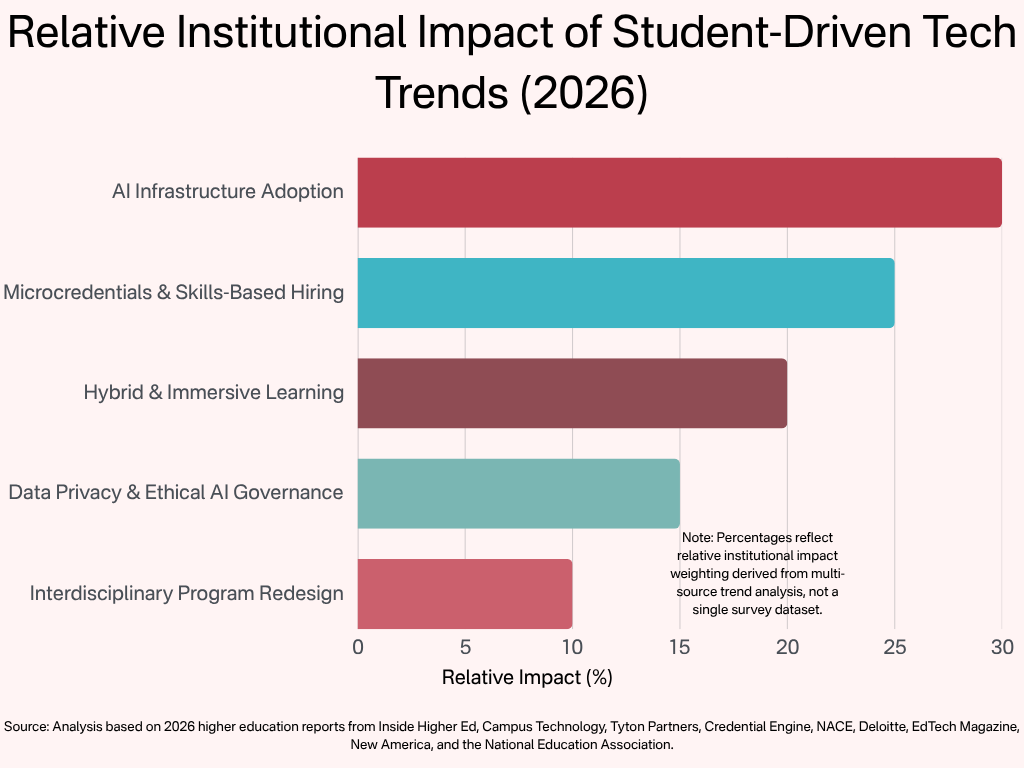
Students are turning away from traditional standalone majors. They want programs that combine humanities, social sciences, and technical skills, particularly AI fluency. The data supports their instinct.
Tyton Partners' three-year conferral analysis (2021 to 2024) shows standalone majors like English, history, and communications declining at compound annual rates of 3% to 5%. Meanwhile, interdisciplinary pathways that pair liberal arts with technical or career-aligned skills are gaining ground. The opportunity for institutions is to redesign humanities programs by embedding applied competencies and AI skills, producing graduates who can apply AI within their discipline.
Deloitte's 2026 higher education report adds another layer of urgency. New federal rules, including the 2023 Financial Value Transparency and Gainful Employment regulations and the 2025 OBBBA legislation, are increasing scrutiny on program-level outcomes like first-year earnings, job placement rates, and cohort default rates. Institutions that cannot demonstrate ROI at the program level will face both regulatory consequences and declining enrollment.
For academic leadership, this means breaking down departmental walls. Cross-disciplinary programs where technical and humanistic competencies reinforce each other are not a progressive ideal. They are a survival strategy.
What University Leaders Should Do Now
The common thread across all five areas is the same: students are not waiting for institutions to figure it out. They are making choices today that force institutional change tomorrow.
Treat AI as infrastructure. Move past the pilot phase. Budget for enterprise-wide adoption, establish governance frameworks, and hire or designate AI leadership at the institutional level.
Build microcredential ecosystems. Create stackable pathways that connect short credentials to degree programs. Align them with NACE hiring data and employer demand in your region.
Invest in interoperable platforms. Your learning management system, CRM, and student information system need to talk to each other. Without integration, personalized student support is guesswork.
Get ahead on data governance. Establish transparent AI governance before the EU AI Act's August 2026 enforcement date creates reactive pressure. Form cross-functional committees. Publish clear data use policies.
Redesign academic programs. Build interdisciplinary pathways that merge humanities with technical competencies. Track and publish program-level employment outcomes. Students and regulators are watching the same numbers.
The institutions that act on these priorities in 2026 will not just keep up with student expectations. They will define what a competitive university looks like for the next decade.
 The Real Economics Behind Entry-Level Gigs
 Can 3-Year Degrees Solve the Teacher Shortage?
 Does College Public Speaking Really Matter in Today’s Job Market?
 Strategies for Communicating Tuition and Outcomes to Prospective Students
 How Politics Is Shaping College Enrollment