
Online enrollment isn't a backup option anymore. For millions of students, it's just college. Yet a lot of institutions still build online programs as an add-on to campus operations instead of a distinct experience. That gap between what students expect and what they get is where retention problems start.
Just over half of U.S. college students take at least one course online, according to NCES data. Here's what they want in 2026, and what it costs institutions when they don't get it.
1. Faculty Engagement
This is the single biggest driver of online student satisfaction. Students rank instructor engagement above the platform, above peer interaction, above any tech feature.
One student works full-time, and her instructor only holds office hours at 10 a.m. on Tuesdays. She works mornings, can't get help when she needs it, and fails the course. The research backs this up: students in courses with more instructor and peer interaction tend to earn meaningfully higher grades than students in low-interaction courses. One large study found online courses dropped grades by roughly a third to nearly half a letter grade compared to the same course taught in person, so the gap is real, though smaller than some articles claim.
A McKinsey survey of 7,000 students found a well-organized, step-by-step course ranked in students' top five priorities in 16 of 17 countries surveyed. Structure isn't a nice-to-have.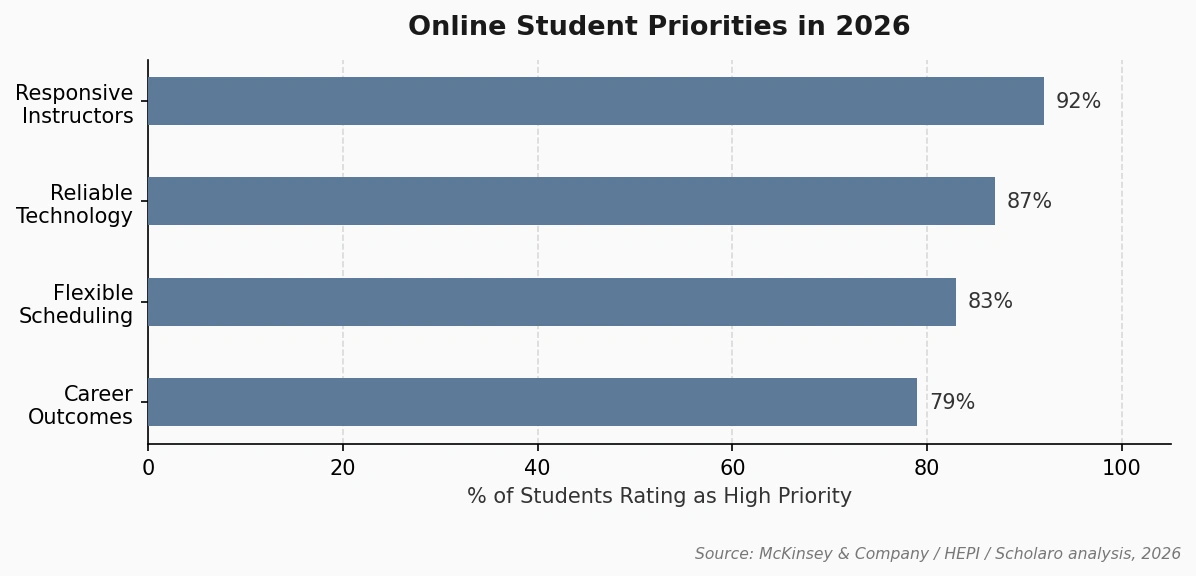
What students expect:
Feedback within a few days, not two weeks
Active instructor participation in discussion boards throughout the module
Evening or weekend office hours
A short intro video so students see a person, not just a name
Why it matters for retention: Faculty responsiveness is one of the most direct levers institutions have on online program persistence. Students who feel unsupported are more likely to stop out.
2. Technology That Works
Students don't want cutting-edge tech. They want tech that doesn't break when they need it most.
Say the LMS crashes mid-upload and a student submits her assignment five minutes late. Her instructor won't accept it. That's the kind of experience that pushes students to transfer. Per McKinsey, the three things students most want to keep virtual are recorded lectures, easy access to course materials, and flexibility to study around work. None of that requires major capital spending.
Mobile access matters more than most institutions plan for. Research from Shift eLearning, cited in McKinsey's analysis, shows mobile users complete lessons faster than desktop users. If your LMS isn't built for mobile, you're adding friction for a large share of your enrollment.
Why it matters for retention: A system that fails at high-stakes moments teaches students to distrust the institution. That distrust is a retention risk.
3. Digital Access
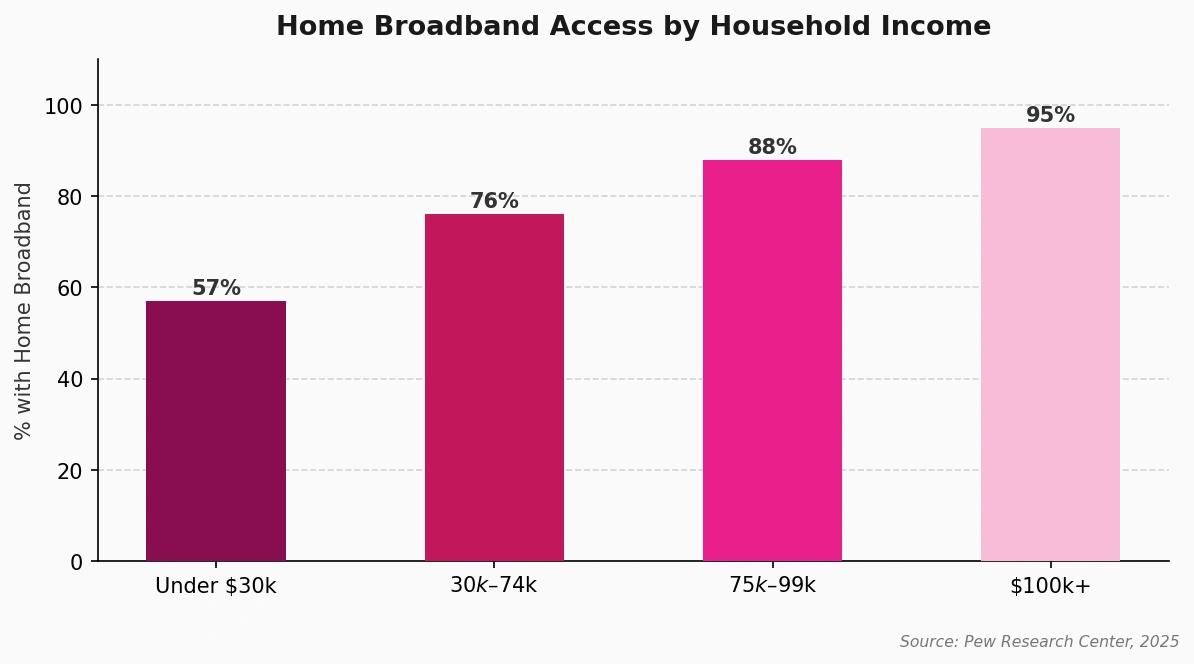
Don't assume your students have reliable internet and working devices. A meaningful share don't.
Students of color and lower-income students are disproportionately affected, and they're already at higher risk of dropping out. Connectivity gaps compound existing equity problems. Practical responses include loaner device programs, data stipends, offline-accessible materials, asynchronous alternatives to live sessions, and low-bandwidth video options.
Why it matters for retention: Research on the digital divide consistently links unreliable access to higher dropout risk. Students who can't reliably reach your platform eventually stop trying.
4. Institutional Support
Online students expect the same quality of support as on-campus students. Most institutions fall short, and that shows up in attrition numbers.
Picture a student who registers for spring courses without realizing she has a financial aid hold. She can't reach anyone until Monday, and by then her courses have been dropped. With no easy way to re-register remotely, she doesn't come back.
A Tyton Partners 2024 survey found awareness of services like academic advising, financial aid counseling, and mental health counseling sits at only about 50% among students overall, and it's lower still among fully online students.
Why it matters for retention: A 2025 study in Cogent Education found at-risk students who received extra academic support saw their graduation rates rise by 55% to 60%.
5. Career ROI
Online students are often working adults with one goal: career advancement. They're not there for the experience. They're there for the outcome.
A student enrolls in a data analytics program expecting to learn current tools, then finds two months in that the curriculum hasn't been updated in four years. She's learning software her employer already stopped using. Students with real industry exposure notice that fast.
Why it matters for retention: Students who attended even one career advising appointment had a persistence rate of 82.1%, compared to 64.2% for those who attended none, per Advance CTE. Career connection drives persistence while students are still enrolled.
6. Quality Standards
Students are skeptical of online programs that feel like a lesser version of the on-campus option. Institutions need to answer that with specifics, not marketing copy.
Suppose a student finishes an online degree, then hears from a hiring manager that the credential doesn't count the same as the in-person version from the same school. Nobody mentioned that at enrollment. That's an avoidable trust problem.
Equivalence has to show up in consistent grading standards, the same access to labs and libraries, accreditation that carries weight with employers, and honest communication about how online credentials read in hiring.
Why it matters for retention: Students who lose confidence in their credential's value mid-program are a dropout risk.
7. AI-Powered Learning Support
This is the area where student expectations have moved fastest, and where most institutions are furthest behind.
A student prepping for an exam at midnight needs feedback on practice problems, but the tutoring center closed at 5 p.m. An AI tool available at that hour can mean the difference between getting help and struggling alone. Students increasingly expect that kind of on-demand support as standard.
A 2026 HEPI survey of UK undergraduates found 49% say AI has improved their overall student experience, mainly through instant support and time saved. Institutions still treating AI as a cheating problem rather than support infrastructure are behind where student expectations already are.
Why it matters for retention: AI-powered student success platforms offering round-the-clock responsiveness have shown real retention gains in multiple recent institutional studies.
What to Prioritize in the Next 12 Months
1. Train faculty for online engagement The top driver of online student satisfaction. Your highest-leverage investment. | 2. Audit mobile accessibility Test your LMS on a phone. If it's frustrating, students leave. |
3. Expand virtual student support Advising, financial aid, mental health, and tech support need hours outside the standard workday. | 4. Publish employment outcomes Put specific graduate outcomes on your program pages. Vague claims don't hold up. |
5. Review online quality standards Apply the same accreditation and faculty development standards online that you apply on campus. | 6. Develop AI-assisted student support Start with tutoring and early alert systems. Students already expect this. |
What It Takes to Win Online
The institutions winning online education aren't the ones with the most technology. They're the ones that remove friction. Students keep asking for the same things: responsive instructors, dependable systems, accessible support, and clear career value. Meeting those expectations isn't a competitive edge anymore. It's the baseline.
 Strategies for Communicating Tuition and Outcomes to Prospective Students
 How Politics Is Shaping College Enrollment
 How Top Performers Land US Job Offers
 The College Majors Foreign Students Regret Choosing
 The Tightest Job Market in Years for College Grads