
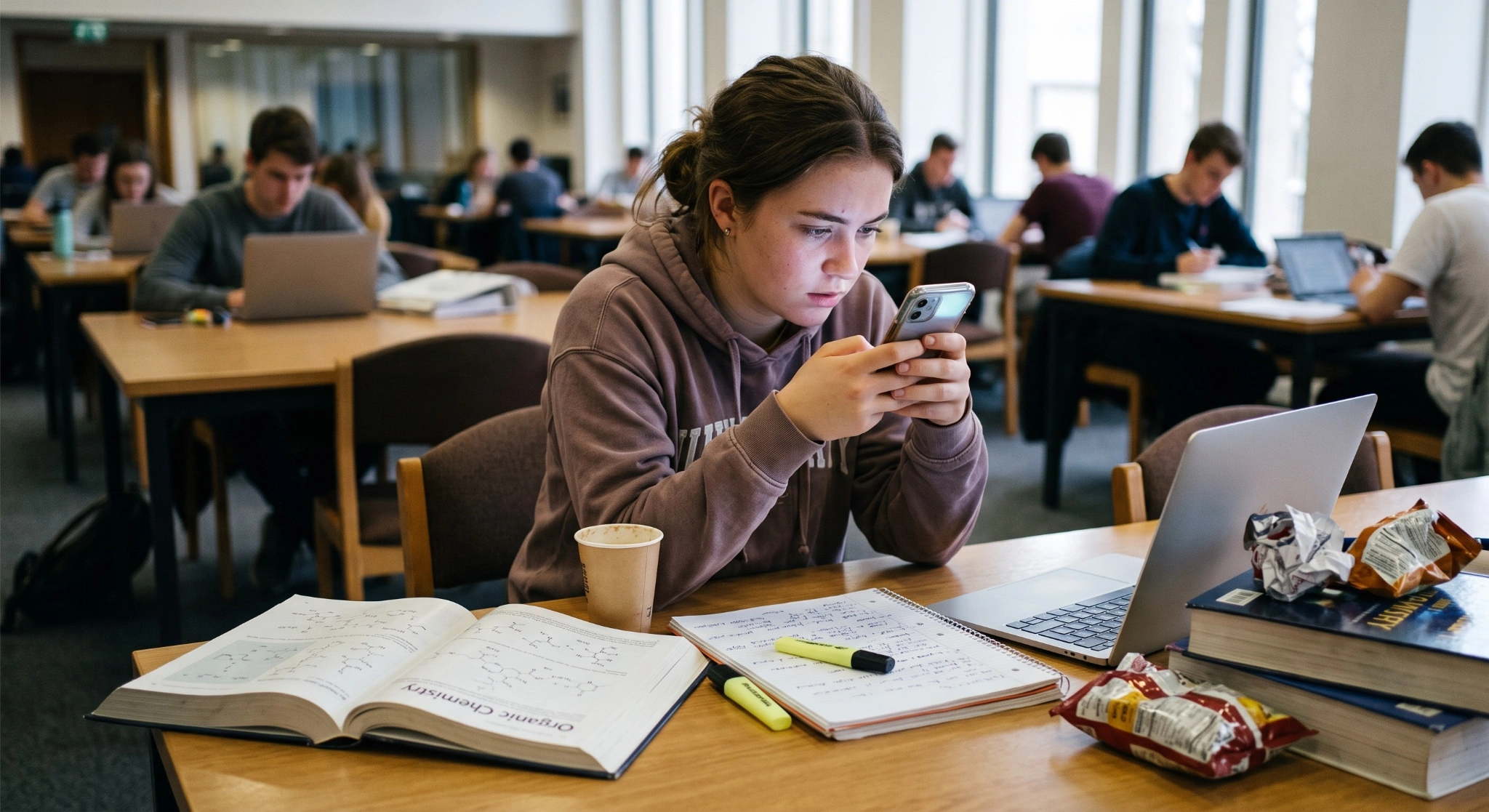
Phone use in college doesn't stay in the background. It quietly drags your GPA down every semester. Here's what's really going on, and what you can do about it.
What the Numbers Say | Stat |
|---|---|
U.S. students on recreational screens 5+ hours daily | 54% |
U.K. students (18 to 22) who say phones hurt their grades | 75%+ |
Students who want colleges to help with tech breaks | 80%+ |
How often phone distractions hit during class | Every 3 to 4 minutes |
Better note retention when phone is put away | 62% more |
Your GPA Drops Faster Than You'd Guess
The numbers are pretty clear on this. For every 1% jump in smartphone use, GPA drops by 0.33% on average. That sounds small until you stack it over a full semester of heavy scrolling.
A 2024 study tracking over 2,000 college students found something else too. Phone use pushes up anxiety, and higher anxiety pulls grades down even further. It's a one two punch.
Your Notes Disappear When Your Phone Comes Out
Students who kept their phones away during class wrote down 62% more notes. They also scored a letter grade and a half higher on tests compared to classmates who kept their phones out on the desk.
Sound familiar? A student, for example, told their professor they'd paid attention the whole lecture. They'd also checked their phone 14 times. Their notes from that class fit on half a page.
Short Videos Are Wrecking Your Focus
TikTok and Instagram train your brain to expect something new every 10 seconds. A textbook chapter does not work that way. The more short form content you scroll through, the harder it gets to sit still with something that takes real effort.
For example: a student sits down to read 10 pages for class. Twenty minutes later they've read the same paragraph four times, and the phone is already back in their hand. That's not laziness. That's conditioning.
Bad Sleep Makes Everything Worse
Around 60% of college students already sleep badly. Keeping your phone in the bedroom makes it worse. Poor sleep breaks memory consolidation, so everything you studied the night before doesn't stick the way it should.
Stress Sends You Straight to Your Phone
When things get overwhelming, most students grab their phone. It feels like a break. It's actually avoidance. Research in BMC Psychology found that academic anxiety is a real driver of smartphone addiction, with self-regulation running low being a big part of why. So if coursework has you anxious, that's exactly when your phone starts winning more often.
3 Groups Who Feel It the Most
Phone use hits some students harder than others:
First year students who are still settling in and lean on their phone for comfort in an unfamiliar place.
International students who rely on apps to stay close to home, which makes it hard to set limits.
Students with lower self control, who find it harder to put the phone down even when they know they should.
For example: a first year student moving to a new city kept their phone on all night to stay in touch with friends back home. By week four, they were missing morning lectures because they hadn't slept properly in weeks. A quick look at how credit systems and grading work at a new school, through a resource like Scholaro, can also ease some of that late night anxiety about falling behind.
4 Reasons You Can't Put It Down
Apps are built to hook you. Notifications, streaks, and personalized feeds all push you to check in. You're up against serious engineering here.
FOMO is real. Logging off feels risky when social life, group chats, and class updates all run through the same apps.
Stress triggers it. When coursework piles up, your phone feels like an escape. Using it that way just makes things worse.
Everyone else is doing it. In a big lecture hall where half the room is on their phone, it feels normal. The room trains you into the habit.
5 Fixes You Can Start Today
You don't need to wait for your college to fix this. 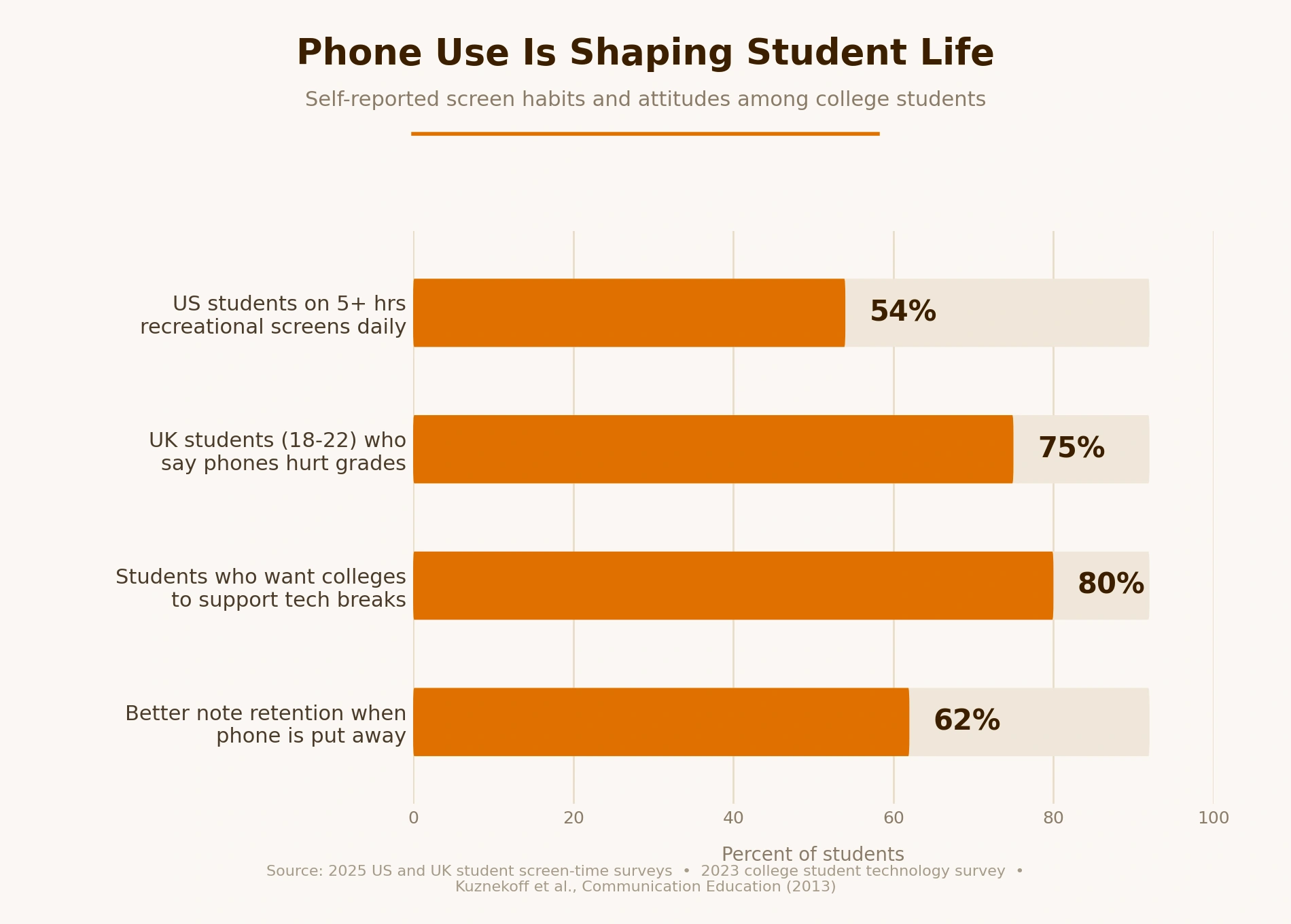
Start here:
Turn off non-essential notifications. This is the fastest win. Fewer pings, fewer interruptions.
Run phone-free study blocks. Set a timer for 45 to 90 minutes. Put your phone in another room, face down. Not on silent on the desk. Another room.
Get your phone out of the bedroom. Buy a cheap alarm clock and use that instead. A tech free hour before bed makes a real difference.
Use your phone's built in screen time tools. Set app limits. They're already there. Most people just never turn them on.
Schedule your social time. Instead of staying logged on all day, pick a window for catching up with people. It cuts FOMO without cutting you off.
One student's fix: a student, for example, started leaving their phone in their bag during lectures. That one change was enough. Their notes got good enough that they stopped needing to re-read whole chapters before exams.
Colleges Are Starting to Notice
Over 80% of students want their college to help them manage this. Some schools are starting to listen:
Some have set up phone free spaces and classrooms.
Others are testing apps that reward students for staying off their phones during lectures.
A few first year programs now track sleep and screen time as part of student wellbeing.
Your Phone, Your Call
Your phone isn't going anywhere. But how you use it decides a lot of your GPA. Turn off notifications, get it out of your bedroom, and watch what changes by finals.
 The Tightest Job Market in Years for College Grads
 How Universities Are Adapting Health Programs to a Moderating Job Market
 How Flexible Are PhDs in a Changing Job Market
 Understanding the Decline of International Enrollment in American Universities
 Why AI Writing Polish Can Flatten Student Expression