Video-based learning on your phone isn't a side habit anymore. It's how most students study in 2026. The eLearning market size sits at roughly $276 billion this year and analysts expect it to hit $462 billion by 2031. Mobile drives a growing chunk of that. Pick the wrong app and you waste your data, your time, and sometimes your money.

See How the Top Apps Stack Up
Platform | Best For | Standout Feature | Price (2026) |
|---|---|---|---|
Coursera | Academic credentials | AI study assistant | Free / $399 per year |
Udemy | Practical tech skills | Buy once, keep forever | $10 to $200 per course |
Khan Academy | Foundational subjects | Khanmigo AI tutor | Free / $4 per month |
LinkedIn Learning | Career skills | Syncs to your profile | Subscription |
YouTube | Quick tutorials | Search by voice or image | Free / $15.99 per month |
edX | University rigor | Stackable credentials | Free / $50 and up |
What Your Phone Actually Needs From an App
Plenty of these platforms started life on desktop and got bolted onto a phone later. You can tell. Slow loading, oversized video files, and buttons that don't work on a small screen all push people to quit.
Here's what a mobile app needs to get right in 2026:
A real app, not a shrunk website, with offline downloads and progress that syncs across your devices
Video shot for a phone screen, not just cropped from a widescreen lecture
Smart video quality that drops automatically so playback doesn't stall when your signal does
Some kind of AI helper built in, since offline mode alone doesn't cut it anymore
Quizzes that interrupt the video to ask you something, instead of letting you zone out for ten minutes
If a student, for example, tries to study on a subway with no signal and the app has no offline mode, that app is dead weight. Check for offline access before anything else.
Why Everyone's Watching Shorter Clips
The biggest shift in video learning right now is length. Long lecture recordings are losing to short, focused clips. Students who grew up on short-form video expect the same pace from their coursework.
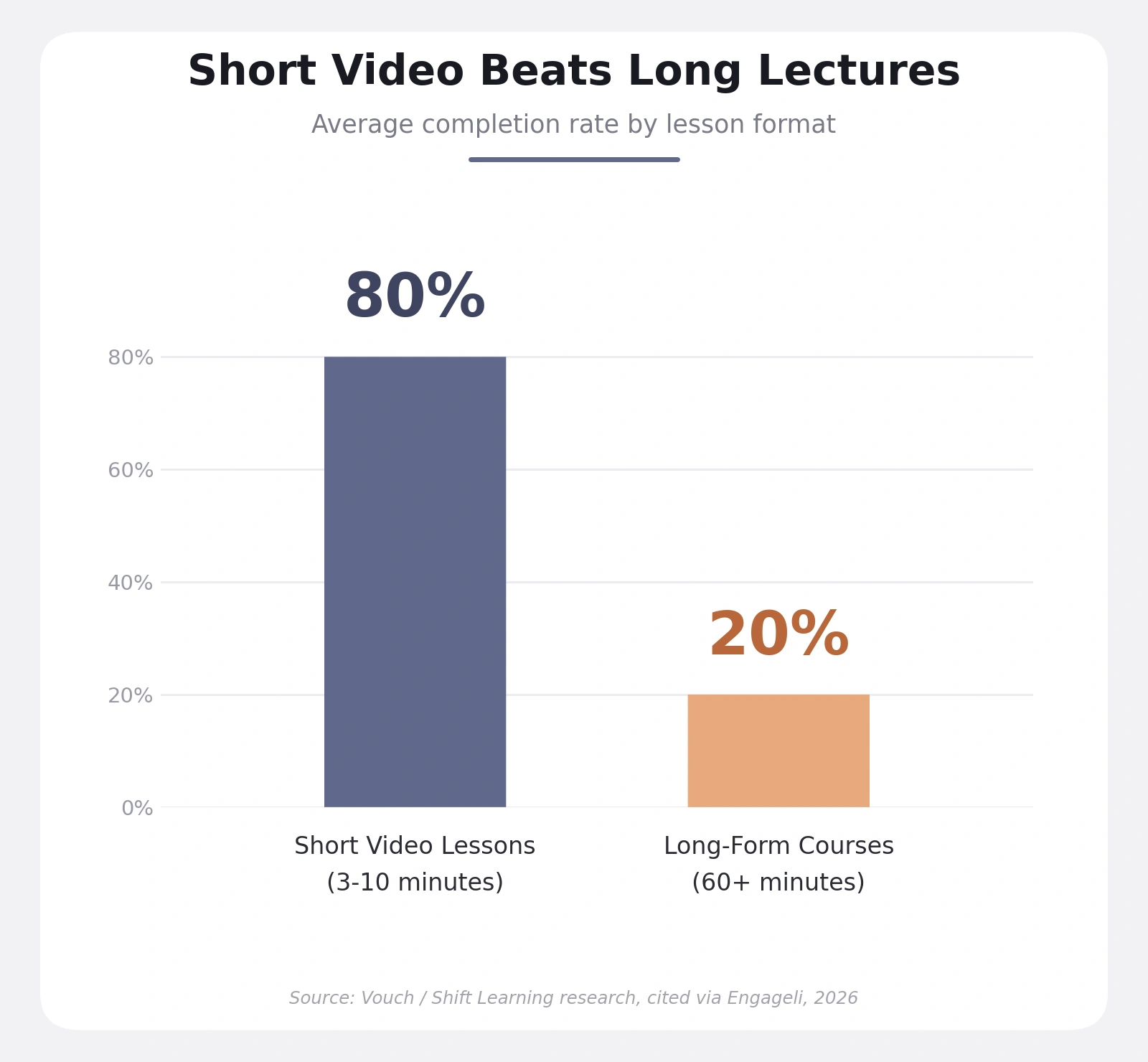
Lessons that run 3 to 10 minutes now dominate mobile learning. According to a microlearning statistics report, these short lessons finish at around an 80% completion rate, against roughly 20% for long-form courses. Pair that with AI sequencing, and platforms that adapt to what you already know tend to push completion rates up by another 35 to 45% compared to a static playlist.
Look for apps built around short segments you can finish on a coffee break, not ones built around hour-long sessions.
Coursera: Real Credentials, Real Weight
Coursera works with universities and companies including Yale, Stanford, Google, and IBM, and passed 205 million registered learners in early 2026. For international students, that credential value is real. A certificate from a name-brand school carries more weight with a US hiring manager than a random course completion.
The mobile standout is Coursera Coach, an AI assistant that answers questions about your course material and summarizes dense lectures, handy when you're reviewing on the bus. The app also handles offline downloads and quizzes cleanly.
Cost: Free to audit most courses. Coursera Plus runs $399 a year.
One thing worth knowing: Coursera announced a merger with Udemy in late 2025, expected to close in the second half of 2026. If you're picking a platform for the long haul, watch how that plays out.
If you already have a foreign degree evaluated through a service like Scholaro, a Coursera or edX certificate stacks on top of that nicely. It gives a US employer something current to look at alongside your degree equivalency.
Udemy: Skills Without the Subscription
Udemy's library runs past 270,000 courses, and you pay once instead of subscribing. AI-generated paths now sequence courses based on gaps in your skills, so it feels less like scrolling a catalog and more like a guided track.
The catch: anyone can publish a course here, so quality swings wildly. Read reviews before you buy. Certificates carry less weight than a university-backed one, but for hands-on skill building, the content is often solid and cheap.
Cost: Courses run $10 to $200, though sales regularly drop that under $20.
Khan Academy: Free, But It Has a Ceiling
Khan Academy is free and covers math, science, economics, and more through short video lessons. Its AI tutor, Khanmigo, asks you guiding questions instead of just handing over answers, which sticks better than a straight lecture.
The limit is scope. It's built for foundational and K to 12 through college-level material, so graduate students hit a wall fast. It also leans toward the US curriculum, which matters if you studied elsewhere. One more limit for international students specifically: Khanmigo needs a US billing address, so you can't buy the individual subscription from outside the US. The free core platform still works everywhere.
Cost: Free. Khanmigo runs $4 a month for US accounts.
YouTube: Fast Answers, Zero Structure
Nothing beats YouTube for sheer volume of video tutorials. You can now search by describing a concept in plain language or by uploading an image, which speeds up finding what you need. For quick topic introductions, it's hard to top.
But there's no curriculum, no progress tracking, and the algorithm will happily drag you off-topic if you let it. Ads interrupt the free tier. If you already know exactly what you're looking for, it works. If you need structure, look elsewhere.
Cost: Free. YouTube Premium removes ads for $15.99 a month, after a price increase in June 2026.
LinkedIn Learning: Skills That Show Up on Your Profile
LinkedIn Learning focuses on business, technology, and creative skills through video. The main draw is the direct tie to your profile. Finish a course and it appears there right away, which matters if you're job hunting.
The app itself is clean. You can download courses for offline viewing and pick up where you left off on another device.
Cost: Subscription-based, though many people get it free through a university or public library account.
edX: Build a Degree in Pieces
edX was founded by Harvard and MIT and hosts courses from schools including MIT, Harvard, and Berkeley. Its MicroMasters programs let you stack short, credentialed courses toward a full master's degree, so you can build qualifications on your phone without committing to a full program right away.
The app is functional rather than polished, but it handles offline access and video playback fine. The course quality makes up for the rougher interface.
Cost: Free to audit. Verified certificates run $50 to $300 per course.
The Apps Your School Already Picked for You
If you're at a US university, you're probably using Canvas, Blackboard, or Moodle already. You don't choose these, your school does. All three handle video and assignment submission on a phone reasonably well, though the experience varies by school.
For graduate students moving into the workforce, mobile learning solutions like TalentLMS are common in employer training programs, so it's worth getting comfortable with an LMS before you graduate, not after.
What Gen Z Actually Wants From Class
Gen Z wants practical, usable content over theory. Survey work from TalentLMS keeps landing on the same point: younger workers say they'd pay more attention if training came in short, on-demand pieces instead of long sessions.
The subjects getting the most attention: AI tools, data skills, entrepreneurship, mental health, and sustainability. For technical skills, Udemy and Coursera's professional certificates line up well with what employers are asking for. For career and creative skills, LinkedIn Learning fits better.
Why Two Apps Beat Five
Most students don't need more than two platforms running at once. Spreading across five just means more switching and no real gain. Here's a simpler split:
One for the credential. Use Coursera or edX for whatever goes on your resume. These carry institutional weight the others don't. Take your time and finish the program.
One for fast skills. Use Udemy or YouTube for the stuff that moves quickly and needs updating often, like a new AI tool or a framework that changed last month. These don't need a certificate. They need to be current.
If a student, for example, is applying for jobs in three months, the credential platform matters more right now than the skills one. Match the platform to the deadline you're actually facing.
Where Mobile Learning Is Headed
Online learning doesn't replace a degree, it backs it up. US hiring managers still favor Coursera and edX certificates because of where they come from. Shorter content, AI personalization, and phone-first design are where every platform is putting its money. A good mobile app isn't optional anymore. It's the baseline.
 How Universities Use Zero-Waste Swap Programs to Cut Student Costs
 How Industry Partnerships Shape Modern Curricula
 How Post-COVID Aid Programs Help Universities Rebuild Admissions
 Beyond the Acceptance Rate and How Colleges Decide Who Gets In
 How Leveraging Job Placement Strategies Can Reenroll Returning Students