
College students today face unprecedented levels of stress, anxiety, and mental fatigue. Balancing coursework, jobs, social obligations, and career planning drains cognitive resources fast. But there's a simple, free tool that can help you think more clearly, feel better, and perform at a higher level: spending time in nature.
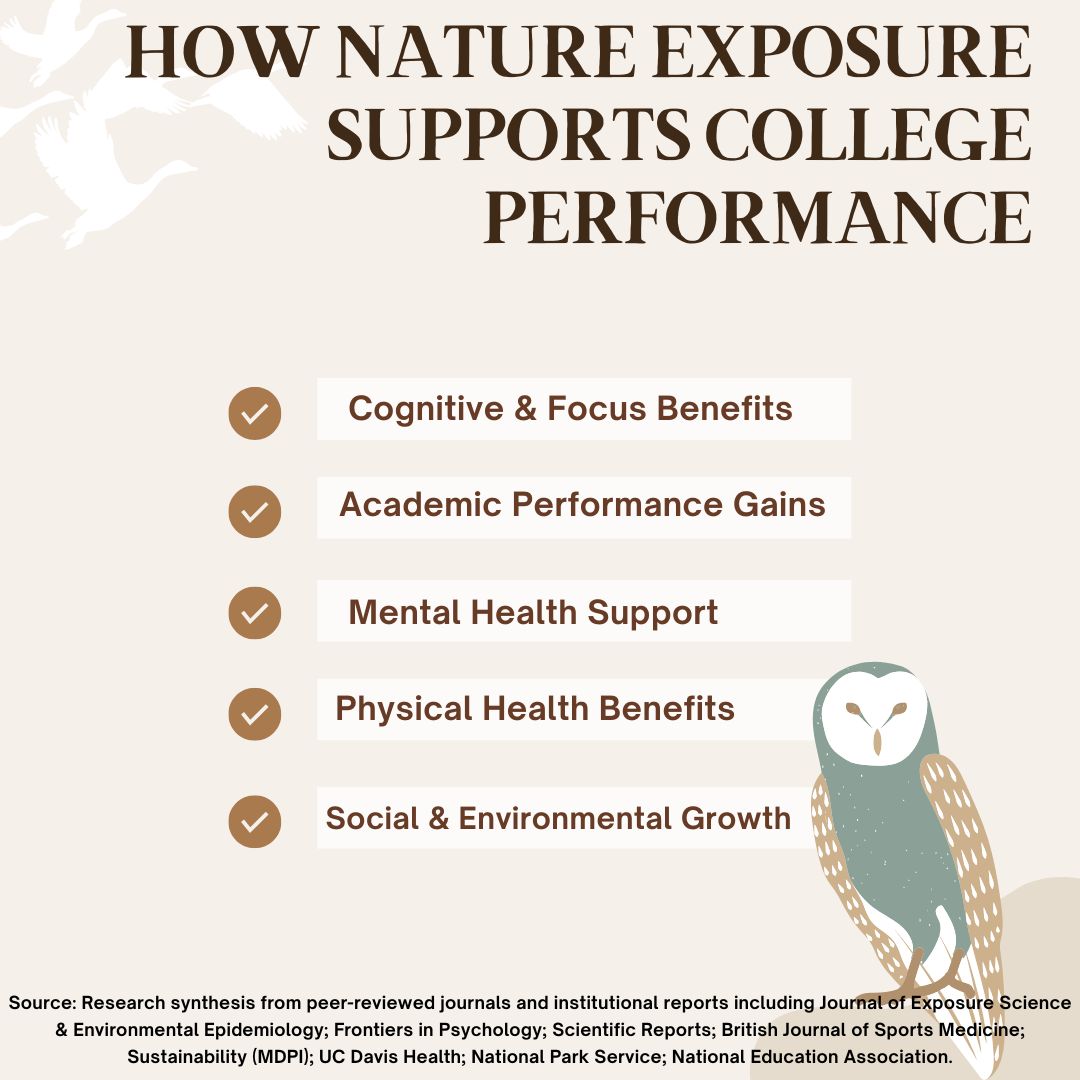
Time outdoors sharpens focus, protects mental health, strengthens the body, builds social skills, and fosters environmental awareness. Understanding how nature affects your brain and body can help you use it strategically throughout your college years.
How Green Spaces Sharpen Thinking and Reasoning
Your brain uses two types of attention. Directed attention requires effort and concentration. You use it when studying, writing papers, or solving problems. Involuntary attention happens automatically when something interesting catches your eye. College coursework drains directed attention, leaving you mentally exhausted.
Natural environments offer a solution. Attention Restoration Theory, developed by environmental psychologists Rachel and Stephen Kaplan, explains that green spaces engage your involuntary attention through what researchers call soft fascination. Watching leaves move in the wind or listening to birds requires no mental effort. This gives your directed attention a chance to recover.
The cognitive benefits are measurable. A systematic review published in the Journal of Exposure Science & Environmental Epidemiology found that working memory and cognitive flexibility improve after nature exposure. A study in CBE Life Sciences Education showed that students who grew up with frequent contact with natural environments earned higher grades in college courses than peers with less nature exposure. Short breaks in green spaces during the study day can restore attention and reduce fatigue.
The practical application is straightforward. Take your study breaks outside rather than scrolling on your phone. Walk through tree-lined paths between classes. Choose study spots with window views of greenery. These small changes add up.
Boosting Concentration and Academic Performance
Nature exposure directly supports academic success. A review in Frontiers in Psychology found that green campus surroundings correlate with better performance on standardized tests, even after accounting for socioeconomic factors. Students in outdoor learning settings show higher motivation, engagement, and persistence in learning.
You don't need hours in the wilderness to see benefits. Ten to 20 minutes of nature exposure can improve mood and focus among college students. The optimal dose appears to be 20 to 30 minutes of sitting or walking in green settings.
Universities are catching on. The Campus Nature Rx Network, a coalition of over 50 U.S. colleges and universities including Cornell University and UC Davis, now prescribes time outdoors to support student well-being and cognitive function. These programs recognize that green spaces are not just amenities but tools for academic success.
Students with attention difficulties benefit particularly. The Children & Nature Network reports that green outdoor settings can reduce ADHD symptoms across diverse populations. If you struggle to concentrate, structured outdoor breaks may help more than another cup of coffee.
Supporting Psychological Well-Being
Mental health challenges on campus have reached historic levels. Depression, anxiety, and overwhelming stress affect a significant portion of college students. The National Education Association reports that emotional stress is a leading withdrawal reason for many students. Campus counseling centers face overwhelming demand and long wait times.
Nature offers accessible relief. UC Davis Health reports that time in green spaces reduces cortisol levels and lowers physiological markers of stress. Interaction with natural environments relieves anxiety, eliminates fatigue, and boosts subjective vitality. A randomized controlled trial published in Scientific Reports found that daily virtual nature exposure decreased anxiety symptoms among college students over several weeks.
Nature builds resilience. Students with more green space exposure tend to recover better from stressful life events in terms of self-worth and emotional distress. Nature connectedness fosters a sense of meaning and psychological strength that carries through difficult times.
Regular nature exposure doesn't replace professional mental health support when you need it. It can serve as a buffer against daily stress and a complement to other wellness strategies.
Strengthening Physical Health Through Outdoor Activity
The physical benefits of outdoor activity extend beyond basic exercise. A meta-analysis published in the British Journal of Sports Medicine found that outdoor walking groups improve key health markers like blood pressure, heart rate, and body fat more effectively than indoor exercise alone. Physical activity in green spaces lowers heart rate, reduces muscle tension, and supports heart health.
Your immune system benefits too. Forest walking can boost white blood cells that help fight infection. The U.S. National Park Service notes that sunlight exposure regulates sleep cycles and increases vitamin D, which supports bone health, mood, and immune function.
Outdoor exercise is easier to stick with. People who exercise outdoors tend to do so longer and at greater intensity than those who work out indoors. Walking group participants show remarkable adherence to exercise routines over time. When physical activity feels less like a chore and more like an experience, you're more likely to keep doing it.
The college years set habits that last. Building outdoor activity into your routine now establishes patterns that support health long after graduation.
Building Connections Through Nature-Based Activities
College success depends partly on relationships. Study groups, professional networks, and friendships all require social skills. Nature-based activities offer a unique setting to develop them.
Campus green spaces function as social venues. A study in Frontiers in Public Health found that outdoor environments maximize interpersonal contact and idea exchange among students. Open lawns, athletic fields, and campus trails provide relaxed settings where conversation flows naturally. The Journal of Environmental Psychology reports that shared time in nature increases social connection among university students.
Outdoor clubs and hiking groups take this further. These organizations bring together people from various backgrounds who share common interests in the outdoors. Group activities require participants to communicate and problem-solve in real time. You can't complete a group hike without coordination, patience, and mutual support.
Outward Bound, a nonprofit outdoor education organization, develops teamwork through challenges and mutual reliance. Penn State's Outdoor Adventures program promotes collaboration and critical thinking through activities like ropes courses, climbing, and group expeditions. Students practice leadership by guiding others, making decisions under pressure, and motivating teammates.
First-year orientation programs that include outdoor components help students build relationships quickly. Working together on a trail or campsite creates bonds faster than sitting in a lecture hall. These early connections often become lasting friendships and professional networks.
Developing Environmental Stewardship
Time in nature changes how you see the world. Students who interact with natural ecosystems develop ecological understanding and sustainability awareness. This happens through direct experience, not just classroom learning.
Environmental awareness has both cognitive and emotional components. Knowing facts about climate change matters. But personal nature experience creates the emotional connection that drives action. You're more likely to care about protecting something you've experienced firsthand.
This translates into behavior. A study in Sustainability found that sustainability education combined with nature exposure increases environmental action among college students. Campus environments with sustainable infrastructure shape greener habits in students. Those with higher environmental self-efficacy are more likely to adopt sustainable practices that persist after graduation.
This matters for your career too. Employers increasingly value environmental literacy. Sustainability roles are growing across industries. The habits of stewardship you develop now position you for a changing job market.
Putting It Into Practice
Knowing the benefits is one thing. Acting on them is another. Here's how to build nature exposure into your college life.
Daily habits: Take study breaks outdoors instead of scrolling on your phone. Walk through green spaces between classes. Eat meals outside when weather permits. Even five minutes helps.
Weekly routines: Join an outdoor club, hiking group, or intramural sport that meets outside. Schedule at least two hours of nature time per week. Use campus trails or nearby parks for exercise. The consistency matters more than the duration.
Semester goals: Plan weekend hikes or camping trips with friends. Volunteer for trail maintenance or conservation projects. Advocate for more green spaces on campus. These larger commitments deepen your connection to nature and build lasting habits.
Start small. You don't need to become a wilderness expert. A 20-minute walk through a campus green space counts. A study session under a tree counts. A weekend hike with friends counts.
Conclusion
The evidence points in one direction. Nature exposure improves cognitive function, mental health, physical wellness, social skills, and environmental awareness. For college students facing intense academic pressure and mental health challenges, time outdoors offers a practical, accessible, and effective tool for success.
The best part: it's free and available right now. Your campus likely has green spaces waiting to be used. Local parks and trails are within reach. The only barrier is making the choice to step outside.
Start with 20 minutes today. Notice how you feel afterward. Build from there. Your brain, body, and future self will thank you.
 Health Care in the U.S. for International Students: Insurance, Costs, and Where to Get Care
 How International Students Can Build Successful U.S. Companies on F-1 and OPT Visas
 Are Extension Schools Worth It? Pros, Cons, and Costs
 Do College Career Development Programs Help Students Get Jobs?
 How Universities Can Improve Student Engagement and Retention