

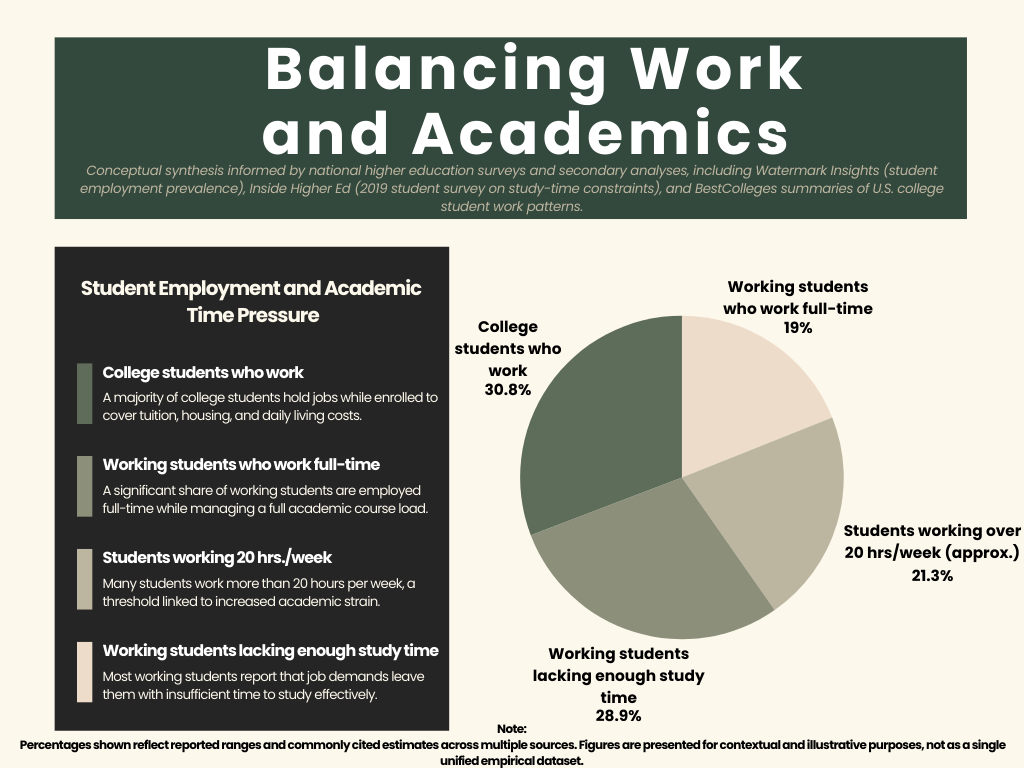
About two-thirds of undergraduates work while enrolled, and four out of five of those students log more than 20 hours a week. (Trellis Strategies) For most, working isn't a choice. It's what keeps tuition paid and rent covered. But constant tension between shift schedules and class schedules takes a toll on your time and energy. This guide covers how to protect your grades, manage your schedule, and avoid burning out.
The Real Impact of Work Hours on Your GPA
The research here is more nuanced than most people expect. Students who work fewer than 20 hours a week often have higher GPAs than students who don't work at all. A moderate job pushes you to manage your time better and stay organized.
Cross the 20-hour threshold, and the picture flips. Students working more than 20 hours a week average a GPA of 2.95, compared to 3.13 for those working under 20 hours. (BLS) Students working full-time are also about 20% less likely to graduate than similar peers who don't work. (AERA Open)
If you can, keep your hours under 20 per week. That's the clearest line in the research.
Challenges That Working Students Face
Working while studying creates pressures non-working students don't experience. Over 60% of working students say their job hours don't leave enough time to study. (Trellis Strategies) One in four working students miss at least one class per semester due to job conflicts.
Some groups carry extra weight:
Parent students coordinate childcare around both work and class.
First-generation students often lack family guidance on managing college demands.
Graduate students balance research requirements on top of employment.
Students with disabilities manage accessibility challenges across multiple environments.
About 36% of working students now identify primarily as workers who attend school, not students who work. (Trellis Strategies) That shift in identity reflects a financial reality: roughly half use their job income to pay for school directly.
Building a Weekly Schedule That Works
A schedule isn't about rigidity. It's about visibility. When you can see your commitments mapped out, you spot conflicts before they become crises.
Start by blocking your fixed obligations: class times, work shifts, and commute. These don't move. Then add study time as if it were another class. Treat it like an appointment you can't cancel.
Use time blocking to assign specific hours to specific tasks. Monday evening might be reserved for reading. Wednesday afternoon could be for problem sets. This prevents the drift that happens when you tell yourself you'll "study later."
Leave buffer time. Unexpected things happen: a shift runs late, an assignment takes longer than you expected, you get sick. Padding your schedule gives you room to adjust without everything falling apart. Review your plan weekly and adjust based on what's working.
How to Prioritize Tasks
Not all tasks deserve equal attention. The Eisenhower Matrix sorts what's urgent from what's important:
Urgent | Not Urgent | |
|---|---|---|
Important | Do it now (exam tomorrow, shift starting) | Schedule it (long-term project, key assignment) |
Not Important | Delegate or do quickly (minor emails) | Drop it |
Beyond that framework:
Tackle demanding tasks when your energy is highest. Don't waste your sharpest hours on busywork.
Break large projects into smaller pieces. "Write the introduction" is doable. "Write a 15-page paper" isn't.
Prioritize assignments with earlier due dates or heavier grade weighting.
Time Management Tools Worth Using
Google Calendar or Outlook for blocking your week and setting reminders.
Todoist or Trello for tracking assignments and deadlines.
Forest or Freedom for blocking social media during study sessions.
The Pomodoro Technique for structured focus: 25 minutes on, 5 minutes off.
Timer apps also help you learn how long tasks actually take. You might think reading a chapter takes 30 minutes when it really takes an hour. Accurate estimates make better schedules.
Communicating With Your Employer
Your employer won't know your class schedule unless you tell them. Have a direct conversation about your school commitments at the start of each semester. Most managers prefer advance notice over last-minute conflicts.
When asking for flexibility:
Provide your class schedule and be specific about which days and times you're unavailable.
Propose concrete alternatives. "Could I work Tuesday and Thursday evenings instead of Monday and Wednesday?" is easier to approve than "I need fewer hours."
Offer something in return. Covering less popular shifts, like early mornings or weekends, makes your request easier to say yes to.
Share exam periods and major deadline weeks in advance.
Suggesting a trial period can also ease concerns. It shows you're willing to prove the arrangement works.
Setting Up a Study Space
Where you study matters as much as when. Find one or more spaces where you can concentrate and return to them consistently. Your brain starts associating that space with focused work.
Keep materials organized and accessible. Nothing kills momentum like hunting for a textbook or charger. If you study at home, separate your study area from where you relax. Working from your bed blurs the line between rest and productivity.
Libraries, quiet campus spots, and coffee shops all work. Turn off notifications. Put your phone in another room if you have to.
Active Learning Techniques for Busy Students
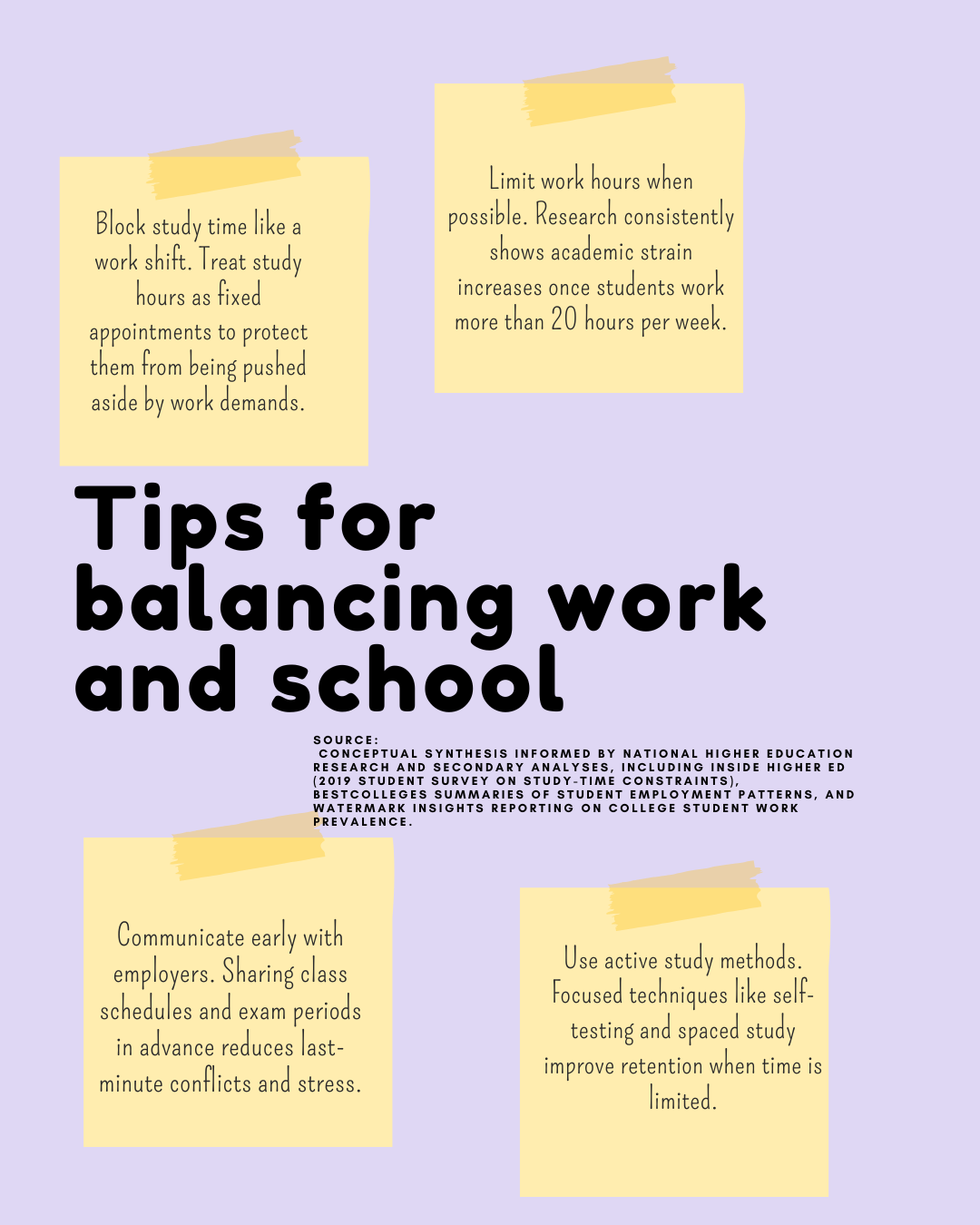
Time is short. Passive reading, where you highlight text without engaging your brain, is one of the least effective ways to learn.
More effective approaches:
Self-testing: Quiz yourself instead of re-reading notes.
The Feynman Technique: Explain concepts out loud as if teaching someone else. If you can't explain it simply, you don't understand it well enough.
SQ3R (Survey, Question, Read, Recite, Review): Turns passive reading into active engagement.
Spaced repetition: Study a little each day instead of cramming. Your brain consolidates information during sleep.
Nearly 45% of students say procrastination negatively affects their academic performance. Active learning keeps you ahead of it.
Recognizing the Signs of Burnout
Burnout sneaks up on you. Watch for:
Exhaustion that sleep doesn't fix
Loss of interest in classes you used to engage with
Declining grades despite effort
Frequent illness, headaches, or trouble sleeping
Withdrawal from friends and activities
Burnout differs from ordinary stress. Stress has an end point. Burnout feels endless. About 50% of university students report experiencing burnout symptoms, with rates even higher among those working long hours.
Catching it early makes recovery faster. Ignoring it leads to missed classes, failed exams, dropped courses, or withdrawal.
Taking Care of Yourself
Protect your sleep. Seven to nine hours isn't optional when you're juggling work and school. Sleep deprivation destroys memory, focus, and mood.
Beyond sleep:
Eat regular meals and move your body. Physical health directly affects your ability to concentrate.
Schedule breaks. Your brain needs downtime to consolidate learning.
Stay connected with friends and family. Isolation worsens stress.
Use campus resources. Counseling services, tutoring centers, and academic advising are often free or low-cost. Knowing when to ask for help is a strength.
Where to Start
You don't need a perfect system on day one. Pick one or two strategies from this article and apply them consistently. Build a schedule. Talk to your employer. Set up a study space.
Small changes compound. The habits you build now, around managing time, communicating proactively, and protecting your health, will carry well past graduation.
 5 ways colleges can make career prep 'unavoidable' for students
 The Real Economics Behind Entry-Level Gigs
 Can 3-Year Degrees Solve the Teacher Shortage?
 Does College Public Speaking Really Matter in Today’s Job Market?
 Strategies for Communicating Tuition and Outcomes to Prospective Students