Disclaimer: This article is for general informational purposes only and does not constitute legal, financial, medical, or professional advice. Policies, requirements, and costs may change. Always verify current information with the relevant institutions or official sources before making decisions.

Getting a work permit with a foreign degree in the U.S. involves several overlapping systems: immigration status, employment authorization, and in some cases, credential evaluation. Each step builds on the last, so understanding the full picture before you graduate gives you a real advantage. This guide covers every stage — from your first legal option to work after graduation, through to permanent residency.
Who Actually Needs Work Authorization?
Not everyone needs a work permit. U.S. citizens can work without any documentation. Lawful permanent residents — green card holders — also do not need to apply separately, as their Green Card serves as proof of employment authorization.
Foreign nationals on nonimmigrant visas are a different story. According to USAGov, nonimmigrant visa holders are typically required to have a work permit before being hired. This includes F-1 students, H-4 dependents, asylum applicants, and others. In most cases, working without authorization is a serious immigration violation and can result in removal from the U.S.
One specific question comes up often: do U.S. citizens need work authorization? The answer is no. Citizenship grants the absolute right to work. The requirement applies only to foreign nationals whose immigration status does not automatically include work authorization.
Your First Option After Graduation: OPT
For most international students, Optional Practical Training (OPT) is the first and most accessible route to legal work after earning a degree in the U.S. It applies to F-1 visa holders and lets you work in a job related to your field of study.
According to U.S. Citizenship and Immigration Services, F-1 students may engage in off-campus employment through OPT after their first academic year. The key terms:
Non-STEM graduates: 12 months of authorized work
STEM graduates: up to 36 months (12 months plus a 24-month extension)
Work must relate directly to your degree
You do not need a job offer to apply, but once you start working, the role must align with your area of study
You apply through your Designated School Official (DSO), who enters the OPT recommendation in SEVIS. You then file Form I-765 with USCIS along with your Form I-20 and proof of degree. Apply up to 90 days before your program end date. Processing typically takes 90 to 120 days, so apply early.
One rule that catches people off guard: F-1 students on post-completion OPT are allowed a maximum of 90 days of unemployment. Exceeding that limit can result in termination of F-1 status.
The Employment Authorization Document (EAD)
The Employment Authorization Document — commonly called an EAD or work permit — is the physical card USCIS issues to confirm you can legally work in the U.S. For OPT applicants, it arrives after Form I-765 approval. Without it in hand, you cannot legally start work.
The EAD displays your name, photo, date of birth, Alien Registration Number, visa classification, and work authorization expiration date. Employers use it to complete Form I-9 employment verification.
Current fees (2025):
Online filing: $470
Paper filing: $520
Processing time: As of late 2025, I-765 processing ranges from 2 to 9 months depending on your category and USCIS service center. Online filing and STEM OPT categories tend to process faster.
A significant 2025 policy change affects EAD renewals. Effective October 30, 2025, USCIS ended the automatic 540-day extension for most EAD renewal applicants. According to Employment Law Worldview, this ends automatic EAD extensions for individuals who timely file renewal applications, raising the risk of employment gaps. File your renewal application at least six months before your current EAD expires.
Does Your Foreign Degree Qualify?
If your degree is from outside the U.S., USCIS will evaluate whether it is equivalent to a U.S. bachelor's degree. This matters most when you move beyond OPT into sponsored visa categories like the H-1B.
USCIS applies two main standards:
1. Direct equivalency. Your foreign degree is assessed by a credential evaluation agency, which confirms it meets U.S. bachelor's level in your field. The evaluation typically takes 7 to 21 business days and costs between $100 and $130. USCIS requires a single-source degree — multiple certificates or diplomas from different institutions cannot be combined to meet the standard.
2. The three-for-one rule. If your foreign degree falls short, USCIS applies a degree equivalency rule that counts three years of specialized training or work experience as equivalent to one year of college education. This means 12 years of relevant, progressive experience can substitute for a four-year bachelor's degree — when properly documented.
Get a credential evaluation done early. A missing or weak evaluation is one of the most common reasons USCIS issues a Request for Evidence (RFE), which delays your case.
Moving from OPT to an H-1B Visa
OPT is temporary. Once it expires, the most common next step is an H-1B visa, which requires employer sponsorship.
The minimum requirements, according to U.S. immigration law:
A U.S. employer to sponsor you
A U.S. bachelor's degree or its equivalent (including a foreign degree that clears the equivalency standard above)
A clear connection between your job duties and your field of study or experience
H-1B visas are for jobs that require theoretical and practical application of a body of highly specialized knowledge. The visa is initially granted for three years, extendable to six, and can lead to employer-sponsored permanent residency.
Cap and lottery: There are 65,000 H-1B visas available per year for bachelor's degree holders, plus an additional 20,000 reserved for those with a U.S. master's degree or higher. Demand far exceeds supply, and selection is by lottery.
Important 2026 change: Starting with the April 2026 registration cycle, the H-1B lottery will shift from a random draw to a wage-ranked system. Higher-wage job offers will have a higher probability of selection. This favors applicants in well-compensated roles and makes salary negotiation more strategically important than before.
Also note: As of September 2025, a new $100,000 filing fee applies to initial H-1B petitions for workers not currently on F-1 OPT. This is a significant cost that employers must factor into sponsorship decisions.
Permanent Work Authorization: The EB-3 Visa
For immigrants seeking to stay and work in the U.S. long-term, the EB-3 employment-based green card is one of the most accessible permanent pathways. It covers three groups:
Skilled workers: roles requiring at least two years of training or experience
Professionals: positions requiring a bachelor's degree or its equivalent
Other workers: roles requiring less than two years of training
The process runs through three stages, each with its own timeline:
Stage 1 — PERM Labor Certification: Your employer files with the U.S. Department of Labor to prove no qualified U.S. worker is available for the role. As of mid-2025, the DOL is certifying applications filed approximately 15 to 16 months earlier, according to current DOL data. A percentage of cases are also selected for audit, adding 3 to 5 months.
Stage 2 — Form I-140 Immigrant Petition: Your employer files this with USCIS. Standard processing takes 10 to 14 months. Premium processing (at additional cost) is available for faster adjudication.
Stage 3 — Visa availability and final filing: You must wait for your priority date to become current in the monthly Visa Bulletin before filing for adjustment of status or going through consular processing.
Total timeline: For most countries (excluding India and China, which face much longer backlogs), the full EB-3 process from PERM filing to green card currently takes around three to four years.
The good news: once you file Form I-485 (adjustment of status), you can simultaneously file Form I-765 for a work permit. This EAD is typically approved within three months, letting you work legally while your green card application is still pending.
Work Permits for 14-Year-Olds
This is a separate system from immigration-based work authorization. The question "how to get a work permit at 14" refers to state-issued employment certificates for minors — not USCIS documents.
Under the federal Fair Labor Standards Act, 14 is the minimum working age for most nonagricultural jobs. However, federal law does not itself require minors to obtain a work permit. Requirements are set at the state level.
Some states, such as New York, require working papers for anyone aged 14 to 17
Others, like Tennessee and Florida, do not require them — but employers must keep proof of age on file
Where required, work permits for minors are issued by your school's guidance office or your state's department of labor, not USCIS
This type of permit has no connection to immigration status. A foreign national minor in the U.S. still needs valid immigration-based work authorization in addition to any state-issued employment certificate.
Other Visa Options for Foreign Graduates
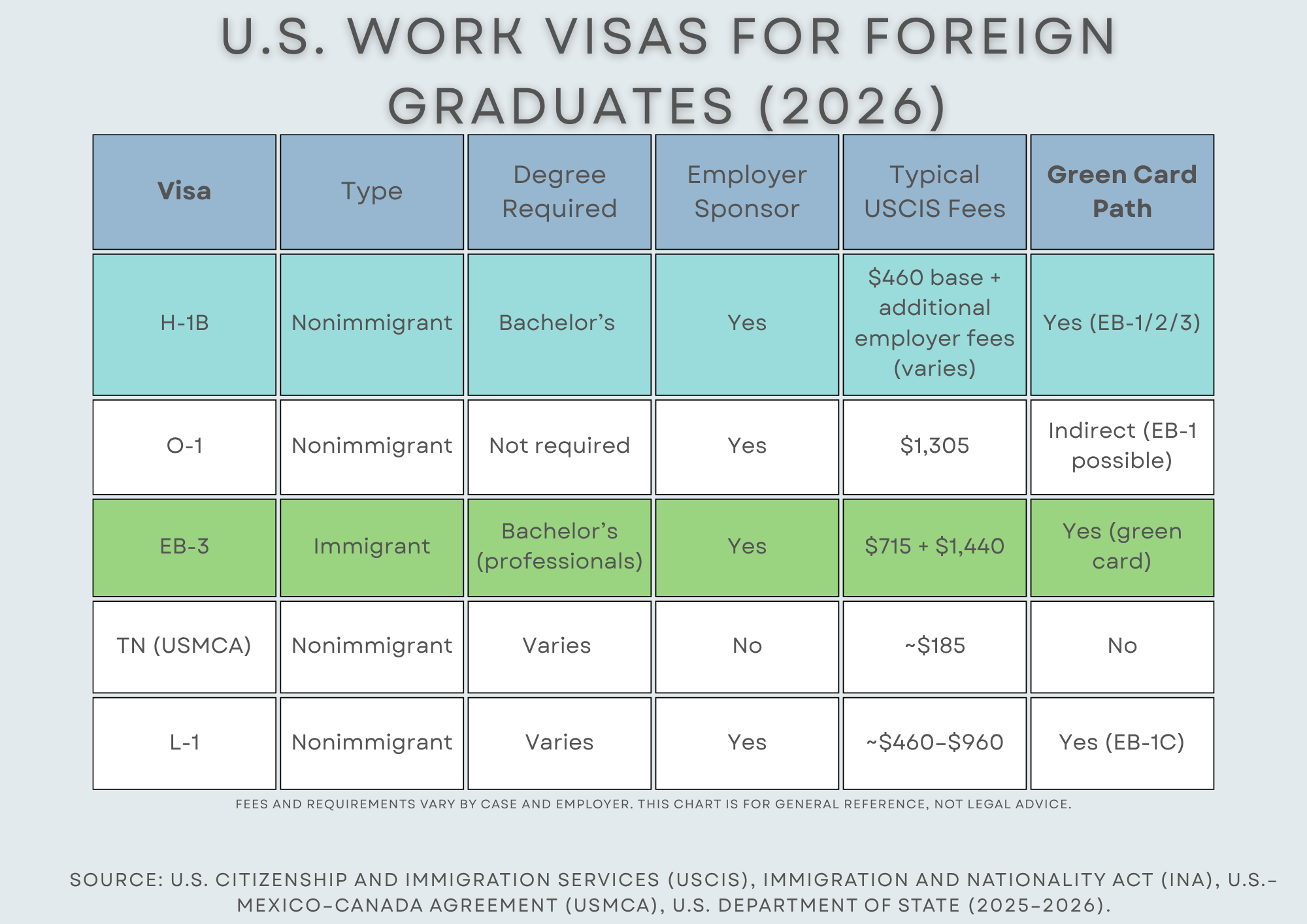
Depending on your degree, nationality, and goals, other pathways may apply:
TN Visa — For Canadian and Mexican nationals in specific professional occupations listed under the USMCA trade agreement. A bachelor's degree is required for most qualifying roles. No annual cap applies, and the visa is valid for three years with indefinite renewal. It is not dual intent, however, which complicates transitioning to a green card.
O-1A Visa — For individuals with extraordinary ability in science, education, business, or athletics. No formal degree requirement, but the standard for "extraordinary ability" is high. There is no annual cap.
EB-2 National Interest Waiver (NIW) — A permanent immigrant petition that lets you self-petition without an employer sponsor. You must demonstrate either an advanced degree or exceptional ability, and show your work benefits the U.S. national interest. Processing can take up to a year after approval before a green card is issued, so apply early relative to your OPT expiration.
Planning Your Timeline
The biggest mistake international graduates make is treating each visa stage as separate. They are not. OPT, H-1B, and EB-3 are sequential, and delays at any stage can create gaps in work authorization.
A practical approach:
Apply for OPT 90 days before graduation
Start the H-1B registration process during your first OPT year (lottery opens in March annually)
If your employer is willing, begin EB-3 PERM discussions during your H-1B period
Renew your EAD at least six months before it expires
Immigration law changes frequently — the H-1B lottery structure, EAD renewal rules, and filing fees all shifted in 2025 alone. Consult a licensed immigration attorney for advice specific to your situation.
 Can MOOCs Help You Study or Work in the U.S.?
 What You Can Do with an Integrated Science Degree
 Why Two Services Can Calculate the Same GPA Differently
 Virtual Study Abroad vs In-Person Programs: What Students Should Know
 How to Adjust to the U.S. Education System as an International Student