

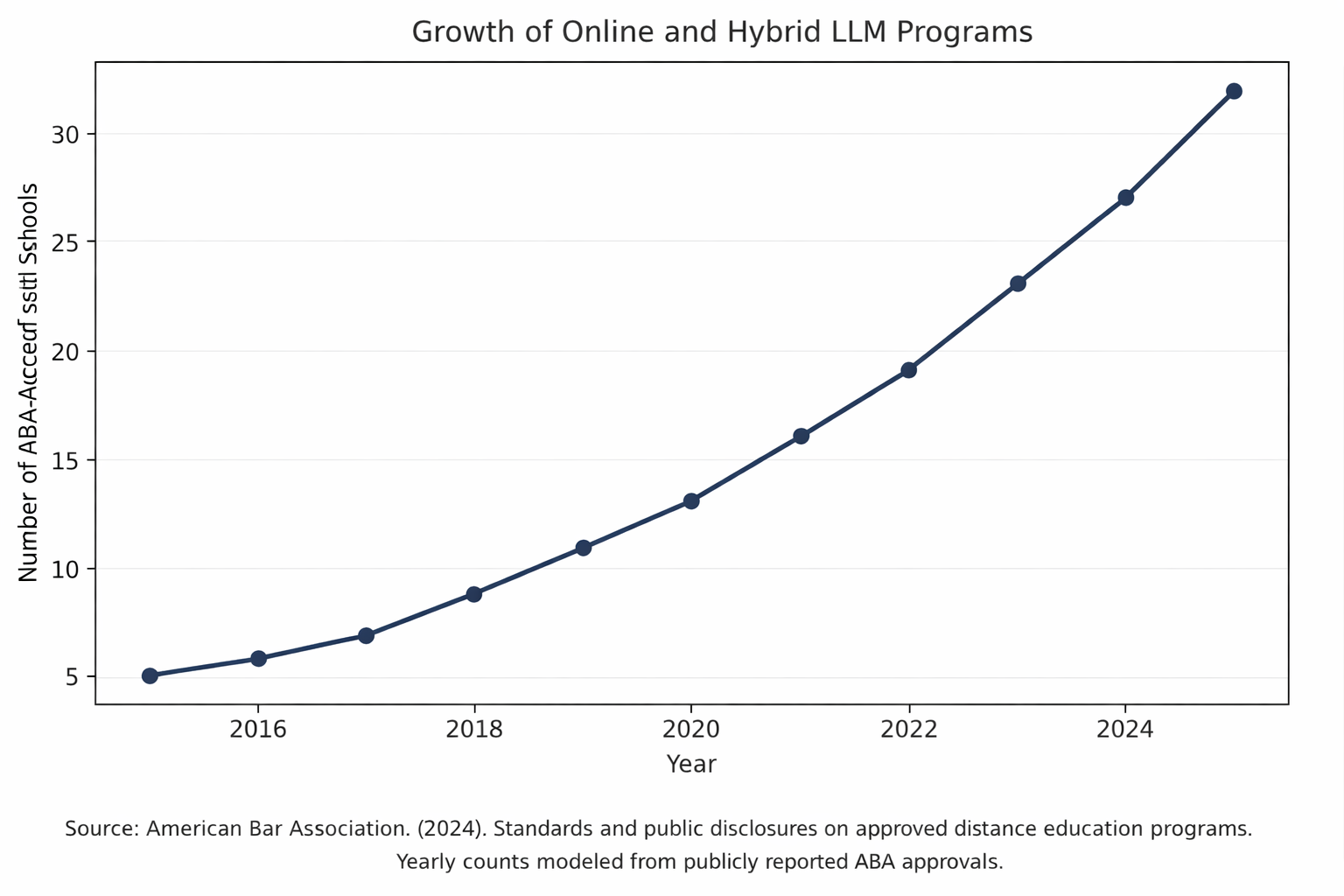
The Master of Laws (LLM) degree has become a strategic credential for lawyers seeking specialization, career advancement, or entry into the US legal market. Online LLM programs have expanded significantly since the American Bar Association began granting variances for distance education in 2015. Today, dozens of accredited law schools offer fully online or hybrid LLM options.
Three groups typically pursue an LLM: JD holders who want deeper expertise in a specific practice area, international lawyers seeking US bar eligibility, and legal professionals looking to pivot into new specializations. Online programs now serve all three groups with varying degrees of success.
But online LLM programs aren't for everyone. This article breaks down who should consider them, which specializations deliver the best return, what employers actually think, and whether the investment makes financial sense for your situation.
Who Is Eligible for an LLM in the US

Eligibility requirements differ based on your educational background and where you earned your law degree.
US and Canadian Students
If you hold a JD from an ABA-accredited law school, you meet the baseline requirement for LLM admission. The LLM serves as a specialization tool rather than a first law degree. You might pursue a Tax LLM to move into tax practice, an IP LLM to work with tech clients, or a Health Law LLM to enter healthcare compliance.
Some programs accept applicants with related graduate degrees and legal work experience, though this varies by school. Temple University, for example, requires taxation coursework or relevant work experience for its Tax LLM applicants.
International Students
You must hold a first professional law degree that permits entry into legal practice in your home country. This typically means an LLB (Bachelor of Laws) or equivalent credential. The degree must come from an accredited institution with standards comparable to US law schools.
An LLM from a US law school can qualify you to sit for the bar exam in certain states. New York and California are the most common destinations for international lawyers seeking US licensure. However, not all states permit LLM holders to take the bar. Check your target state's requirements before enrolling.
Additional Requirements
Most programs require TOEFL or IELTS scores for non-native English speakers. Typical minimums hover around 100 for TOEFL or 7.0 for IELTS, though top programs set higher thresholds. Berkeley requires a minimum TOEFL of 100 or IELTS of 7.0.
You'll also need law school transcripts, letters of recommendation, and a statement of purpose explaining your career goals and interest in the program. Some schools require interviews for competitive applicants. For detailed application requirements, LSAC provides comprehensive guides for both domestic and international applicants.
Which LLM Specializations Are Most In Demand
Not all LLM specializations carry equal weight in the job market. Some consistently deliver strong career outcomes while others offer limited practical advantage.
Tax Law
Tax LLMs remain among the most valuable specializations. With income and payroll taxes contributing over $3 trillion annually to the US economy, demand for tax specialists stays high. NYU, Georgetown, and Northwestern run the top Tax LLM programs. Graduates work in law firms, accounting firms, corporate tax departments, and government agencies like the IRS.
Tax is one of the few LLM specializations where the credential directly translates to higher compensation and expanded job opportunities.
Intellectual Property Law
The tech sector's growth drives steady demand for IP lawyers. Patent, trademark, and copyright work requires specialized knowledge that general JD programs don't provide in depth. Strong programs exist at UC Berkeley, Santa Clara (with its Silicon Valley location), Cardozo, and George Washington.
IP LLMs are particularly valuable for lawyers with technical undergraduate degrees who want to practice patent law.
Corporate and Business Law
Mergers and acquisitions, securities regulation, and corporate compliance work favor candidates with specialized training. Business law LLMs cover securities, finance, contracts, and employment law. These programs appeal to lawyers working in or targeting corporate legal departments and transactional practice groups.
Health Law
Healthcare's complex regulatory environment creates ongoing demand for specialists. Health law LLMs cover FDA regulations, healthcare compliance, medical malpractice, and insurance law. Houston, Loyola Chicago, and Saint Louis University offer respected programs.
International Business Law
Global trade expertise matters for multinational corporations and firms with cross-border practices. These programs cover international trade rules, compliance, and transnational transactions.
Emerging: Technology and Cybersecurity Law
AI regulation, data privacy, and cybersecurity law represent growing practice areas. Some schools now offer specialized tracks or certificates in these fields within broader LLM programs.
The market reality: specialization matters more than a general LLM for employment outcomes. A Tax LLM from a respected program significantly boosts earning potential. A general LLM without focus offers less clear career advantage. You can compare program rankings and specialization options at LLM Guide, which maintains updated listings of programs worldwide.
Is an Online LLM Worth It?
The honest answer depends entirely on your circumstances, goals, and how you plan to use the degree.
The Value Proposition
For Working Professionals
Online LLMs let you continue earning while studying. You avoid relocation costs, maintain your current job, and complete coursework around your schedule. Most programs take one to two years part-time.
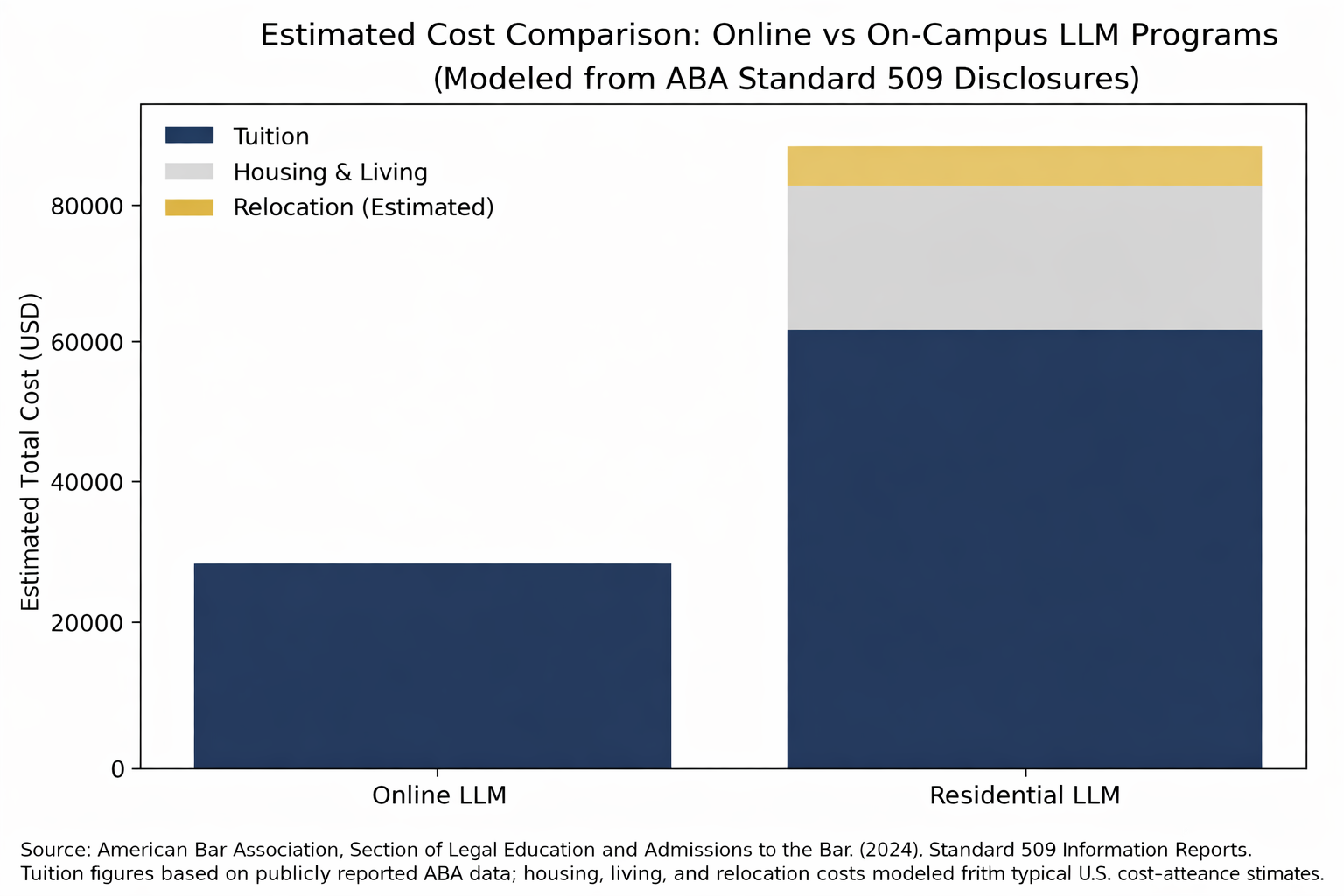
Tuition ranges dramatically. The University of Arkansas offers an Agricultural and Food Law LLM for approximately $13,500 total. Top programs charge $60,000 or more. Online programs often cost less than their residential counterparts when you factor in housing, commuting, and opportunity costs.
For Career Advancement
Specialization can command salary premiums in certain practice areas. Tax LLM holders often see meaningful salary increases when moving into tax-focused roles. IP expertise ties to higher compensation in corporate settings and specialized firms.
The credential signals commitment to a practice area and provides substantive knowledge that general practice doesn't develop.
Honest Assessment of Limitations
Networking opportunities are more limited than residential programs. You won't share study groups, grab coffee with professors, or build relationships through daily interaction. For some career paths, these connections matter significantly.
Some employers still prefer traditional programs, though this bias is fading. The online format doesn't appear on your diploma or transcript. Unless you volunteer the information, employers won't know whether you attended in person or online.
Career services support varies by program. Some schools provide robust remote career counseling while others focus resources on residential students.
When It Makes Sense
An online LLM makes sense when you're already employed and want to specialize without leaving your job. It works well when you need flexibility due to family obligations or geographic constraints. It delivers value when you're pursuing a specialization like tax that has clear career ROI. It's practical when you're an international lawyer seeking US bar eligibility without relocating for a full year.
When It May Not Be Worth It
Think twice if you're hoping an LLM alone will open doors to BigLaw. Large firm hiring of LLM candidates depends heavily on school prestige, existing connections, and specific practice area needs. An online LLM from a mid-ranked school won't overcome those barriers.
If networking and in-person connections are central to your career strategy, a residential program serves you better. If you can afford the time and money for a top residential program, that investment may yield stronger long-term returns. The ABA Journal has published extensive coverage on online legal education outcomes that can help inform your decision.
Do Employers Accept Online Law Degrees?
This question matters less than it did five years ago, but it still deserves a direct answer.
The Accreditation Factor
ABA accreditation remains the gold standard. Currently, 19 law schools offer ABA-approved online or hybrid JD programs. Online LLM programs from ABA-accredited schools carry the same institutional weight as residential programs.
Here's what many applicants don't realize: your diploma and transcript do not indicate whether you completed the program online or in person. The degree is the degree. Mitchell Hamline, Syracuse, and Dayton issue the same credentials to online and residential graduates.
Non-ABA-accredited online programs present different challenges. Bar passage rates at these schools fall well below ABA-accredited institutions. Many states won't allow graduates to sit for the bar. Employer skepticism is higher and often justified.
Employer Perspectives
Large law firms (BigLaw) hiring LLM candidates focus primarily on school reputation and specialization relevance. A Tax LLM from NYU opens doors regardless of format. A general LLM from an unranked school doesn't, whether online or residential.
Corporate counsel positions value practical skills and specialization over delivery format. Companies hiring in-house lawyers care whether you can do the work, not how you learned to do it.
Government agencies typically accept degrees from accredited institutions without distinguishing between formats. Small and mid-size firms often care more about bar passage and practical capabilities than where or how you studied.
Employment Data Reality
Limited outcome data exists for online programs compared to residential ones. What we know: Mitchell Hamline's blended-learning graduates show strong employment outcomes, with 93.5% of job-seekers employed or in graduate studies. Most graduates of online JD and LLM programs enter small and mid-size firms, government positions, or solo practice rather than BigLaw.
Career resources at schools like Yale Law note that LLM candidates face structural challenges in the US job market. This applies to residential and online LLM candidates alike. The challenge isn't the format; it's the degree type competing against JD holders in a JD-oriented market.
Key Considerations
School reputation matters regardless of format. A Syracuse online LLM carries Syracuse's institutional weight. Specialization relevance to your target job matters more than delivery method. And bar eligibility varies by state for all LLM graduates, online or otherwise.
Online vs. In-Person Law School: Which Is Better?
Neither format is universally superior. The right choice depends on your circumstances.
In-Person Advantages
Residential programs offer stronger networking opportunities. Daily interaction with classmates builds relationships that often last throughout careers. Face time with professors leads to mentorship, recommendations, and professional connections.
Access to clinics, moot court, and mock trials develops practical skills that online formats struggle to replicate. Some schools find creative solutions, but hands-on advocacy training works best in person.
On-campus recruiting and career services typically focus more resources on residential students. Employers who recruit on campus meet students in person, which creates advantages for those physically present.
Bar passage rates skew slightly higher for in-person students at some schools. Mitchell Hamline's data shows 83.64% first-time bar passage for in-person graduates versus 73.96% for blended-program graduates on the July 2023 bar. The gap isn't enormous, but it exists.
Online Advantages
Flexibility matters enormously for working professionals. Online programs let you maintain employment, income, and career momentum while adding credentials. You study when your schedule permits rather than when classes meet.
Total cost drops significantly. You save on housing, commuting, and relocation expenses. Some estimates suggest online students save $31,000 or more compared to residential options at the same institution.
Geographic freedom expands your options. You can choose a program based on specialization strength and reputation rather than proximity. A lawyer in Montana can pursue NYU's Tax LLM or Boston University's Banking Law LLM without relocating.
Quality Considerations
ABA-accredited online programs must meet the same standards as residential programs. The accreditation process doesn't distinguish between formats for quality purposes.
Many online programs are actually hybrid, requiring some in-person components. Syracuse's JDinteractive program includes residential periods. Dayton blends online coursework with campus visits. These hybrid models capture some networking benefits while maintaining flexibility.
Admissions standards remain similar at schools offering both formats. Case Western's median LSAT is 161 for online students and 160 for in-person students. The academic caliber of classmates doesn't differ dramatically.
The Verdict
For LLM candidates specifically, online programs make particular sense. You've already completed a law degree. You understand how to study law. You likely have work experience and professional connections. The LLM adds a credential and specialized knowledge; it doesn't need to provide the foundational law school experience.
The choice comes down to your priorities: maximum networking and immersion versus flexibility and cost savings. Rankings and program comparisons at US News can help you evaluate specific schools across both formats.
Lawyer Salary Expectations: The Reality Check
Before investing in any LLM, understand what lawyers actually earn and how an LLM might affect your trajectory.
Average and Median Salaries
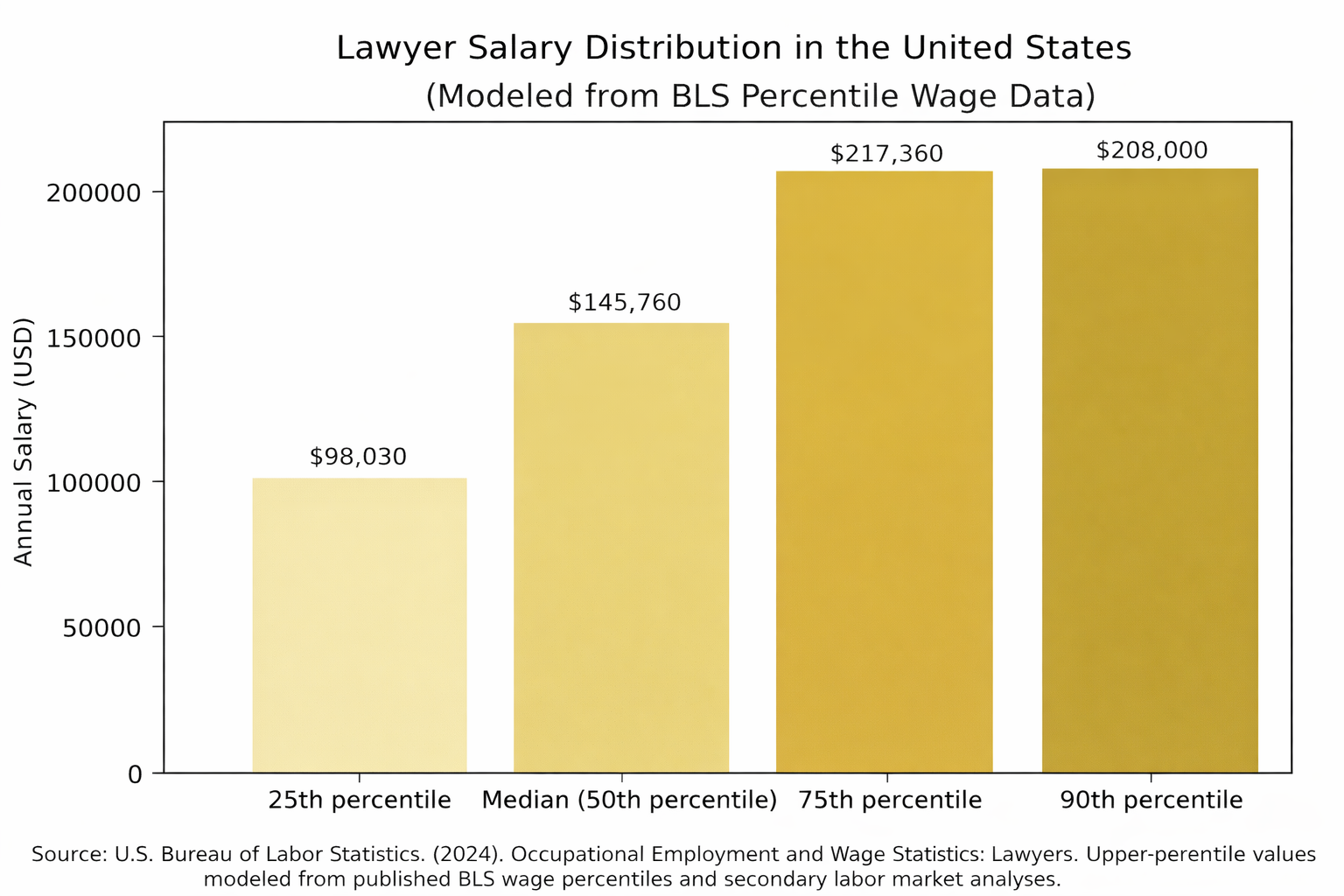
The Bureau of Labor Statistics reports a median lawyer salary of $145,760 for 2023. The average wage reached $176,470 that year. These figures don't include profits for law firm partners and shareholders.
The best-paid 25% of lawyers earned $217,360 or more. The lowest-paid 25% made below $98,030. Location dramatically affects these numbers. Lawyers in San Jose average $268,570. Lawyers in Hot Springs, Arkansas average $73,870.
Do Lawyers Make $500,000 a Year?
Some do. The top 1% of attorneys earn $500,000 or more annually. The top 10% earn over $208,000. But these figures represent a small fraction of the profession.
Lawyers reaching $500,000 typically work at large firms handling complex corporate transactions, high-stakes litigation, or specialized practices like patent prosecution for major tech companies. Partners at top firms can earn millions. These outcomes require more than credentials; they require years of high performance, business development, and often significant luck.
Top Earners: What Sets Them Apart
High-paying specializations include corporate M&A, patent law (especially with technical backgrounds), medical malpractice plaintiff work, and complex tax planning. BigLaw associate starting salaries at firms with 1,000+ lawyers hit a median of $215,000 in 2023. Some firms now start associates at $225,000.
Location matters significantly. Washington DC leads with an average of $238,990. California follows at $213,860, then New York at $208,480. The lowest-paying states include Wyoming ($88,570), Idaho ($96,810), and Montana ($98,170).
Public service lawyers earn far less. Entry-level legal aid attorneys made a median of $64,200 to $69,608 in 2023. The gap between private and public sector compensation remains substantial throughout careers. The ABA publishes annual salary data that tracks these trends across practice settings and regions.
LLM Impact on Salary
An LLM creates salary potential through specialization, not through the credential alone. A Tax LLM enables you to pursue tax-focused roles that pay premiums. An IP LLM qualifies you for patent work that commands higher rates.
The degree won't automatically increase your salary. An LLM won't catapult you into the top 1% without other factors: the right firm, the right practice area, the right clients, and strong performance over years.
ROI depends entirely on how you use the credential. For someone moving from general practice into tax at a major accounting firm, the return is clear. For someone adding a general LLM to an already-established career, the financial benefit may be minimal.
Who Should Seriously Consider an Online LLM
Based on the realities of cost, career outcomes, and program structure, certain candidates benefit most from online LLM programs.
Ideal Candidates
Practicing Attorneys Seeking Specialization
If you're an established lawyer wanting to add tax, IP, healthcare, or another niche expertise, an online LLM makes practical sense. You maintain your income, keep your clients, and add credentials that open new practice areas. This is the sweet spot for online LLM programs.
International Lawyers Seeking US Credentials
If you need US legal credentials for bar eligibility and want to practice in states that permit LLM holders to sit for the exam, online programs offer a path without full relocation. New York and California accept LLM graduates under certain conditions. Verify your target state's specific requirements before enrolling.
Career Changers Within Law
If you want to move from litigation to corporate work, or from general practice to a specialty, an LLM signals commitment and provides substantive knowledge. Online format lets you make this transition without abandoning your current position.
Geographically Constrained Candidates
If you live far from quality law schools or have family obligations preventing relocation, online programs expand your options dramatically. You can access programs across the country based on specialization fit rather than geographic proximity.
Cost-Conscious Candidates
If you cannot justify residential program expenses or want to minimize additional debt, online programs offer lower total costs. Some programs run under $20,000 total. Combined with continued employment income, the financial equation improves significantly.
Who Should Think Twice
Those targeting BigLaw without existing connections face an uphill battle regardless of LLM format. Large firm hiring of LLM candidates is limited and competitive. An online LLM from a mid-tier school won't overcome structural barriers to BigLaw entry.
If networking serves as your primary goal, residential programs deliver better. The in-person relationships, faculty mentorship, and campus recruiting access matter for career strategies built on connections.
If you thrive in traditional classroom settings and struggle with self-directed learning, online format may not suit your learning style. Be honest about how you work best.
If your target state has restrictive bar admission rules for online graduates or LLM holders generally, verify eligibility before investing time and money. Schools like Penn Carey Law provide frank assessments of LLM employment challenges that can help you set realistic expectations.
Conclusion
Online LLM programs offer legitimate, accredited pathways for the right candidates. They're not inferior versions of residential programs; they're different tools serving different needs.
Value depends on your specific goals, current career stage, and target specialization. A Tax LLM that enables you to move into tax practice delivers clear returns. A general LLM added to an established career may offer less tangible benefit.
Accreditation matters. Stick with ABA-accredited schools. The online versus in-person distinction matters less than specialization choice and institutional reputation. Employers care whether you can do the work and whether your credentials signal relevant expertise.
For practicing lawyers seeking to specialize while maintaining employment and income, online LLMs represent a practical solution. For career changers and international lawyers, they provide accessible pathways to new opportunities.
Do your research. Verify bar eligibility in your target state before enrolling. Understand what the degree will and won't do for your specific career goals. The legal market remains competitive regardless of degree format. Success depends on how you leverage your credentials, not simply on earning them. Resources like NYU Law career services can provide additional guidance on maximizing your LLM investment.
 The Tightest Job Market in Years for College Grads
 How Universities Are Adapting Health Programs to a Moderating Job Market
 How Flexible Are PhDs in a Changing Job Market
 Understanding the Decline of International Enrollment in American Universities
 Why AI Writing Polish Can Flatten Student Expression