
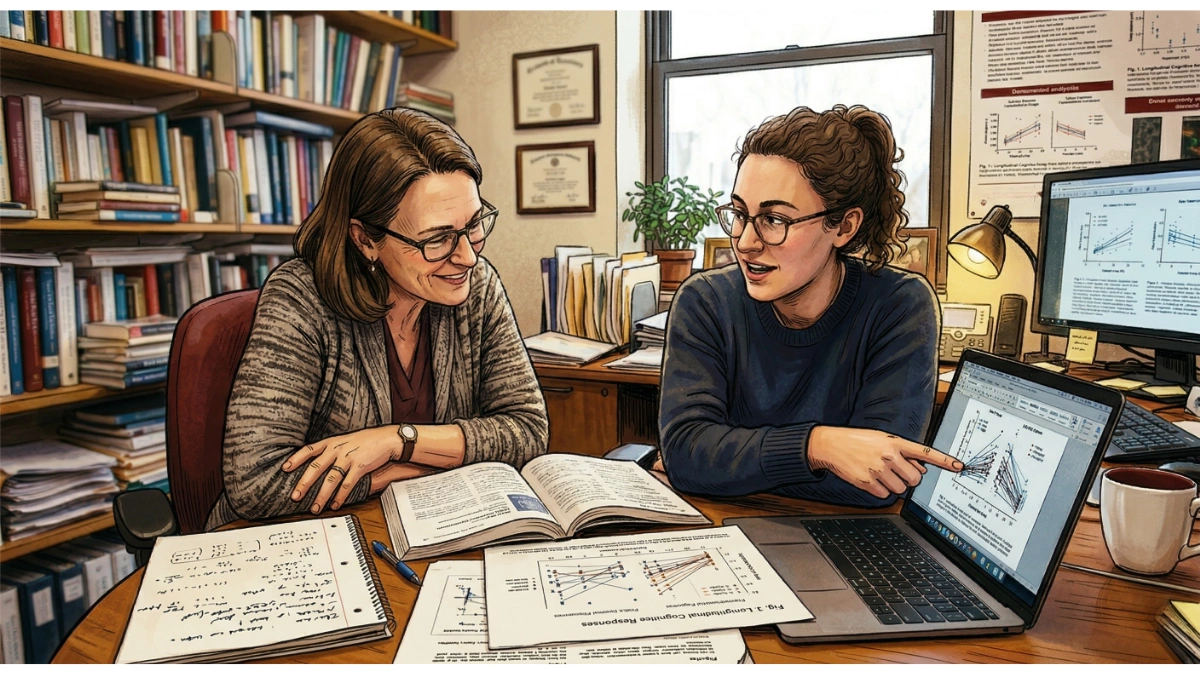
When a faculty member guides a student through a self-directed research project, something shifts.
It's not just about the work. It's about a student realizing — sometimes for the first time — that they can actually do this. That their ideas are worth pursuing. That someone in their field sees potential in them.
That's the real power of independent study mentorship. And right now, most universities are leaving it on the table.
A 2017 analysis found professors dedicate only 2–6% of weekly hours to one-on-one student mentoring. Compare that to the impact: mentored students show 15–20% higher STEM retention rates than non-participating peers, and having a mentor more than doubles a graduate's odds of being engaged in their work and thriving in their overall well-being, according to the Gallup-Purdue Index.
Here's what the data looks like when you put mentored and non-mentored students side by side:
Outcome | Mentored research | Non-mentored / no research |
|---|---|---|
Persistence | Higher graduation and STEM retention rates, especially for first-gen and underrepresented students | Higher attrition; lower four-year graduation rates for low-income and minority students |
GPA | Significantly higher cumulative GPA | Lower among matched peer groups |
Graduate school enrollment | More likely to enroll | Less likely to pursue postgraduate study |
Science self-efficacy | Higher self-reported confidence | Lower confidence in research ability |
Research presentation quality | Improved with high-quality mentorship | Inconsistent without faculty guidance |
The pattern is consistent: a little structured mentoring goes a very long way.
It's Not Just Teaching
Here's a relatable scenario. Imagine a sophomore who comes to office hours with a half-formed idea about environmental policy and data. She's bright but scattered. Her project scope is enormous. Left alone, she'd spend a semester going in circles.
A good mentor doesn't hand her the answer. They help her find the right question.
That's the difference between teaching and mentoring. Teaching transfers knowledge. Mentoring builds the person.
A faculty mentor fills seven roles at once: teacher, sponsor, advisor, agent, role model, coach, and confidante. Not all of them feel like "work" in the traditional sense. The sponsor opens doors. The agent removes obstacles. The confidante hears the stuff the student won't say in class. Together, these roles enable what researchers call a "vicarious transfer of skills" — students absorb how a professional thinks, handles setbacks, and navigates a field. You can't replicate that in a lecture hall.
Getting the Foundation Right
Most projects fail in the first two weeks — not because the idea is bad, but because nobody nailed down the basics.
Scope the project properly
Students tend to show up with ideas that are either way too big ("I want to study climate change policy") or too narrow to go anywhere. Your job in those first meetings is to help them find the middle ground: a specific, doable contribution they can actually finish.
The sweet spot is high challenge with real achievement. Push too hard, and they disengage. Aim too low, and they don't grow.
Have the honest conversation about constraints
Not every good idea is a good project. Check the practical stuff early:
Lab access and equipment availability
IRB approval timelines (these can add months)
The student's course load and outside commitments
How much time you can realistically give
A student carrying 18 credits while working part-time cannot run the same project as someone with a lighter schedule. Be straight about that upfront.
Prepare them for failure
Research fails. Nobel laureate Robert Lefkowitz has a piece of advice worth borrowing: teach students to build around problems, not techniques. If their work is anchored to a question rather than a method, a setback becomes a pivot — not a disaster.
Structure Is Your Friend
Good intentions don't carry a project through a full semester. Structure does.
Write it down
Use a formal learning agreement. It should cover:
Hours per week
Meeting frequency
Key deliverables and due dates
How the work will be evaluated
This protects you both. When expectations drift (and they will), you have something to point to.
Set a meeting cadence
Weekly or biweekly check-ins work for most projects. The format — in person, video call, hybrid — matters less than the consistency.
One thing that makes a real difference: being available between meetings. Students read accessibility as a sign that you actually care about them. A professor I once spoke to held occasional office hours at a local coffee shop. Students said it made the whole dynamic feel more collaborative. Small move, big impact.
Also — require students to come prepared. A short written update or two specific questions before each meeting keeps things focused.
Build the timeline together
Don't hand students a schedule. Build it with them. A thesis due in May needs checkpoints in January, February, March, and April. Build in buffer time — things will go sideways.
The 5 C's: A Tool You Can Use Tomorrow
When a student gets stuck, most mentors default to just telling them what to do. There's a better way.
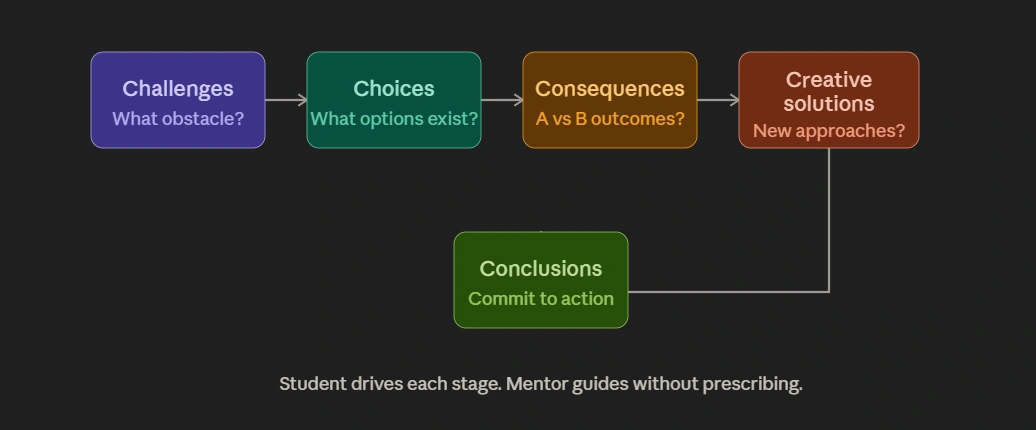
The 5 C's framework gives you a structured path through any roadblock without taking the wheel from the student:
Challenges — What obstacle are they facing right now?
Choices — What options actually exist?
Consequences — What happens if they pick option A versus option B?
Creative solutions — Are there approaches neither of you has considered yet?
Conclusions — What specific action are they committing to?
The goal isn't to solve the problem for them. It's to walk them through solving it themselves.
Other frameworks worth knowing: the 5 Pillars (Interest, Investment, Involvement, Inculcation, Inspiration) and the 4 C's (Connection, Clarity, Compassion, Commitment). Constellation mentoring — where students work with a small team of mentors rather than just one — is gaining traction too, especially for scaling programs without burning out individual faculty.
Building Independence (Not Dependency)
Here's something a lot of mentors don't realize: your job is to make yourself unnecessary.
Early on, you guide closely. As the student finds their footing, you step back. The worst thing you can do is spoonfeed them — it feels helpful in the moment, but it stunts their growth.
When a student asks "what should I do?", try flipping it: "What do you think you should do, and why?"
It feels awkward at first. But it's the question that actually builds a researcher.
On intellectual courage
Research takes guts. Students need to be willing to be wrong, to defend ideas that might get challenged, to push through when an experiment fails.
Nobel laureate Robert Lefkowitz tells the story of a researcher who made a genuinely significant discovery — but was so afraid of being wrong that he held back. Another lab scooped him. A mentor who'd built more confidence in him might have changed that story entirely.
Share your own failures. Tell your students about the paper that got rejected four times, the dataset that didn't cooperate, the thesis chapter you had to scrap. It normalizes the struggle.
Giving Feedback That Actually Helps
Good feedback is honest and useful. Not just one or the other.
Students need to hear what's working — not just what needs fixing. But sugarcoating doesn't serve them either. If the argument is weak, say so. Then show them how to fix it.
A few practical tips:
Give undergrads more turnaround time than you'd give a grad student
Be specific — "this section is unclear" is not feedback; "the logic between paragraphs 2 and 3 breaks down here" is
Offer the chance to revise and resubmit, not just a final grade
Faculty and students both report that mentored research experiences promote intellectual and personal growth — but only when the feedback loop is real.
Mentoring in 2026: Three Things That Have Changed
1. AI in the research process
Generative AI is in every student's toolkit now. Most institutional policies emphasize responsible use with attention to originality, attribution, and learning objectives — but the implementation burden has landed on faculty. Get ahead of it. Set your AI use expectations in the mentoring agreement from day one: what's allowed, what attribution looks like, where the line is between AI-assisted thinking and AI-generated work.
2. Remote and hybrid mentoring
Availability isn't just about showing up to office hours anymore. A shared Notion board for project milestones, a Slack channel for quick questions, a collaborative doc for running meeting notes — these aren't fancy. But they reduce friction and keep the project visible between formal check-ins.
3. Mental health awareness
Mentors are increasingly the first person a struggling student talks to. You're not a counselor, and you shouldn't try to be — but knowing when to make a referral is now part of the job. If engagement drops sharply, if a student seems overwhelmed beyond what the project warrants, or if they share something that's clearly beyond the scope of research mentoring, a direct, non-judgmental referral to campus counseling is the right move.
Career Guidance Belongs Here Too
One thing mentors consistently underuse: career conversations.
You've navigated this field. Your student probably hasn't talked to anyone who has. That's valuable. Don't save it for the end of the semester — bring it in early.
Ask them:
What does your professional life look like in five years?
Is graduate school something you're genuinely considering, or just a default?
What does a real career in this field actually look like day-to-day?
And when their work is ready, push them to present it. A symposium or conference presentation does two things: it builds communication skills, and it signals to the student that their work matters beyond your office.
What Good Mentors Actually Do
The National Academies' 2019 report synthesizes decades of research on this. The traits that show up consistently:
They respect students as emerging colleagues, not subordinates
They give honest feedback, not just kind feedback
They stay patient when progress is slow
They adapt their approach to each individual
They share their own failures, not just their successes
Mentoring skill is learned. CIMER offers structured training programs for faculty who want to improve. The Council on Undergraduate Research has resources specifically for undergraduate research mentoring.
What Institutions Need to Do
Mentoring is invisible labor. Faculty who do it well often get no formal credit for it — which is exactly why so many rational faculty deprioritize it.
Here's what actually moves the needle:
Reward it. Tenure and promotion criteria should explicitly value mentoring. Some institutions now require mentoring statements in review portfolios.
Train for it. CIMER's "Entering Mentoring" curriculum and Penn State's Undergraduate Research and Fellowships Mentoring office are good starting points.
Don't mandate it. Reluctant mentors harm students. Let faculty volunteer.
Cap the load. UNC Chapel Hill limits faculty to two independent study students per semester. That's a reasonable model.
Build exit ramps. When a mentoring relationship isn't working, both parties need a way out without blame. Clear reassignment policies matter.
Quick-Start Checklist
Before the project starts:
Ask your student: "What does your professional life look like in 5 years?"
Draft a written agreement covering hours, meeting cadence, deliverables, and evaluation criteria
Set your AI use policy explicitly — what tools are permitted, what attribution is required
Co-create a milestone timeline with buffer built in for setbacks
During the project:
When students ask "what should I do?" — respond with "what do you think, and why?"
Share one of your own research failures with your student this semester
Watch for sharp drops in engagement — know when to refer to campus counseling
Introduce your student to at least one colleague or professional contact this term
At the end:
Encourage your student to present their work at a symposium or conference
Have a direct conversation about graduate school or career next steps
The Bottom Line
Good mentoring happens one student at a time. It can't be automated or scaled carelessly. But done well, mentored independent research has a large positive impact on four-year retention and graduation — and the students who benefit most are often the ones who'd otherwise slip through the cracks.
That's worth the time.
 5 ways colleges can make career prep 'unavoidable' for students
 The Real Economics Behind Entry-Level Gigs
 Can 3-Year Degrees Solve the Teacher Shortage?
 Does College Public Speaking Really Matter in Today’s Job Market?
 Strategies for Communicating Tuition and Outcomes to Prospective Students