
Disclaimer: This content is informational only and does not constitute legal advice. Consult an immigration attorney for guidance specific to individual circumstances.

International workers often wonder whether U.S. employers reduce salaries to offset visa sponsorship costs. The concern makes intuitive sense: if a company spends $100,000 on an H-1B fee, surely that expense comes out of compensation somewhere.
It doesn't work that way.
Employers pay visa sponsorship fees as a recruitment cost. The fee goes to the government, not out of worker paychecks. Salaries stay the same whether a hire is international or domestic in the same role. Compensation follows market rates, job responsibilities, and company pay scales. Visa costs sit in a separate budget line entirely.
The $100,000 H-1B fee announced in September 2025 has intensified these concerns. Understanding how visa costs actually affect hiring decisions helps international workers make informed career moves and set realistic expectations.
The $100,000 H-1B Fee: What Workers Need to Know
Breaking Down the New Cost Structure
The $100,000 fee applies to new H-1B petitions filed after September 21, 2025, for workers located outside the United States. Before this change, employers paid between $2,000 and $5,000 per petition. The increase represents a 20-fold jump in sponsorship costs.
A critical exemption exists for workers already in the country. Those holding an F-1 or J-1 visa whose employer files to change status to H-1B are not subject to the fee. This exemption covers most international graduates who completed degrees at U.S. institutions and workers already employed on other valid statuses.
For context, the H-1B is a specialty occupation visa allowing skilled workers to remain in the U.S. for three to six years. It requires employer sponsorship and, for most employers, entry into an annual lottery when demand exceeds the 85,000 visa cap.
Who Bears This Cost?
Employers pay the fee. Employees do not. Federal regulations prohibit employers from passing visa costs to workers. The $100,000 cannot be deducted from salaries or charged as a condition of employment.
The fee also does not result in lower compensation for international hires. Salaries are determined by market rates, job responsibilities, and internal pay scales. A company hiring an international software engineer pays that person the same salary offered to a domestic candidate with equivalent qualifications.
What changes is employer behavior. Some companies will reduce H-1B sponsorship. Others will prioritize candidates already in the U.S. who qualify for the fee exemption. Budget-constrained organizations may limit international hiring to senior positions where the investment is easier to justify.
Why Employers Cannot Lower Salaries
Legal Protections
The H-1B program includes wage requirements designed to prevent employers from underpaying international workers. Employers must pay H-1B workers at least the prevailing wage for the occupation in the geographic area where the employee works.
The Department of Labor sets these prevailing wage levels based on occupation, location, and experience requirements. Employers who pay below the prevailing wage face penalties, back-pay obligations, and potential debarment from the visa program.
These rules exist specifically to prevent companies from using visa workers to undercut domestic wages. The $100,000 fee does not change these requirements. Employers cannot legally offset visa costs by reducing salaries below market rates.
Market Forces Still Apply
Beyond legal requirements, market dynamics protect international worker salaries. Employers compete for talent. A company offering below-market compensation loses candidates to competitors willing to pay fairly.
International workers with in-demand skills have options. Tech workers can choose among multiple employers. Healthcare professionals can relocate to different systems. Researchers can pursue opportunities at various institutions. Employers who try to lowball international candidates simply fail to hire them.
The $100,000 fee changes whether employers pursue international candidates at all. It does not change what they pay the candidates they choose to hire.
How the Fee Actually Affects Hiring
What Employers Do Instead
When visa costs increase dramatically, employers adjust in several ways:
Reduced sponsorship volume. Companies sponsor fewer international workers overall, reserving sponsorship for roles that cannot be filled domestically.
Preference for in-country candidates. Employers prioritize candidates already in the U.S. on F-1 visas or other statuses who qualify for fee exemptions.
Geographic shifts. Some companies move positions to international offices rather than bringing workers to the U.S.
Increased selectivity. Employers raise the bar for international candidates, requiring stronger qualifications to justify the sponsorship investment.
None of these adjustments involve paying international workers less. The fee creates hiring friction, not salary reductions.
The Budget Reality
Employers view visa sponsorship as a fixed cost, similar to recruiting fees or relocation expenses. These costs do not flow into employee compensation. A company paying a $30,000 recruiting fee to hire a domestic worker does not subtract that amount from the employee's salary. The same logic applies to visa fees.
A department with budget for three new hires might choose two international candidates instead of three. The international hires still receive market-rate compensation. The company simply sponsors fewer international workers overall.
How the Fee Affects Different Industries
Technology Companies
Tech firms have historically dominated H-1B sponsorship. Amazon alone secured about 15,000 H-1B approvals in 2024. Microsoft and Meta each received around 5,000. These companies rely on global talent pipelines for software engineering, data science, and product development roles.
Large tech companies can absorb the $100,000 fee more easily than smaller competitors. A company generating billions in revenue may treat the fee as a cost of doing business for critical hires. The fee still changes hiring calculations, but it rarely stops major employers from sponsoring essential talent.
Mid-sized tech companies face harder choices. A firm with 500 employees and modest margins cannot easily absorb six-figure sponsorship costs for multiple hires. These employers may shift toward domestic candidates, relocate positions to international offices, or limit H-1B sponsorship to senior roles.
Startups face the steepest challenge. Early-stage companies operating on venture funding struggle to justify $100,000 per hire before the employee writes a single line of code. Many international founders built companies in the U.S. on H-1B visas. The fee threatens this entrepreneurial pipeline.
Healthcare Systems
One in four U.S. physicians was born overseas. Hospitals and health systems sponsor thousands of H-1B workers annually, particularly for positions in underserved and rural areas where domestic recruitment falls short.
The American Hospital Association has requested fee exemptions for physicians. Healthcare organizations argue that the fee threatens patient care in communities already facing provider shortages. A rural hospital struggling to recruit a cardiologist cannot easily add $100,000 to an already expensive recruitment process.
Nursing shortages compound the problem. While most nurses do not require H-1B visas, specialty positions and advanced practice roles often involve international recruitment. The fee adds friction to an already strained system.
Research Institutions and Universities
Universities operate differently from private employers. They hold exemption from the annual H-1B cap, meaning they can sponsor workers year-round without entering the lottery. However, the $100,000 fee applies regardless of cap exemption.
Over 70% of faculty on H-1B visas hold tenured positions. Top disciplines include business, engineering, health professions, computer science, and physical sciences. These are long-term employees building careers, not temporary workers filling short-term gaps.
Large research universities like Stanford, Michigan, and Columbia each employ over 200 H-1B workers. Higher education groups have filed lawsuits challenging the fee as unconstitutional, arguing that only Congress has authority to set visa fees.
Consulting and Professional Services
Consulting firms sponsor significant numbers of H-1B workers for client-facing roles. The fee adds complexity to staffing models that depend on deploying talent across multiple projects and locations.
Some consulting firms have faced criticism for using H-1B workers to reduce labor costs. The $100,000 fee directly targets this practice by making sponsorship economically viable only for higher-paid positions. Firms paying entry-level wages will find the fee difficult to justify.
Professional services companies in accounting, law, and finance also sponsor H-1B workers. These employers typically pay competitive salaries, making the fee more manageable. However, the cost still factors into hiring decisions, particularly for roles that could be filled domestically.
Policy Changes Reshaping the H-1B Program
The Wage-Based Lottery System
A new weighted selection process takes effect in February 2026 for cap-subject H-1B petitions. The change replaces the random lottery with a system favoring higher-wage positions.
Under the new rules, petitions are weighted by wage level. Positions at the highest wage level receive four entries in the pool. Level III receives three entries. Level II receives two. Level I receives one.
This change disadvantages recent graduates. Entry-level positions typically qualify for Level I or Level II wages based on Department of Labor classifications. A new graduate earning $95,000 in San Francisco might still be classified at Level I because the local prevailing wage for experienced workers exceeds that amount.
Critics warn the rule could reduce H-1Bs for graduates by 7% or more. The policy favors seniority and high-cost labor markets over talent and potential.
Additional Policy Pressures
The wage-based lottery is one of several policy changes affecting international workers. Proposed elimination of "duration of status" would require visa holders to apply for extensions at fixed intervals rather than remaining in status for the duration of their authorized stay.
Social media vetting now applies to visa applicants. Workers must provide access to public social media accounts during immigration processing.
SEVIS record terminations have increased for students. Travel restrictions create uncertainty about whether workers can attend international conferences or visit family and return without complications.
Survey data suggests potential 30-40% decline in international student enrollment for 2025-26. Fewer international students today means fewer H-1B candidates tomorrow.
Work Authorization Pathways for International Graduates
Understanding OPT and STEM Extensions
International students completing U.S. degrees have several pathways to remain for work. Optional Practical Training provides 12 months of work authorization after graduation.
STEM graduates qualify for a 24-month extension, bringing total work authorization to 36 months. The extension requires employment with an E-Verify registered employer and completion of a formal training plan.
Unemployment limits apply during OPT. Standard OPT allows 90 days of unemployment over the authorization period. STEM OPT allows 150 days total. Exceeding these limits puts status at risk.
The OPT period serves as a critical bridge. Workers can demonstrate value to employers, build professional networks, and position themselves for H-1B sponsorship while remaining in the U.S.
Transitioning to H-1B Status
H-1B remains the most common transition from OPT. Employers file petitions on behalf of workers and enter the annual lottery if subject to the cap. Workers already in the U.S. on valid status avoid the $100,000 fee.
Cap-gap extensions protect workers during transitions. If an employer files an H-1B petition while a worker is on OPT, work authorization extends automatically through April 1 of the relevant fiscal year while the petition is pending.
The O-1 visa offers an alternative for high achievers. It requires demonstrating extraordinary ability through sustained acclaim in the field. No lottery applies and no $100,000 fee. However, the evidentiary standard is demanding.
New USCIS guidance clarifies that startup founders can self-sponsor for H-1B under specific conditions. The company must be a legally registered business entity with governance structures preventing the founder from being the sole decision-maker on employment matters.
Strengthening Candidacy for Sponsorship
Strategic Career Planning
Targeting employers with strong H-1B sponsorship track records improves outcomes. Large technology companies, research universities, healthcare systems, and consulting firms sponsor significant numbers of international workers annually. Public records show which employers file the most petitions.
Building relationships before needing sponsorship matters. Internships, OPT positions, and networking create connections that improve chances of receiving an offer from an employer willing to sponsor.
STEM degrees provide advantages. The 36-month OPT period gives more time to prove value and more lottery attempts. Employers know STEM graduates offer longer runways before visa issues arise.
Documenting accomplishments carefully supports future applications. Publications, patents, awards, and media coverage can strengthen O-1 or EB-1 applications. Building an extraordinary ability case takes years.
Leveraging the Fee Exemption
Workers already in the U.S. on F-1, J-1, or other valid status represent more attractive candidates than those abroad. Employers can sponsor H-1B status without paying the $100,000 fee. This exemption provides a competitive advantage.
Communicating this advantage clearly during job searches helps. Hiring managers may not understand the fee exemption rules. Explaining that sponsorship costs $2,000-$5,000 rather than $100,000 removes a significant objection.
Staying in the U.S. during job searches is advisable when possible. Leaving the country and returning on a new petition could trigger the $100,000 fee depending on circumstances. Consulting an immigration attorney before international travel is recommended.
Using Available Resources
Organizations like NAFSA and the Presidents' Alliance track policy changes and provide guidance and advocacy tools. Their websites offer policy updates and resources for navigating immigration challenges.
University international student offices or employer immigration counsel serve as first stops for visa questions. These professionals understand H-1B regulations, OPT procedures, and sponsorship processes.
Consulting an immigration attorney for complex situations is worth considering. The stakes are high, and rules change frequently. Professional guidance can prevent costly mistakes that derail careers.
Conclusion
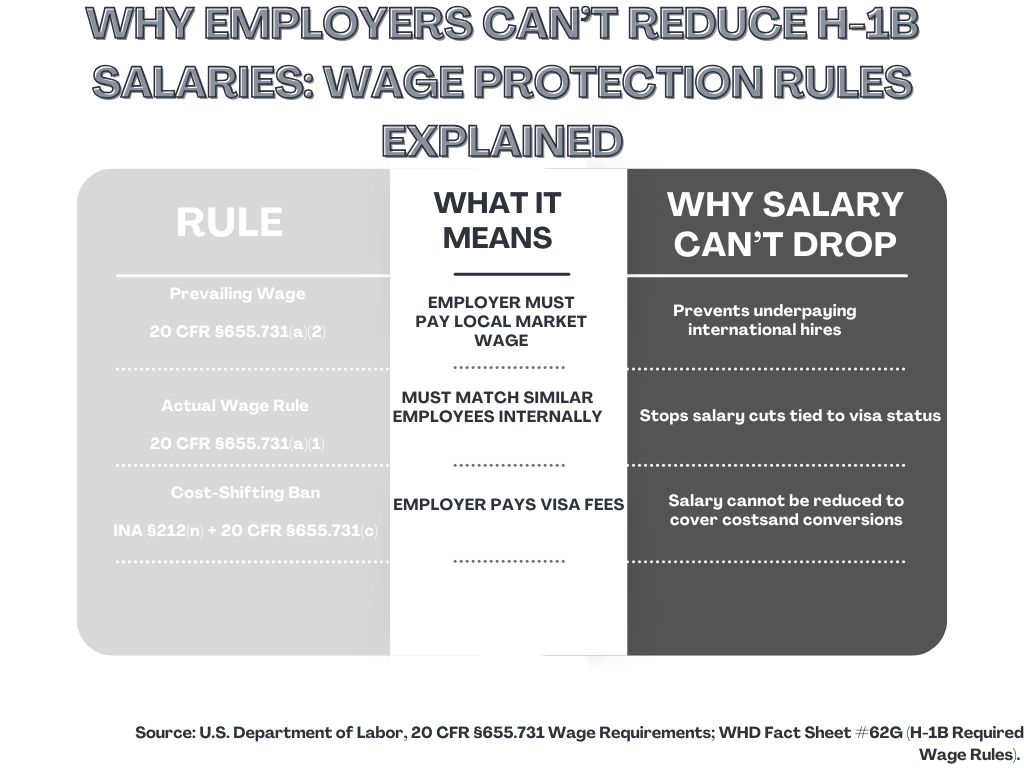
Employers do not lower salaries to offset H-1B visa costs. Federal wage requirements prohibit underpaying visa workers, and market forces support competitive compensation for in-demand skills. Visa sponsorship sits in a separate budget category from employee compensation.
The $100,000 H-1B fee changes hiring behavior, not salaries. Employers across industries will sponsor fewer international workers, prioritize candidates already in the U.S., and raise the bar for sponsorship decisions. The fee creates a hiring barrier, not a pay cut.
International workers benefit from focusing on controllable factors. Targeting employers with strong sponsorship histories, leveraging fee exemptions when available, and building skills that justify sponsorship costs all improve outcomes.
The path has become more difficult. It remains open to those who plan carefully and position themselves strategically.
 Choosing Between Online and Classroom Learning? Here’s What Affects Your Future
 Rethinking Online Learning Strategy: What Today’s Students Demand
 Career Shock vs Culture Shock: What Shapes the First Job Abroad
 Best Platforms for Video-Based Learning on Mobile in 2026
 How Student Expectations Are Forcing U.S. Universities to Rethink Tech Strategy in 2026