
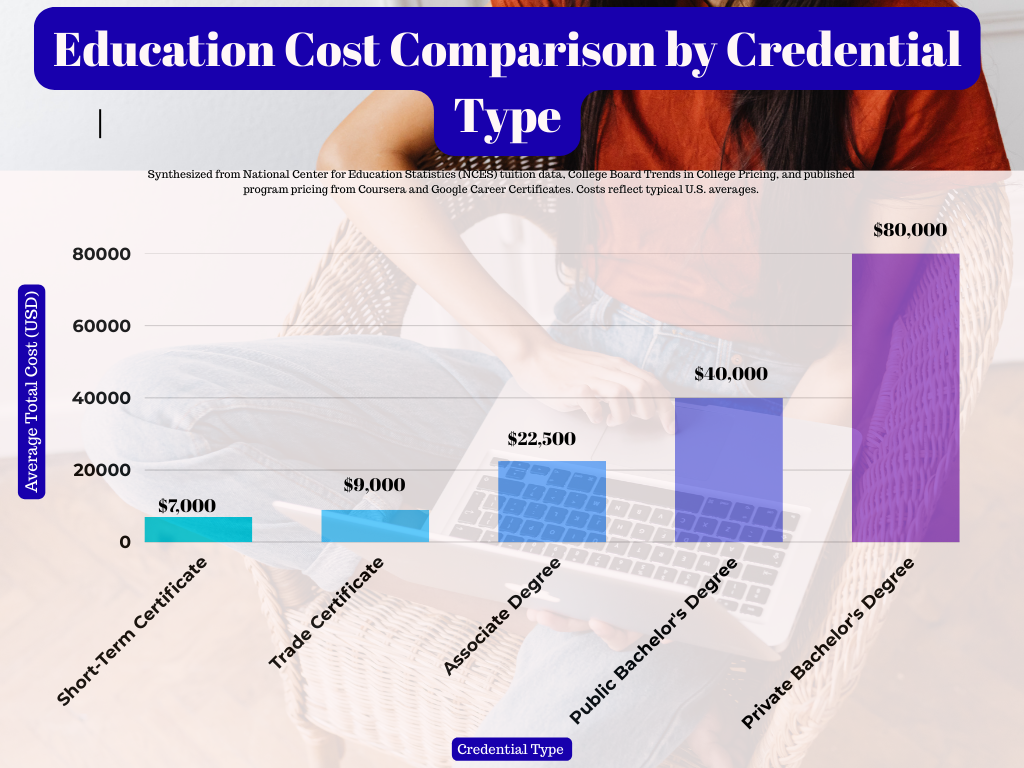
Short-term certificates have exploded in popularity. Platforms like Coursera, Google Career Certificates, and community college programs promise job-ready skills in months, not years. The price tag? Often under $10,000, sometimes under $1,000. Compare that to the $80,000+ you might spend on a bachelor's degree.
At the same time, employers keep talking about "skills-first hiring." Headlines announce that Apple, Google, and IBM no longer require degrees for many roles. It sounds like the rules have changed.
But have they? This article examines whether short-term certificates can truly compete with full degrees in 2026. We'll focus on three high-demand fields: IT and cybersecurity, healthcare, and skilled trades. By the end, you'll have a clearer picture of when certificates make sense, when degrees still win, and how to make the right choice for your situation.
Factor | Short-term certificate | Bachelor's degree |
|---|---|---|
Typical cost | $1,000–$10,000 | $20,000–$80,000+ |
Time to complete | Weeks to 12 months | 4 years |
Time to first paycheck | Months | 4+ years |
Best fields | IT, trades, healthcare support | Engineering, law, medicine, finance |
Employer acceptance | 86% view as valid credential | Universally accepted |
Avg. weekly earnings premium | Varies by field | 68% more than high school diploma |
Career advancement | Limited without further credentials | Broader long-term mobility |
Stackable toward degree | Sometimes | N/A |
What Are Short-Term Certificate Programs?
A short-term certificate program is focused training that typically lasts a few weeks to 12 months. Unlike degree programs, certificates skip general education requirements. You learn specific, job-ready skills in one field and move on.
You can earn certificates through community colleges, trade schools, universities, and online platforms. Some of the most recognized options include:
Technical and IT certifications like AWS, Google Cloud, CompTIA, and cybersecurity credentials
Healthcare certificates such as Certified Nursing Assistant (CNA), phlebotomy, and medical assistant programs
Trade certificates in HVAC, welding, electrical work, and plumbing
Professional certificates in project management, data analytics, and digital marketing
Where do certificates sit in the education hierarchy? Here's the standard ranking from lowest to highest:
Certificate or diploma (weeks to 18 months)
Associate degree (2 years)
Bachelor's degree (4 years)
Master's degree (1 to 3 years beyond bachelor's)
Doctoral degree (2 to 8 years beyond master's)
Certificates are not degrees. They're specialized credentials that prove you completed training in a specific area. Some certificates can stack toward an associate or bachelor's degree later, but many stand alone. An associate degree is a two-year undergraduate program that gives you foundational knowledge and skills in a specific field, while certificates offer more targeted training, according to Best Schools.
Are 6-Month Courses Worth the Investment?
The math looks attractive on paper. A six-month certificate program might cost $3,000 to $10,000. A bachelor's degree at a public university runs $20,000 to $40,000 for in-state students, and private universities can exceed $80,000. You also start earning income years earlier with a certificate.
About 7.8% of adults in the United States possess short-term credentials that result in salary increases of at least 10%, according to Research.com. In some cases, the wage premiums can be significantly higher.
The case for short programs is straightforward:
Lower upfront cost
Faster entry to the workforce
Curriculum designed with employer input
Targeted skills that match current job openings
But certificates have real limitations. Some employers still view short-term credentials as less prestigious than traditional degrees. Not all programs are accredited or recognized by the industry. And as more people pursue certificates, certain job markets can become saturated with qualified candidates.
The bottom line: ROI depends heavily on your field, the specific program, and local job market conditions. Certificates work best in fields with clear skills gaps and strong employer buy-in.
Can You Get a Job with a Certificate?
Yes, but context matters.
Employer attitudes have shifted. A Western Governors University report found that 86% of employers now view non-degree certificates as a valid way to assess whether a candidate is ready for a job, as reported by Fortune. That's a significant change from a decade ago.
The skills-first hiring movement has gained momentum. Nearly two-thirds of employers now use skills-based hiring practices for entry-level professional positions, according to the National Association of Colleges and Employers (NACE). Major tech companies have made headlines by dropping degree requirements. Google treats its career certificates as the equivalent of a four-year degree for relevant roles. IBM coined the term "New Collar" jobs to describe roles that require specialized skills but not necessarily a college degree.
Certificates open doors most readily in:
IT, cybersecurity, and cloud computing
Entry-level healthcare roles
Skilled trades like HVAC, electrical, and welding
Project management and data analytics
But here's the reality check. From 2014 to 2023, the number of roles that went from degree to skill-based hiring almost quadrupled. However, this shift has only resulted in real opportunities for about 1 in 700 hires without a degree, according to National University. The requirement may disappear from the job listing but not from the hiring decision.
Around 68% of employers also viewed degrees as important, particularly in industries like IT and technology, and finance and professional services, per The HR Digest.
Certificate vs. Degree: Field-by-Field Comparison
The certificate-vs-degree debate plays out differently depending on your industry. Here's how it breaks down in three high-demand fields.
Information Technology and Cybersecurity
This is where certificates compete most effectively with degrees.
Cloud certifications from AWS, Google, and Microsoft can lead to six-figure salaries without a bachelor's degree. AWS Certified Security specialists average $203,597 annually. Google Cloud Professional Cloud Architect certification holders average $190,204. CCSP (Certified Cloud Security Professional) holders average $171,524, according to Skillsoft.
The most popular programs on Coursera revolve around technology and AI. Particular professional certificates that stand out are two from Google: 'Foundations of Data Science' and 'Data, Data, Everywhere.' Also popular is Google's project management certificate and 'Foundations of Cybersecurity' course, according to Fortune.
The tech industry has embraced certificates because skills change fast, and a certification from this year proves current competence better than a degree from five years ago. The work is project-based and portfolio-driven. And the talent shortage is severe enough that employers can't afford to filter out capable candidates without degrees.
Where degrees still win in tech: senior engineering and architecture roles often require bachelor's or master's degrees. Research and development positions typically require advanced degrees. And long-term career mobility into management often favors degree holders.
Healthcare
Healthcare offers a mixed picture. Entry-level roles welcome certificates. Advanced clinical positions require degrees.
Certificate programs for CNA, phlebotomy, and medical assistant take 6 weeks to 12 months. Employment of medical assistants is projected to grow 14% from 2022 to 2032, much faster than the average for all occupations, according to Stellar College.
With over 7 million people currently employed in healthcare support occupations and a projected job growth of 11% by 2032, the healthcare industry offers many opportunities, per Research.com.
Healthcare certificates also offer clear career ladders. A Certified Nursing Assistant (CNA) can work toward becoming a Licensed Practical Nurse (LPN) or a Registered Nurse (RN) through additional training and licensure.
Where degrees still win in healthcare: nursing (RN), respiratory therapy, and dental hygiene require associate degrees at minimum. Some careers require an associate degree: respiratory therapists, dental hygienists, funeral directors, and sonographers, according to Goodwin University. Advancement into clinical leadership requires a bachelor's or higher.
Skilled Trades
Skilled trades may be the strongest case for certificates over degrees.
For many skilled trades, a certificate and the right license or certification are exactly what employers are looking for. These credentials prove you have the specific, job-ready skills they need, according to SkillCat.
Electricians alone are expected to see about 66,600 new openings by 2033. Welding work keeps climbing at around 12% growth, while HVAC and plumbing both add tens of thousands of jobs every year, per PTT.
Salaries can reach six figures without any college. Industrial electricians who specialize in PLCs (programmable logic controllers) or high-voltage systems command premium rates. Median salary ranges from $80,000 to $90,000, with top earners reaching $110,000 to $160,000+, according to Blue Collar Recruiter.
HVAC technicians who specialize in commercial systems, chillers, or building automation earn significantly more than residential techs. Median salary ranges from $85,000 to $95,000, with top earners reaching $120,000 to $200,000+.
Where degrees help in trades: construction management roles often prefer bachelor's degrees. But for hands-on trade work, certificates and apprenticeships are the standard path.
Highest-Paying Certificates in 2026
If you're optimizing for salary, certain certificates stand out.
Top IT and cloud certifications by average salary:
AWS Certified Security at $203,597. Google Cloud Professional Cloud Architect at $190,204. Nutanix Certified Professional at $175,409. CCSP (Certified Cloud Security Professional) at $171,524, per Skillsoft.
Emerging AI certifications gaining value:
AWS Certified AI Practitioner validates broad AI literacy including gen AI concepts, responsible AI, basic ML, and AWS AI services. Most candidates can prepare in 4 to 8 weeks. NVIDIA generative AI certifications are gaining traction for engineers building LLM-driven applications, according to Connors Group.
High-value trade certifications:
EPA Section 608 certification (required for HVAC refrigerant handling)
Journeyman Electrician license (state requirements vary, typically 4 to 5 years of apprenticeship)
American Welding Society (AWS) certifications for specialized welding
Healthcare certifications with growth potential:
Certified Clinical Medical Assistant (CCMA) through the National Healthcareer Association
Certified Phlebotomy Technician (CPT) through the National Healthcareer Association
Certified Nursing Assistant (CNA) as a stepping stone to LPN or RN
While many certifications can lead to high-paying jobs, those in cloud computing, cybersecurity, and project management tend to offer the most lucrative salaries without requiring a degree, according to Research.com.
Certificate vs. Associate Degree: Which Is Better?
This comparison comes up often, and the answer depends on your goals.
A certificate makes sense when:
You need to enter the workforce quickly
You want training in a specific, narrow skill set
You're adding credentials to an existing degree
Cost and time are major constraints
Certificate programs can be completed in a shorter period, which might be appealing if you need to start working or switch careers quickly, according to University of the People.
An associate degree wins when:
Your field requires it (respiratory therapy, dental hygiene, sonography)
You want transferable credits toward a bachelor's degree
You prefer broader general education alongside career training
Long-term career growth and management roles are your goal
On earnings, the picture is nuanced. Associate degree holders earned nearly 18% more than workers with only a high school diploma in 2023, according to SNHU. But field of study matters more than credential type. Workers who earned an associate degree in engineering have median annual earnings in the $50,000 to $60,000 range, while those with a bachelor's degree in education earn between $30,000 and $40,000, per Georgetown CEW.
Is a Certificate Just as Good as a Degree?
The honest answer: it depends entirely on your field and goals.
For IT, cybersecurity, project management, and skilled trades, certificates can absolutely compete. They can open doors to high-paying roles, and many employers actively prefer candidates with current, relevant certifications over those with outdated degrees.
For law, medicine, engineering, and finance, degrees remain required or strongly preferred. These fields have regulatory requirements, licensing exams, and professional expectations that certificates cannot satisfy.
Bachelor's degree holders make, on average, 68% more per week than someone with a high school diploma, according to National University.
The smartest approach may be stacking. The best strategy for many students is stacking both: use a degree for core knowledge and a certificate for specialization, upskilling, or staying current in a shifting job market.
Your Next Steps
Before enrolling in any certificate program, take these steps:
1. Research job postings in your target field. Look at 20 to 30 listings for roles you want. Note what credentials employers actually require vs. prefer. If most say "bachelor's required," a certificate alone may not be enough. Pay attention to whether employers list specific certifications by name.
2. Verify accreditation. If a school is accredited, it means that an independent organization (recognized by the Department of Education) looked over the classes and programs at the school, and said that it meets minimum academic standards, according to the FTC. Use the Department of Education's accreditation search tool. Employers trust accredited programs; unaccredited ones can waste your time and money.
3. Ask about job placement rates. How many graduates find jobs in their chosen field? What is the average starting salary? Reputable programs publish graduate outcomes. Look for placement rates above 70 to 80%. Ask for a list of employers who have hired recent graduates.
4. Calculate the true ROI. Compare total program cost (tuition, fees, materials, lost wages) against expected starting salary in your area. Evaluating the return on investment involves analyzing upfront costs, potential salary increases, and long-term career growth, per Research.com.
5. Talk to people already working in the field. Ask what credentials they hold, how they got hired, and whether they would choose the same path today. LinkedIn, Reddit, and industry forums are good places to start. More than 65% of employers report that they are more likely to trust a certificate if an accredited or well-known educational provider issues it, according to DigitalDefynd. Real feedback from people in the job market beats marketing materials every time.
The Bottom Line
Certificates and degrees serve different purposes. Neither is universally "better."
In fast-moving fields like tech and in-demand trades, certificates can compete with degrees or serve as powerful complements to them. The skills-first hiring movement is real, and employers in these fields genuinely care more about what you can do than where you studied.
In regulated professions and fields with established hierarchies, degrees remain necessary. No certificate will make you a doctor, lawyer, or licensed engineer.
For most students, the winning strategy is to view certificates and degrees as complementary tools, not either-or choices. Your field, your goals, and your local job market should drive the decision. Do the research, talk to people in the industry, and make the choice that fits your situation.
The credential that gets you hired is the one that matters.
 Strategies for Communicating Tuition and Outcomes to Prospective Students
 How Politics Is Shaping College Enrollment
 How Top Performers Land US Job Offers
 The College Majors Foreign Students Regret Choosing
 The Tightest Job Market in Years for College Grads